

In the complex ecosystem of modern air travel, Airport RFID Baggage Tracking has emerged as a revolutionary technology, fundamentally transforming how luggage is managed from check-in to final destination. By utilizing radio-frequency identification (RFID) tags, airports and airlines can now achieve unprecedented accuracy in monitoring the journey of each bag, significantly reducing the incidence of mishandled luggage and enhancing overall operational efficiency.
1.The transformation of luggage tracking
With the rapid development of Radio Frequency Identification (RFID) technology and the widespread popularity of information technology, the luggage tracking capability in the civil aviation industry is undergoing a revolutionary improvement. This change not only means that airlines can manage luggage more efficiently and improve operational efficiency, but also allows passengers to understand the status of their luggage in real time through mobile applications, reducing anxiety during waiting and enhancing the travel experience.
On May 7th, Qingdao Airport officially launched the RFID baggage full process tracking system. The system is equipped with GPS positioning function for each piece of luggage through a new type of RFID luggage tag and an added reading device, which can identify and record the location of each piece of luggage in real time and accurately, and take photos for binding, achieving full process tracking of outbound luggage. At the same time, incoming luggage has also been monitored comprehensively, and the data is displayed in real-time through a mini program platform, providing passengers with a convenient way to query.

1.1 Application of RFID Technology
In the past, passengers’ understanding of airport baggage handling systems was mainly limited to two aspects: check-in and collection. However, in reality, the complexity of baggage handling systems far exceeds our imagination. This system not only involves multiple links, but also includes multiple subsystems such as check-in and collection, luggage sorting, loading, and transportation. The close connection and efficient operation of these links are crucial for ensuring the safety and timely arrival of luggage.
However, due to various reasons such as system failures, human errors, etc., the problems of luggage misplacement, omission, and loss still exist. The application of RFID technology has made this goal possible. By placing RFID chips in luggage tags, we can track the real-time location of passengers’ luggage.

Delta RFID Baggage Tracking with Omnidirectional Antenna Impinj H47
1.2 Development history and application status of the system
In fact, RFID technology is not a new thing, it has been widely used in multiple fields such as supermarkets, logistics and warehousing for many years. In recent years, this technology has also been widely applied in the field of civil aviation. In 2019, China Eastern Airlines took the lead in using RFID technology on the route from Shanghai Hongqiao to Wuhan. Passengers can easily check the status of their luggage through China Eastern Airlines’ app or WeChat mini program, just like checking express delivery information. Subsequently, RFID technology has sprung up like mushrooms in many airports and airlines in China, including Beijing Daxing Airport, Shenzhen Bao’an Airport, Chengdu Tianfu Airport, etc. In September 2020, China Aviation Information Corporation’s “Hangyixing” platform was officially recognized by the Civil Aviation Administration of China as a public information platform for the full process tracking system of civil aviation luggage.
As of the end of November 2021, 25 domestic airports have achieved data exchange and docking with the platform, successfully tracking over 1.42 million pieces of luggage on 59000 flights throughout the entire process. At present, the luggage tracking system has formed a networked layout of radio frequency identification. Looking ahead to the future, the “14th Five Year Plan” for the development of civil aviation predicts that by 2025, the level of luggage full process tracking services for smart travel is expected to reach 90%.
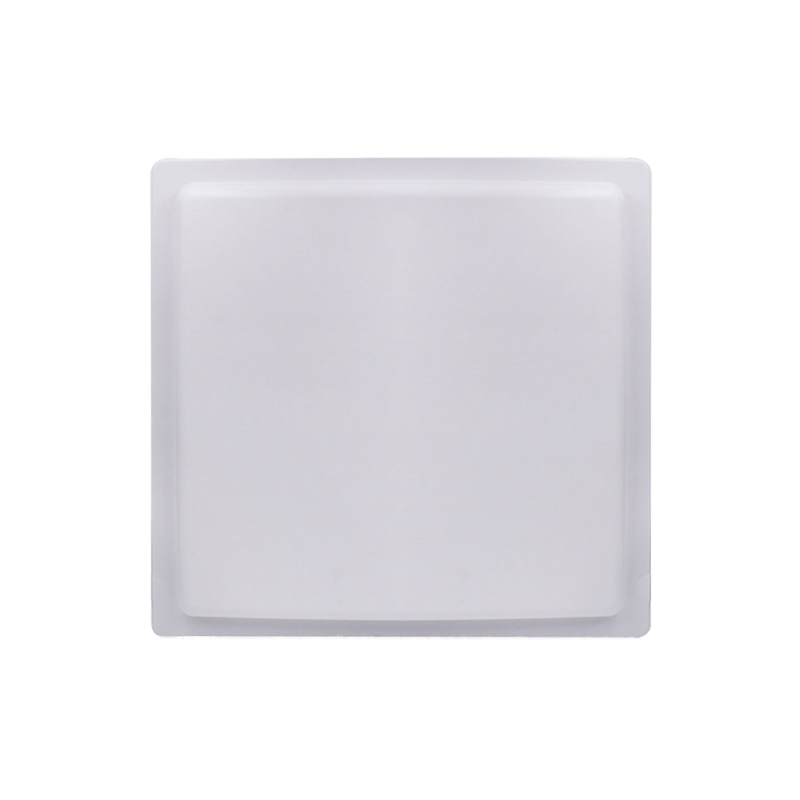
12dBi Circular Linear RFD UHF Reader Antenna
2.Principles and advantages of RFID technology
2.1 Composition and Working Principle of RFID System
Radio Frequency Identification (RFID), abbreviated as RFID, is an automatic identification technology that enables non-contact bidirectional data communication through wireless radio frequency. It uses wireless methods to read and write data, achieving the purpose of identifying targets and exchanging data. The basic working principle of RFID technology is not complicated: when the tag enters the working area of the reader, it will receive the RF signal emitted by the reader, and use the energy obtained from these induced currents to actively send the product information stored in the chip, or the tag will actively send a signal of a certain frequency. After reading and decoding this information, the reader will send it to the central information system for relevant data processing.
Therefore, to form a complete RFID system, it needs to include three core parts: readers, electronic tags, and application software systems. For the application of luggage full process tracking, the key is to attach electronic tags to the luggage and deploy readers throughout the entire luggage transportation process. Finally, all information is processed uniformly through the RFID management service system platform.
2.2 Advantages of RFID Technology
Taking Chongqing Jiangbei Airport as an example, they have installed RFID luggage tag printers at more than 200 check-in counters in Terminal 3A. RFID code reading devices have also been installed at key nodes such as security checks, tray sorting machine import line entrances, belt loading and unloading machines, inbound baggage unloading lines, and inbound pick-up halls. Paired with the RFID management service system platform, the airport can efficiently manage, process, and store all software, hardware, and luggage information data related to RFID.
The reason why RFID technology can be widely applied to the full process tracking of luggage is mainly due to its excellent applicability, efficiency, and simplicity. Compared to traditional barcode technology, RFID has extremely fast read and write speeds, with a typical transmission process typically taking less than 100 milliseconds. In addition, high-frequency RFID readers can even recognize and read multiple tags simultaneously. RFID technology relies on electromagnetic waves for communication, without the need for physical contact between both parties, making it easy to pass through obstacles such as dust, plastic, and paper, ensuring that luggage is not missed during loading and unloading processes. Moreover, RFID tags have a simple structure, high recognition speed, and relatively simple reading devices required.
3.The wide range of applications of RFID technology
3.1 Aviation and Cross Industry Applications
The benefits of introducing RFID technology go far beyond baggage tracking. According to the plan of the Civil Aviation Administration of China, the application of this technology enables airlines, airports and other units to obtain real-time location and status information of luggage, thereby strengthening the management of luggage transportation. As a result, the accuracy and punctuality of luggage transportation have been significantly improved, reducing flight delays caused by luggage issues.
In addition, RFID technology has also promoted the development of direct baggage transfer services for domestic cross airline companies. In the past, passengers could usually only enjoy baggage drop off services when transferring with the same airline or codeshare airline. However, with the support of RFID technology, passengers can now make requests at the departure airport, and the transit airport can provide baggage direct hanging support, achieving baggage direct hanging between two completely unrelated airlines. This progress not only provides travelers with more free time for activities, but also enhances their travel experience.
3.2 Personnel and Goods Management
Meanwhile, RFID technology is widely used in the field of airport cargo management. By combining network technology and database technology, it can achieve real-time, accurate, and complete recording and tracking of goods, providing functions such as querying, statistics, and data analysis. Each item of goods has detailed information records within the central information system, making it easy for management personnel to view the tracking and management logs of the goods at any time.
In addition, RFID technology is also applicable to personnel management. Its fast reading and difficult to forge characteristics enable airports to clearly define the scope of activities of staff based on their positions and identities, and manage them through electronic tags embedded in employee work cards. This not only improves management efficiency, but also ensures the safety and smoothness of airport operations.