

In library management scenarios, achieving rapid borrowing and returning, precise inventory management, and efficient data processing are key to enhancing the service experience. RFID (Radio Frequency Identification) technology enables contactless data exchange via wireless radio frequency signals. High-frequency/ultra-high-frequency Book Security Tags, serving as the core medium, are progressively replacing traditional barcodes and magnetic strips, becoming an essential component in the development of smart libraries.
1. Technical Principles and Core Components
RFID book tags consist of a chip, antenna, and encapsulation layer. The chip stores the book’s unique identification code (EPC 96-bit) and user-defined data. The antenna facilitates radio frequency signal transmission with the reader/writer. The encapsulation layer employs a wet inlay with double-sided adhesive backing, protecting internal components while enabling direct attachment to book covers. Its operating frequency bands cover high frequency (13.56MHz) and ultra-high frequency (UHF, 860-960MHz). The latter, offering extended read range (approximately 10 meters, depending on reader power), has become the mainstream choice for large-scale libraries.

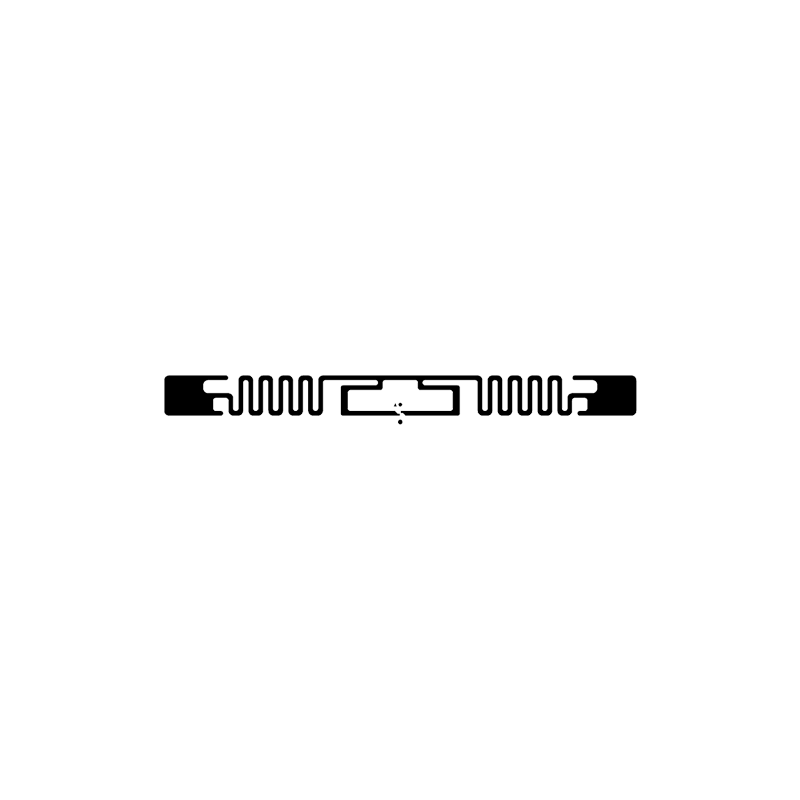
RFID Qstar-7U Chip
2. Features and Use Cases
This tag supports “read-write” functionality, with 100,000 rewrites and a 10-year data retention period, meeting libraries’ long-term operational needs. Its applications span self-service book borrowing/returning, precise inventory management, misplaced book retrieval, and anti-theft systems: Readers scan tags via self-service terminals for automated borrowing/returning; Administrators use handheld devices to batch-read tags, completing inventory for a single shelf layer within 30 seconds. UHF technology enables simultaneous recognition of multiple books, boosting efficiency over traditional barcodes by more than fivefold. Additionally, the tag incorporates an F08 chip supporting encrypted communication to prevent data tampering and unauthorized access.
3. Technical Specifications and Compatibility
The tag measures 125mm × 7mm with a thickness of just 0.3mm, compatible with all book sizes. Its composite encapsulation design offers tear resistance and wear durability, suitable for high-frequency operational environments. Recognition range correlates with reader power output, typically covering 3–5 meters under standard configurations. With directional antennas, range extends to 10 meters, accommodating both open shelving and high-density storage requirements. Regarding storage capacity, the EPC 96-bit code can encode 2^96 unique identifiers, far exceeding the limitations of traditional barcodes. This provides expanded capabilities for book classification and version management.

5. Practical Performance and Industry Value
Compared to magnetic strips and barcodes, RFID tags offer advantages in contactless operation and simultaneous identification of multiple tags. For instance, after implementing this technology, a provincial library increased its daily average of book check-ins and check-outs from 2,000 to 8,000 volumes. Manual inventory time was reduced from two days per week to just two hours, while misplacement rates dropped by 90%. Additionally, the tags seamlessly integrate with library management systems (ILS), providing real-time updates on book locations and statuses. This enables precise services like “online reservation + offline location tracking” for patrons. With a 10-year data retention period and 100,000 write cycles, the tags significantly reduce long-term maintenance costs, making them an optimal solution for archives, reference rooms, and similar environments.