

“Can RFID track animals? ”The answer to this question is affirmative. In today’s animal husbandry and animal management, radio frequency identification (RFID) technology has become a revolutionary tool that enables precise identification and tracking of animals through tiny electronic tags. From ranches to laboratories, RFID not only improves management efficiency, but also provides reliable technical support for animal health monitoring and food safety traceability. This article will delve into the working principle of RFID technology, its specific application methods in animals, and the transformative impact it brings.
1. What is RFID?
Radio Frequency Identification (RFID) is an automatic identification technology that uses radio waves for non-contact data exchange. A complete RFID system consists of three basic components: an electronic tag, a reader, and a data processing system. The electronic tag is embedded with a microchip and antenna, which can store unique identification codes and related information; The reader activates the tag and reads data by emitting radio waves; The data processing system analyzes and manages the collected information.
Compared with traditional barcodes, RFID has significant advantages: it can read data without line of sight, can simultaneously read multiple tags, has a large data storage capacity, and can withstand harsh environments. These characteristics make it particularly suitable for application in the field of animal management.
2.What is the RFID tag on a cow?
In animal husbandry, especially in cattle farming, RFID tags have become a standard configuration for modern management. These animal specific labels are mainly divided into several categories:
Ear tag: The most common form is to package the RFID chip in a special ear tag and fix it on the cow ear with a special tool. Modern ear tag design considers animal welfare and uses biocompatible materials to ensure comfort and resistance to detachment.
Rumen internal device: a ingestible capsule type RFID tag that stays in the first stomach chamber of ruminants for lifelong identification, especially suitable for long-term tracking.
Foot and neck rings: suitable for specific situations, such as cow management in milking farms or special research projects.
Cattle use RFID tags not only to store the unique identification number of the animal, but also to associate important data such as its date of birth, vaccination records, paternal and maternal information, medical history, etc. This electronic “ID card” provides each cow with a complete digital file, laying the foundation for precision animal husbandry.

UHF 860-960 MHz Livestock RFID Ear Tag
3.Can RFID track animals? How to apply it?
RFID technology has powerful capabilities in animal tracking, with a wide and diverse range of application scenarios
3.1 Individual Identification and Inventory Management
In large-scale breeding farms, RFID systems can quickly and accurately identify each animal, automatically record entry and exit of the enclosure, weighing, vaccination, and other information. Australian cattle farms have utilized RFID technology to shorten the manual counting process that originally required hours to a few minutes, with an accuracy rate close to 100%.
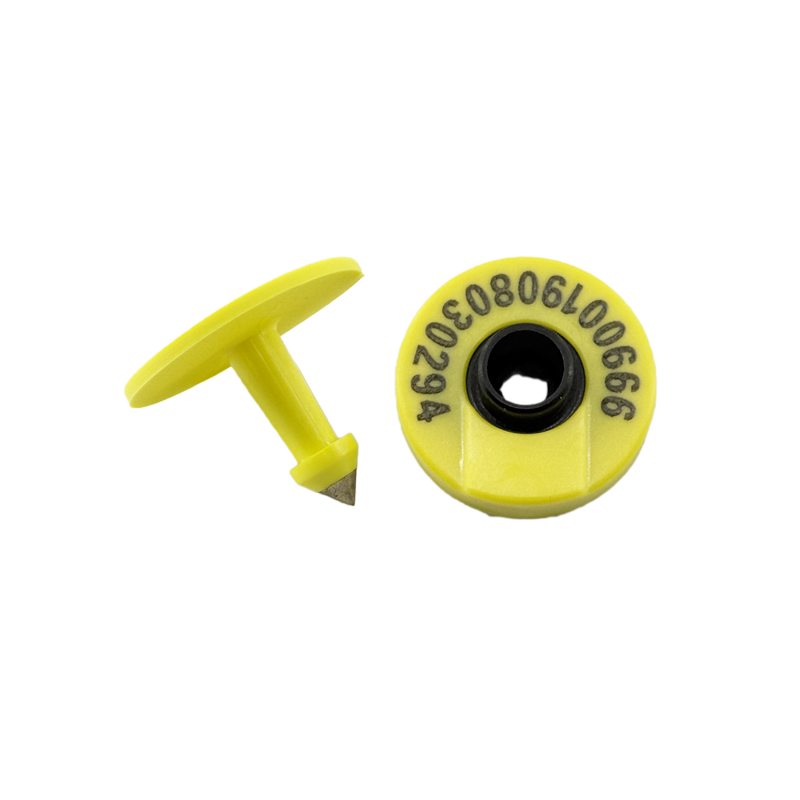
RFID Ear Tag Manufacturer
3.2 Health Monitoring and Disease Control
By monitoring the activity patterns, water intake, and feeding frequency of animals, RFID systems can detect diseased individuals early. When the system detects a significant decrease in rumination time or abnormal exercise volume of a certain cow, it will automatically remind the breeder to undergo examination, achieving early intervention for the disease.
3.3 Breeding and Gene Management
In breeding projects, RFID technology ensures accurate parental identification and descendant recording, avoiding errors that may occur in manual recording. The dairy breeding project in New Zealand has successfully increased the accuracy of tracing high-quality genes by 40% through an RFID system.
3.4 Food Safety Traceability
The full chain traceability from farm to table is one of the core applications of RFID technology. Since 2000, the European Union has gradually implemented an RFID identification system for livestock. Once a food safety issue occurs, it can be traced back to the source farm, feeding process, and transportation path of the problematic animal within a few hours.
3.5 Wildlife Research and Conservation
RFID technology is also widely used in wildlife research. Scientists use miniature RFID tags to track bird migration and monitor the activity range of endangered species. In Brazil, researchers implanted micro RFID under the skin of endangered golden lion tamarins to successfully monitor their population dynamics and habitat use.
3.6 Laboratory Animal Management
In the field of scientific research, RFID tags help researchers accurately identify experimental animals, automatically record their behavioral data, and reduce the impact of manual intervention on experimental results.
4. Challenges and Future Prospects
Although RFID technology has made significant achievements in animal tracking, it still faces some challenges, such as high initial investment costs, compatibility issues between different systems, and reading reliability in extreme environments. However, with the continuous advancement of technology, these challenges are gradually being overcome.
In the future, RFID technology will further integrate with the Internet of Things, big data analytics, and artificial intelligence. Smart ranches will achieve fully automated management, with systems that can not only track animal locations, but also predict estrus periods, optimize feeding plans, and even predict potential health issues through behavioral patterns. The development of nanoRFID technology may enable tags to be small enough to be implanted in insects, opening up new possibilities for ecological research.
5. Conclusion
Returning to the original question – ‘Can RFID track animals?’ – RFID is not only able to track animals, but is also fundamentally changing the way we interact and manage them. From improving livestock efficiency to ensuring food safety, from protecting endangered species to promoting scientific research, this technology demonstrates its cross disciplinary value. With the reduction of technology costs and the popularization of applications, RFID is expected to become a standard practice for animal management worldwide, creating a more efficient, transparent, and sustainable environment for the coexistence of humans and animals.