

Clothing, shoes, and hats anti-counterfeiting solution: During production, clothing security labels (electronic RFID tags) are programmed with vital garment attributes including: name, grade, item number, model, fabric composition, lining, care instructions, compliance standards, product ID, and inspector details. These clothing security labels are then permanently affixed to garments via,Direct implantation into seams/fabric;Integration into nameplates or hangtags;Reusable anti-theft hard tag attachments.

Garment Labels Manufacturers In China
1.The current situation of the clothing, footwear and hats industry
As clothing, footwear and hats products are characterized by color, style, variety of changes very quickly, so the requirements of the footwear and apparel industry manufacturing enterprises to manage production, inventory, distribution turnover speed to be constantly improved. Out-of-season varieties should be quickly cleared off the counter and replaced with new varieties. Inventory can not be backlogged, the backlog of products will cause a great burden to the enterprise. Control the amount of inventory to ensure that the sales department has the right varieties on the counter to meet customer needs; but also to ensure that most of the products produced can be sold, will not produce a large number of slow-moving inventory is the footwear and apparel industry enterprises to consider the key issues.
The emergence and application of RFID technology will largely promote the field of clothing and footwear on the production, inventory, distribution, sales, retail store management and other aspects of development.

RFID Single piece Hangtags For the Garment Retail
2. About EPC and RFID technology
EPC (Electronic Product Code) is the latest international development in recent years, a global unified identification system, is a revolutionary new technology.
Based on the Internet and RFID technology EPC system, will be constructed to realize a global real-time sharing of information on goods “Internet of Things (Internet ofThings)”. EPC system mainly consists of the following six parts: EPC coding standards, EPC tags, RFID readers, object name, resolution services, entity markup language. EPC system will be the traditional bar code technology used in the identification and management of goods categories, the development of RFID technology used in the identification and management of individual items, it will be following the bar code technology, and again change the product production, inventory, logistics and product tracking and management mode of a new technology, is an extension of the application of bar code technology and expansion.
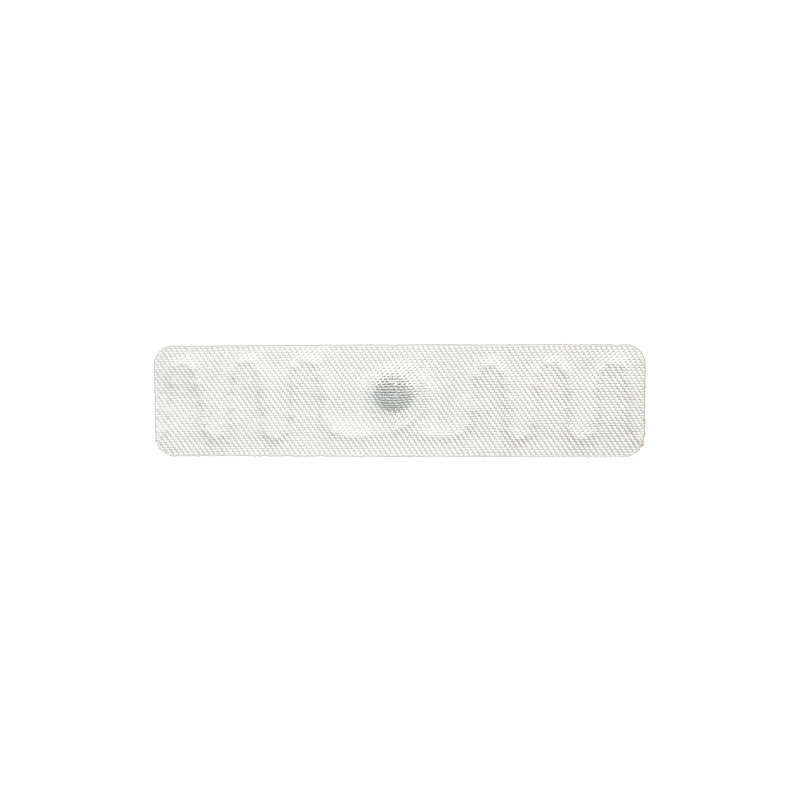
Custom RFID laundry tags
2.1 Anti-counterfeiting function of the brand
Brand clothing industry because of its characteristics determine it is the most suitable application of RFID technology industry. First of all, we look at the brand clothing can be how to use RFID technology to improve access to benefits, in the production process of clothing, the use of electronic tags to write a single piece of clothing, some important attributes such as: name, grade, item number, model, fabric, lining, washing methods, the implementation of the standard, commodity number, the inspector number, etc. Write into the corresponding electronic tags, and will be attached to the electronic tags on the clothing. The electronic tag attachment method can be taken: implanted in the clothing, made into a nameplate or hangtag way or to take the anti-theft hard tag can be recycled way and so on.
In this way, it gives each piece of clothing with a unique electronic tag mark that is difficult to forge, can effectively avoid the act of counterfeiting, and well solved the anti-counterfeiting problem of branded apparel.
2.2 Placement
- Placed on the clothing nameplate, clothing will have more than one nameplate to record its various information, we can add more than one built-in UHF tag nameplate, the benefits of this is convenient to install, read is also convenient, but after the sale of this tag must be added to the destruction of the collection, so as to avoid malicious diversion of others.
- Placed in the clothing back neckline label. This placement can be with the clothes for a long time, but in the production process must have protection of the label to prevent sewing nail bad label, in addition, this label can be waterproof treatment, but can not do anti-rubbing. That is, it will cause damage to the label in the laundry process. In addition can not be very good to play the effect of confidentiality, but also easy to be reused by others, substituting good for bad. Suggestion: choose the nameplate type, the label will be taken off after selling, kept by the boutique people, and then through the Internet back to the factory, the factory can be the first time to know which region, which model of clothes sells well, the rapid circulation of goods has a great help.
3. Integrated application of logistics
In the factory’s in and out of the warehouse management, as well as logistics and distribution centers in and out of the warehouse management and retail store inventory management, due to the RFID technology non-visible reading and multi-tag reading characteristics, dozens of pieces of clothing attached to the electronic tag of the whole box of goods can be accurately read through the RFID reader at one time all of the logistics data, and greatly improve the efficiency of the logistics. If the store’s sales also adopt RFID technology to realize, then can realize “store replenishment demand — distribution center — manufacturer” the whole supply chain process of optimal management.
4. Should process management automation
4.1 Purchasing control
The establishment of material supply information files, you can effectively control the quality and price of materials, purchased material code labeled with electronic tags for unique identification, easy inventory management.
4.2 Order Matching
Purchase orders are often multiple arrivals and frequent orders. In order to ensure that the order and the arrival of goods will not cause confusion, must be matched one by one, at any time you can check the arrival of the order. Ordered materials should use electronic tags for unique identification, in order to facilitate inventory and pursue the supplier’s product quality issues.
4.3 Supply cycle control
In order to ensure that the needs of production and sales, while reducing the inventory backlog of materials, the supply time must be controlled. Through the supplier’s unique number and service quality certification, accurately calculate the supply time of each material, you can order as needed to ensure immediate production!
4.4 Quality Tracking
By matching the quality check list with the electronic tag identifier of the purchased products, the quality responsibility of the supplying manufacturers can be effectively pursued.
4.5 Commissioned processing control
Many manufacturers themselves only operate brand, generally commissioned OEM manufacturers for manufacturing production, through the pre-formulated electronic tags, assigned to each OEM manufacturers pasted on the product. Acceptance is easy to count, the sales process found any quality problems, can be directly pursued to the original manufacturer, commissioned processing of the remaining materials can also be quickly calculated.
4.6 Tracking of goods in transit
The shoes and hats clothing class product is a kind of turnover speed very fast commodity, often is once but the production completes quickly puts on the market, distributes to each place the counter and the retail specialty store, in the transportation process the commodity accounts for the proportion is larger (including between each place transfers). Uses the electronic label to make the unique identifier may accurately the tracing in the way the goods, may strictly guarantees the arrival time and the arrival quantity.
5. Production process management automation
5.1 Material Cost Control
All used production materials establish unique numbers with electronic tags, establishing strict control of collaterals. Through the material list of each type of product, the product production plan is decomposed into a material usage plan, and the margin of clipping is reasonably calculated to control the material usage of each batch of products and the deviation from the standard cost.
5.2 Production Statistics
Through the label identification marking, it can automatically complete the production statistics, scrap statistics, material statistics.
5.3 Order Quotation
For each received order to the customer has been a headache, due to the cost of a single product data (operating time and material usage) can easily calculate the profit margin.
5.4 Piecework Statistics
Many companies use piece-rate wages, and piece-rate statistics is a very tedious job. Through the single tracking technology, electronic labeling on each product identification and production work orders, can easily count the output of each worker to complete, for defective products can also be held responsible for personnel.
6. Automation of product distribution and warehouse management
6.1 Distribution of order products
Due to the complexity and diversity of the order products, the manual distribution method is inefficient. In the electronic label written in the order product information, pasted on the surface of the box, you can quickly and efficiently distribute distribution products.
6.2 Multi-bank cooperative operation
Shoes and hats apparel industry enterprise products in order to circulate the need, often distributed in different warehouses around the world, in order to transfer to the transfer, distribution, replenishment. Warehouse types are also more, such as: finished goods warehouse, raw materials warehouse, circulation library, turnover library, scattered small library and so on. Daily need to monitor the inventory of each warehouse to ensure timely supply. Through the warehouse management automation, you can always check the inventory of the library, in order to track the product logistics process in a timely manner.
6.3 Warehouse receipt and issue of disk operations
Warehouse management is one of the most important work to ensure that the number of books and the number of physical consistency, the use of readers can easily realize the accuracy of commodity receipt records and shipping, distribution automation, so that inventory inventory will not be missed and lost.
6.4 First-in-first-out
Each product has its own inventory period, due to the many types of products, in the actual warehouse management through manual records and custodian records is difficult to ensure that the product is accurate first-in-first-out. Through the product labeling information, you can clearly understand the status of each product, so that you can ensure that the specified period of time to achieve the goods out of the warehouse operations.
6.5 Out-of-stock alarm
Any warehouse shortage of a product, not only can automatically prompt the alarm, but also can be subdivided into models, colors, sizes and other details of the product composition. That is: a certain style of certain sizes appear out of stock, you can immediately prompt the custodian to replenish the goods in a timely manner.
7. Slow-moving product statistics
Clothing shoes and hats industry product backlog in the warehouse is a big headache, through the slow-moving product statistics, get each product (broken down into models, colors, sizes) in the library to stay time, you can quickly find out which products are slow-moving, out of season, you can easily provide price cuts to accelerate the decision to sell the product!

Bluetooth RFID Reader
8. Conclusion
The integration of RFID technology into the clothing, footwear, and hats industry revolutionizes production, logistics, inventory management, and anti-counterfeiting efforts. By embedding electronic tags in garments, brands gain real-time visibility across the supply chain—from manufacturing to retail—enhancing efficiency, reducing costs, and minimizing errors.
9. Frequently Asked Questions
9.1 What is RFID technology, and how does it help in clothing anti-counterfeiting?
RFID (Radio Frequency Identification) uses electronic tags to store unique product data (e.g., fabric, model, inspector number). Each garment gets a globally unique ID, making counterfeiting nearly impossible since fake products lack valid RFID authentication.
9.2 How are RFID tags attached to clothing?
Tags can be:
Sewn into garments (hidden in collars/seams)
Embedded in washable nameplates or hangtags
Attached via reusable anti-theft hard tags (removed post-sale)
9.3 Can RFID tags survive washing and long-term use?
Yes! Waterproof and durable RFID tags are designed for repeated washing. However, abrasion over time may damage them, so placement (e.g., nameplates) matters.
9.4 How does RFID improve inventory and logistics?
Batch scanning: Read entire boxes of clothes instantly (vs. manual barcode checks).
Real-time tracking: Monitor stock levels, prevent overstocking, and automate reorders.
Anti-theft: Tags trigger alarms if unpaid items leave stores.
9.5 What’s the difference between RFID and barcodes?
RFID: No line-of-sight needed; scans multiple items at once; stores more data (e.g., wash cycles).
Barcodes: Require manual scanning; easily copied; limited data storage.
9.6 How does RFID help with slow-moving inventory?
By tracking how long items sit in warehouses, brands can:
Identify unsold styles/colors/sizes.
Launch targeted discounts to clear stock.
9.7 Is RFID cost-effective for small businesses?
Initial costs exist (tags, readers), but long-term savings from reduced labor, theft, and errors outweigh investment. Start with high-value items (e.g., luxury brands).
9.8 Can customers remove or tamper with RFID tags?
Post-sale tags (e.g., nameplates) are removed/destroyed to prevent reuse.
Permanent tags (sewn-in) are hidden and durable but may require encryption to prevent cloning.
9.9 How does RFID enhance sustainability?
Reduces waste: Accurate demand forecasting minimizes overproduction.
Reusable tags: Hard tags can be recycled for new garments.
9.10 What’s the future of RFID in fashion?
Smart mirrors: Scan RFID to show product details in fitting rooms.
Circular fashion: Track garments for resale/recycling via lifetime RFID records.