

How Far Can RFID Labels Be Read? The short answer is anywhere from a deliberate tap to several meters for common passive systems, while specialized active tags can communicate much farther. The useful answer depends on frequency, label design, tagged material, reader and antenna configuration, orientation, regional power limits, interference, and the reliability required by the business process.
A supplier’s maximum distance is usually measured under stated conditions. It is not a guarantee that every label on a packed pallet, liquid bottle, metal tool, folded garment, or moving carton will be captured at that distance. B2B buyers should distinguish a one-time maximum read from a repeatable read zone that produces the correct inventory, shipping, or asset event.
This guide provides realistic planning ranges, explains the variables that change them, and shows how to test and improve RFID label performance without creating unwanted reads or violating local radio rules.
How Far Can RFID Labels Be Read?
There is no single RFID read distance. The GS1 read-range guidance states that there is no typical RFID tag because range depends on whether the system is active or passive and on factors such as frequency, reader power, interference, antennas, and tag orientation. The following figures are planning ranges, not purchase guarantees.
| RFID technology | Practical planning range | Common uses | Important qualification |
|---|---|---|---|
| NFC at 13.56 MHz | A deliberate tap, normally within a few centimeters | Product engagement, authentication journeys, service records, mobile interactions | Designed for intentional close interaction with a compatible device |
| Passive LF at 125 or 134 kHz | Often about 10-50 cm | Animal identification, access, close industrial identification | Coil design, reader, protocol, and mounting affect results |
| Passive HF at 13.56 MHz | Often from close contact to roughly 1 m | Libraries, tickets, cards, documents, item tracking | Protocol, antenna size, coupling, and reader design are decisive |
| Passive UHF or RAIN RFID | Commonly several meters; optimized systems can reach farther | Retail inventory, logistics, manufacturing, warehousing, assets | Highly dependent on the tagged item, orientation, reader antennas, region, and read-zone design |
| Battery-assisted or active RFID | Tens of meters and sometimes beyond 100 m | Vehicles, high-value assets, yards, sensors, real-time location | Usually a powered tag rather than a thin disposable RFID label |
GS1 describes passive UHF range as typically several meters, with longer results possible in specialized arrangements. It also emphasizes that the shape of the readable volume may matter more than one distance value. A long narrow zone, a wide portal, and a close tabletop zone can all report the same peak distance while producing very different operational outcomes.
Read Range Is a System Property
An RFID label does not generate a fixed bubble of coverage. In a passive UHF system, the reader must deliver enough energy to power the chip, and the label must return a signal strong enough for the reader to decode. The forward link from reader to label and the return link from label to reader both matter. A sensitive chip cannot compensate for a badly detuned antenna, and a powerful reader cannot legally or reliably solve every placement problem.
Range also changes with the command. A simple inventory response may work farther away than reading user memory, performing cryptographic operations, or writing data. The RAIN Alliance notes that additional read, write, sensor, or security operations can require more time or energy and may reduce practical performance. Specify the actual operation, not just whether the identifier can be seen once.
Factor 1: Frequency and Protocol
Frequency is the first major range decision. LF and HF systems rely primarily on near-field magnetic coupling and are commonly used for controlled close reads. NFC is an HF technology designed around intentional proximity. Passive UHF uses backscatter and supports longer-range, multi-item identification. The GS1 frequency comparison outlines the practical differences among LF, HF, and UHF systems.
Protocol matters within a frequency family. A label and reader must support the same air interface, and application software must understand the data. Common passive UHF supply chain systems use EPC Class 1 Gen 2, standardized as ISO/IEC 18000-63. HF and NFC projects may require ISO/IEC 15693, ISO/IEC 14443, or NFC Forum specifications. A matching frequency without a matching protocol does not create interoperability.
Factor 2: Label Antenna, Chip Sensitivity, and Size
The inlay antenna collects energy and shapes the label’s response. Geometry, conductor material, tuning, bandwidth, and efficiency affect range and orientation tolerance. A larger UHF antenna often has more potential sensitivity, but physical size alone does not determine performance. A smaller design properly matched to the object can outperform a larger inlay that bends, detunes, or sits in the wrong location.
Chip sensitivity determines how much incoming energy is needed to activate the label, while backscatter performance affects the return signal. Modern chips can support strong sensitivity, but buyers should compare finished tagged-item results. Face stock, adhesive, protective layers, spacing, and conversion tolerances can change the behavior of the same nominal inlay.
Factor 3: Reader Power, Sensitivity, and Antennas
Reader output power, receiver sensitivity, antenna gain, cable loss, polarization, beam shape, and mounting position influence the read zone. A fixed reader with a well-placed directional antenna may read a label farther than a compact handheld using the same protocol. Circular polarization can improve tolerance to tag rotation, while linear polarization can provide stronger coupling when orientation is controlled.
Adding power is not always the right fix. Higher power can extend the zone into adjacent shelves, doors, rooms, or vehicles. It may also exceed permitted levels when antenna gain and cable loss are not included in the calculation. Design for the smallest reliable zone that captures intended labels and rejects unintended ones.
Factor 4: Orientation and Polarization
RFID labels can have directional behavior. A long dipole-style UHF label may respond strongly in one orientation and weakly when rotated relative to a linearly polarized reader antenna. Products tossed into a tote, garments hanging at different angles, and cases stacked on a pallet create a mix of orientations. Test the angles that occur in real operations, including the worst credible orientation.
Antenna diversity, circular polarization, multiple reader antennas, or a different label design can improve orientation coverage. However, more antennas also create overlap and possible cross-reads. The objective is a controlled three-dimensional read volume, not a single line-of-sight distance.
Factor 5: Material Behind and Around the Label
The tagged object becomes part of the RF system. Dry cardboard and many plastics are relatively friendly to standard UHF labels, but contents still matter. Metal reflects and changes electromagnetic fields, while water and liquid-rich materials absorb energy and can detune a label. Human bodies also contain significant water and can reduce performance when they block the path or sit directly behind a label.
- Metal assets: Use an on-metal label or tag designed with suitable spacing and tuning. A standard paper UHF inlay may become unreadable when placed directly on metal.
- Liquid products: Test the filled package, not an empty bottle. Placement above the fill line, added spacing, or an application-specific design may help.
- Curved surfaces: Excessive bending can distort the antenna and reduce adhesive contact. Confirm the minimum bend diameter.
- Dense stacks: Labels can shadow or couple with one another. Evaluate realistic case, garment, document, or package density.
- People and wearables: Body proximity and movement can change performance. Test the label while the item is worn or handled.
Factor 6: Environment, Interference, and Multipath
Walls, racks, machinery, vehicles, floors, doors, and nearby products reflect or absorb radio energy. Reflections can create useful coverage in one position and a weak spot only centimeters away. This multipath behavior is why a label may read well in an open test and behave differently inside a loaded warehouse, metal cabinet, refrigerated room, or production cell.
Other readers and RF systems can reduce throughput or raise the noise floor. Reader modes, channel planning, antenna isolation, synchronization, dwell time, and physical shielding may be necessary at dense sites. Temperature, moisture, dirt, chemicals, vibration, and aging can also change the label construction or attachment over its service life.
Factor 7: Tag Population, Motion, and Reader Settings
One stationary label is easier to read than hundreds of moving labels with mixed orientations. Anti-collision settings, session, target, Q value, data rate, inventory duration, repetition, and filtering affect how quickly a population is identified. A fast conveyor or forklift gives the reader a limited window, while a handheld count provides more time but introduces operator motion and variable distance.
Measure the business event under expected and peak load. A portal that reads one carton at ten meters but misses cases on a full moving pallet does not have a ten-meter operational range for that application. Similarly, a reader that captures every intended label plus inventory in the next lane is not accurate.
Regional Regulations Limit Reader Settings
Passive UHF frequency channels and power limits differ by country or region. The GS1 overview of UHF spectrum allocations summarizes known allocations, power, and communication requirements across markets, while advising users to verify current rules. A result measured with one regional reader configuration may not transfer directly to another market.
Calculate the permitted radiated power using the reader output, antenna gain, cable loss, and applicable ERP or EIRP convention. Use readers approved for the deployment region and lock production configurations against unauthorized changes. Compliance is a design requirement, not an adjustment to make after range testing.
Read Range vs. Write Range
Writing normally requires more energy at the chip and should be planned at a shorter, controlled distance than inventory reading. Locking memory, reading a large user-memory block, or executing authentication can also have different performance from a simple EPC inventory response. If the process encodes labels in a printer, tests a password, or updates memory on an installed asset, validate that exact command sequence.
Do not use a successful inventory read as proof that a label can be reliably written at the same distance. Separate acceptance criteria for inventory, targeted read, write, lock, kill, sensor, and security operations when the application uses them.
How Product Specifications Should Be Interpreted
A product data sheet should state the label, tagged surface, reader or test equipment, antenna, frequency region, output level, orientation, and environment used for its range claim. If those conditions are absent, treat the number as a screening indicator. Ask whether the figure is a maximum activation distance, a repeatable read distance, or a recommended operating distance with margin.
The Advanced UHF Solution for RFID Asset Management ALN-9640 Label is an example of a passive UHF label designed for extended asset identification. Its published range remains dependent on the reader and operating environment, so buyers should validate it on their actual item and within their intended zone.
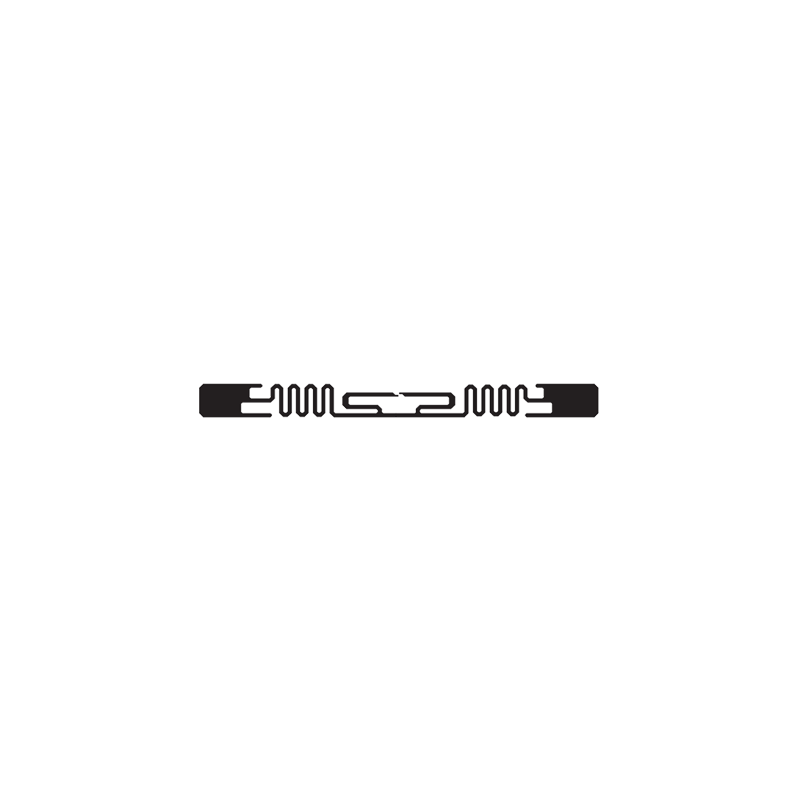
Advanced UHF Solution for RFID Asset Management ALN-9640 Label
How to Test RFID Label Read Range
Testing should begin with a written acceptance definition. State the required operation, tagged item, placement, reader, antenna, region, orientation set, environmental condition, motion, population, success rate, read time, and unwanted-read boundary. Measure enough samples from representative production lots to expose variation.
- Prepare real tagged items. Use filled packages, installed assets, folded garments, or finished products with production-equivalent labels and adhesive.
- Control the reader setup. Record firmware, power, antenna gain, cable, polarization, height, angle, protocol settings, and regional mode.
- Test distance and orientation. Move the item through a repeatable grid or rail and rotate it through expected and worst-case angles.
- Measure consistency. Record successful reads across repetitions and samples, not only the farthest single response.
- Test population and motion. Repeat with realistic quantities, density, conveyor speed, forklift movement, and operator behavior.
- Condition samples. Include temperature, humidity, washing, chemicals, abrasion, bending, or aging that represents the lifecycle.
- Check the rejection boundary. Place unwanted labels nearby and confirm that they do not create false business events.
- Verify the full transaction. Confirm that software assigns the correct object, zone, time, and workflow status.
The GS1 Tagged-Item Performance Protocol is useful because it evaluates the RFID-enabled item rather than the loose inlay. It provides grading definitions, test configurations, and methodology that can help users and suppliers express repeatable tagged-item performance requirements.
How to Improve Read Range Safely
- Choose a label designed for the material: Use on-metal, liquid-tolerant, textile, windshield, or other application-specific constructions where necessary.
- Optimize placement: Move the label away from metal, liquid concentration, folds, seams, corners, and routine hand coverage.
- Improve orientation coverage: Adjust label direction, antenna polarization, or the number and position of reader antennas.
- Reduce RF loss: Use appropriate low-loss cable, sound connectors, and reasonable cable lengths in fixed systems.
- Tune reader settings: Select legal power, mode, session, Q, dwell, and filtering for the population and site.
- Control the physical zone: Use shielding, absorbers, antenna direction, triggers, and lane logic to reduce stray reads.
- Improve time in field: Adjust conveyor speed, trigger timing, scan path, or operator procedure when the process allows.
- Maintain the system: Monitor antennas, cables, firmware, mounting, reader health, and environmental changes over time.
When a Shorter Range Is Better
Maximum range is valuable for some portals, yards, and high-bay applications, but many workflows need intentional proximity. Point-of-sale, smart shelves, cabinets, tool issue, document stations, and neighboring dock doors can suffer when the zone is too broad. A shorter range can improve location confidence, privacy, security, and exception handling.
Define the minimum range and coverage needed to complete the task, then add an engineering margin for normal variation. Also define where reads must stop. A well-designed system knows both its capture zone and its rejection zone.
Common Range-Planning Mistakes
- Quoting one universal RFID distance: NFC, LF, HF, passive UHF, and active RFID are different systems.
- Using free-air data for a real product: Metal, liquids, packaging, people, and placement change performance.
- Confusing maximum with reliable range: Approve a repeatable operating zone with margin and rejection boundaries.
- Testing one orientation: Include all credible angles, motion, stacking, and handling.
- Ignoring write and security operations: These may work at a shorter distance than inventory reads.
- Increasing power without control: Excessive coverage creates cross-reads and can breach regional limits.
- Testing one sample: Evaluate manufacturing lots, environmental exposure, and normal process variation.
- Scoring raw reads instead of outcomes: Measure correct inventory, shipment, access, or asset events.
Conclusion
How Far Can RFID Labels Be Read is not answered by one number. NFC and passive LF or HF labels support deliberate close-range interaction, while passive UHF labels commonly reach several meters and may go farther in optimized conditions. Active systems extend beyond that but use different hardware and economics. The correct business range is the distance and three-dimensional zone in which the finished tagged item is read consistently, unwanted labels are rejected, regulations are respected, and software creates the right event.
Frequently Asked Questions
How Far Can RFID Labels Be Read in a warehouse?
Passive UHF labels are often read across several meters in warehouse applications, but the reliable distance depends on the label, carton contents, pallet density, reader, antennas, orientation, motion, region, and nearby structures. Validate full representative loads at the intended portal, shelf, tunnel, or handheld workflow.
Can passive UHF RFID labels be read from 10 meters away?
Some passive UHF labels can be detected around that distance under suitable conditions, but it is not a universal guarantee. Confirm the tagged surface, orientation, reader power, antenna, regional limits, command, environment, and required success rate. Use a shorter qualified operating distance when reliability requires margin.
Why does an RFID label read farther before it is attached?
The product changes the antenna’s electrical environment. Metal can detune a standard label, liquids can absorb energy, curvature can distort the antenna, and nearby labels can interact. Select a design tuned for the object and test the completed tagged item.
Is RFID write range the same as read range?
No. Writing normally requires more energy and a more controlled connection, so dependable write range is commonly shorter than inventory range. Test the exact write, lock, authentication, or memory-read operation used by the process.
Do bigger RFID labels always read farther?
No. Antenna size can help, but geometry, chip sensitivity, tuning, frequency, material, placement, curvature, orientation, reader, and surroundings all influence range. A smaller application-matched label can outperform a larger poorly mounted one.
How should a company specify RFID read range?
Specify a three-dimensional operating zone, tagged item, placement, reader and antenna configuration, regional mode, orientation set, motion, population, command, environment, success rate, response time, and rejection boundary. Approve the complete business transaction using representative production samples.