

In 2024, Bosideng invested over 50 million yuan and completed the nationwide deployment of RFID in retail across its stores within just 5 months—seamlessly connecting the entire process from factories to warehouses to thousands of storefronts. The speed and scale of this rollout left industry peers calling it “hard to replicate.” On June 26, 2025, Bosideng announced its annual results for fiscal year 24/25: revenue grew 11.6% year-on-year to approximately RMB 25.902 billion, marking nine consecutive years of record performance.
Yet, despite this success, many in the retail industry still see Bosideng’s achievement with RFID in retail as an outlier—a “story that belongs to others.” RFID is far from a new topic; it has been discussed in retail for more than a decade. Since Decathlon first adopted the technology over ten years ago, the technical barriers have largely vanished. What continues to hold most brands back is the challenge of making RFID systems operate smoothly, reliably, and in a fully integrated manner within real-world environments.
1.Warehouse renovation: Equipment selection is only superficial, data structure is the first wall before starting
This brand’s warehousing system did not start from scratch – barcode management has been running for many years, and there seems to be no obvious weakness in the location coding and process on the surface. But when RFID was introduced, the real trouble became apparent: the original SKU code, location system, and interface logic were not prepared for the “scan all” operation mode.
At the beginning of the project, the error rate of importing the first batch of RFID tags into the system was close to 8% due to inconsistent encoding formats. This wave of ‘beginning failure’ made the team realize that the equipment is just running errands, and if the underlying data is not unified first, errors will be added layer by layer later.
After the SEIKO project team intervened in the re planning, adjustments were made to the warehouse flow and system interfaces, and equipment was deployed in different zones
1.1 Main storage area: RFID warehouse access control batch reads full box clothing labels, can process thousands of items per second, and cooperates with automatic scanning stations to complete box binding;
1.2 Outbound verification area: RFID channel machine batch rechecks shipments, the system automatically compares the SKU of the order with the physical reading results, and directly marks the differences;
1.3 Return and dismantling area: Industrial grade RFID handheld terminals handle loose parts and special returns, ensuring that non-standard processes can also be closed-loop recorded.
For high-value or fast-moving SKUs, RFID all-in-one machines and camera linkage are also installed, and real-time inventory dynamic coordinates are generated in the background. When goods are moved, records are immediately triggered.

RFID Handheld Reader
After the renovation was completed, the sampling ratio decreased from 100% to 10%, but the quality inspection efficiency more than doubled. In the past, a quality inspector could handle 600 boxes per day, but now it can stabilize at around 10000 boxes.
2. Label Writing and Information Link
The key to whether the system can “reconcile accounts on its own” lies in the project, and a repeatedly emphasized viewpoint is that RFID tags are not attached, but written in.
Many companies only write SKU codes in the labels for the sake of speed, ignoring information such as batch and storage time. But the result of doing so is that once there is a return, wrong shipment, or responsibility determination, the system lacks the ability to “self trace” and can only rely on manual tracing. The final established approach for this project is:
Use an RFID card issuer to write SKU, batch number, supplier code, warehouse timestamp, location coordinates and other fields to the tag, using a unified coding rule to ensure that the system can automatically deconstruct and match data.
The writing process is controlled by middleware and automatically generates log records upon completion. Any anomalies can be located within one minute, reducing the time cost of human intervention.
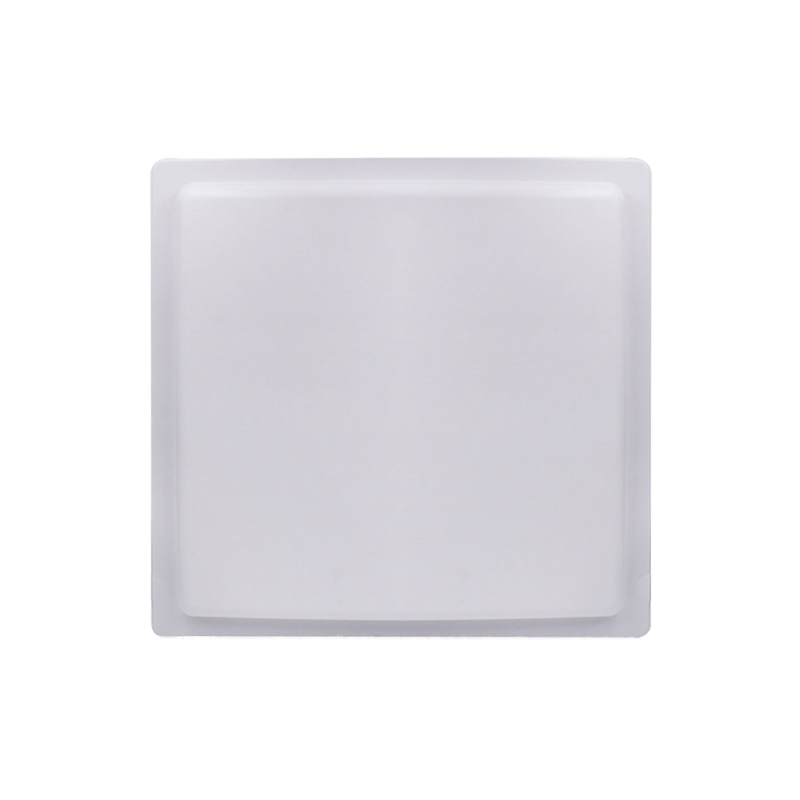
12dBi Circular Linear RFD UHF Reader Antenna
3. Store side: The problem is not insufficient equipment, but too few “understandable” ones
The trouble on the store side is more direct: when customers check out, they bring multiple items through the channel. If the system cannot accurately determine which ones have been paid for, there may be missed readings or false alarms in the frequency response. In the past few years, common symptoms include:
- Missed reading: During peak hours, multiple products passed by simultaneously, and some labels were not read;
- Misreading: Displaying clothing on models triggers false alarms, affecting customer experience;
- Serial reading: The tag settlement status has not been updated, resulting in frequent false alarms in the access control system.
These issues have made many brands cautious even when deploying RFID in their warehouses and stores. The goal of this project has been clearly defined in the store section: to completely solve the problems of missing, misreading, and cross reading, and ensure stable operation during peak cash register periods.
4.The store side combination scheme based on SEIKO information was adopted
4.1 AI algorithm RFID access control: capable of recognition and better judgment
The access control adopts a combination of phased array antenna and AI trajectory algorithm, which can distinguish whether the tag is stationary or taken out, and automatically shield irrelevant tags. At the same time, it supports dynamic whitelist, excluding models, exhibits, and store staff uniforms from the alarm range.

UHF Handheld Reader
In the test, multiple settled and unsettled goods were mixed simultaneously within a 2.5-meter channel, with a missed reading rate controlled within 0.2% and a false alarm rate below 0.1%.
4.2 RFID cash register system: Hand over the decision-making power to the system
The risk of cash register during peak hours lies in the irreversible human negligence. The new system can identify all tags carried by customers in bulk at once, and the status of unpaid goods will not be rewritten before settlement.
After completing the payment, the system synchronously updates the access control recognition rules to ensure that any unsettled goods cannot be exported.
When an exception occurs, the backend can directly display specific product information, and the salesperson does not need to repeatedly check in front of the customer, reducing embarrassment and disputes.
4.3 RFID handheld terminal: integrating inventory into daily life
Store inventory no longer requires large-scale mobilization to close stores. Two employees take turns using handheld terminals to complete a full inventory and upload data in half an hour. The system can also mark records of inventory that has not been moved for a long time and discrepancies between entry and exit, shifting management from passive to active.
4.4 Why is retail still “testing the waters” with RFID after ten years
The project leader pointed out the key point with one sentence: “Whoever did it before fell into the trap
In the eyes of retail enterprises, RFID is not a technical issue, but a high investment and high-risk system transformation. Once the delivery is not smooth, it will not only delay the shipment, but also directly affect the customer experience on the store side.
The experience of this project is not to see how much RFID can recognize, but to see how much manual judgment it can replace. From tag encoding to recognition strategy, from system interface to on-site construction, all variables that affect the final effect, missing one link may render all previous efforts in vain.
5. Conclusion
RFID technology and equipment are no longer scarce in the retail industry. What is truly scarce is the ability to ‘get it done’. Bosideng has been able to land on a large scale because the process from front-end to store has been streamlined; The case of this chain brand proves that RFID truly integrates into daily operations when the system can make its own judgments and reconcile accounts.
After the project was implemented, the warehouse manpower was reduced by nearly half, the inventory turnover time was shortened by more than 20%, and the store theft rate decreased by more than 90%. But for store employees, the biggest advantage of this system is that it operates quietly like water and electricity, without having to think about it every day, yet it can always be effective.