

An Industrial RFID Tracking Tag gives manufacturers, maintenance teams and logistics operators a durable digital identity for tools, machines, returnable containers and work-in-process assets. Instead of searching for a serial plate or scanning every barcode individually, authorized staff can capture tag identities by radio and connect each read event to an asset record. The result can be faster audits, better custody control and more dependable maintenance data.
That promise, however, depends on engineering the complete system. A rugged tag alone does not create visibility. The mounting surface, tag orientation, reader antenna, facility layout, software rules and data ownership all influence whether an RFID project delivers useful business events or simply produces more data. This guide explains how B2B teams can evaluate and deploy industrial RFID with realistic expectations.
Why Industrial Asset Tracking Needs Better Data
Industrial assets move through tool rooms, production cells, maintenance shops, warehouses and external service locations. Paper logs and spreadsheets often show who was supposed to hold an asset, not where it was last handled. Barcodes improve identification but require line of sight and deliberate one-at-a-time scanning. Damaged labels, dirty surfaces and inconsistent handoffs can leave gaps in the record.
RFID supports non-line-of-sight identification and can capture multiple tags in one read cycle. It is especially useful when the business needs to verify a group of tools, confirm a reusable container at a doorway, identify work-in-process at a station or conduct a rapid area audit. The objective is not “real-time” as a slogan. The objective is a trustworthy sequence of events that answers practical questions: What asset was seen? Where? When? By which process? What should happen next?
What Is an Industrial RFID Tracking Tag?
An Industrial RFID Tracking Tag combines an integrated circuit, an antenna and a protective construction suited to its operating environment. The chip carries an identifier and, depending on the model, additional memory. The antenna exchanges radio energy and data with a reader. The housing, substrate or encapsulation protects the electronics and helps the antenna perform on the target material.
For many industrial applications, passive UHF RFID, often called RAIN RFID, provides a useful balance of range, read speed, size and unit cost. Passive tags have no battery; they harvest energy from the reader and respond by backscatter. The RAIN RFID Alliance overview describes this tag-reader-software chain, while ISO/IEC 18000-63 defines the air interface for item-management RFID in the 860–960 MHz band.
When a reader energizes tags in its interrogation zone, each tag returns its identity. Reader software filters repeated observations and sends meaningful events to an asset management, warehouse, manufacturing or maintenance application. The tag is therefore a data carrier and identifier; location and status are inferred from where, when and how it was read.
Passive RFID, Active RFID or Another Technology?
The right architecture starts with the business question. Passive UHF tags are strong candidates for portals, cabinets, handheld audits and chokepoint tracking. They are battery-free, generally compact and suitable for large asset populations. Read range varies with tag design, reader settings, antenna placement, material and surrounding objects, so catalogue figures should never replace testing on the actual asset.
Active RFID or Bluetooth Low Energy tags contain a battery and can beacon at intervals. They may suit wide-area locating, high-value mobile equipment or applications that need frequent presence updates. Their tradeoffs include a higher tag cost, battery lifecycle management and a different infrastructure model. GPS is useful for outdoor fleet or container location but is rarely the right method for identifying many small tools indoors. NFC and HF RFID suit close-range interactions where intentional tap or near-field reading is desirable.
A B2B buyer should therefore avoid asking only, “What is the longest range?” A better question is, “What read event will trigger a useful workflow, with an acceptable total cost and error rate?”
How to Select a Rugged Industrial RFID Tracking Tag
1. Match the tag to the mounting surface
Metal changes an antenna’s tuning and can make an ordinary RFID label perform poorly. Assets such as dies, pumps, racks, returnable steel containers and machine tools normally require an on-metal design with the correct isolation and antenna structure. Liquids, carbon-loaded materials and tightly packed mixed materials can also affect performance. Test every important asset class rather than assuming one tag will cover the entire plant.
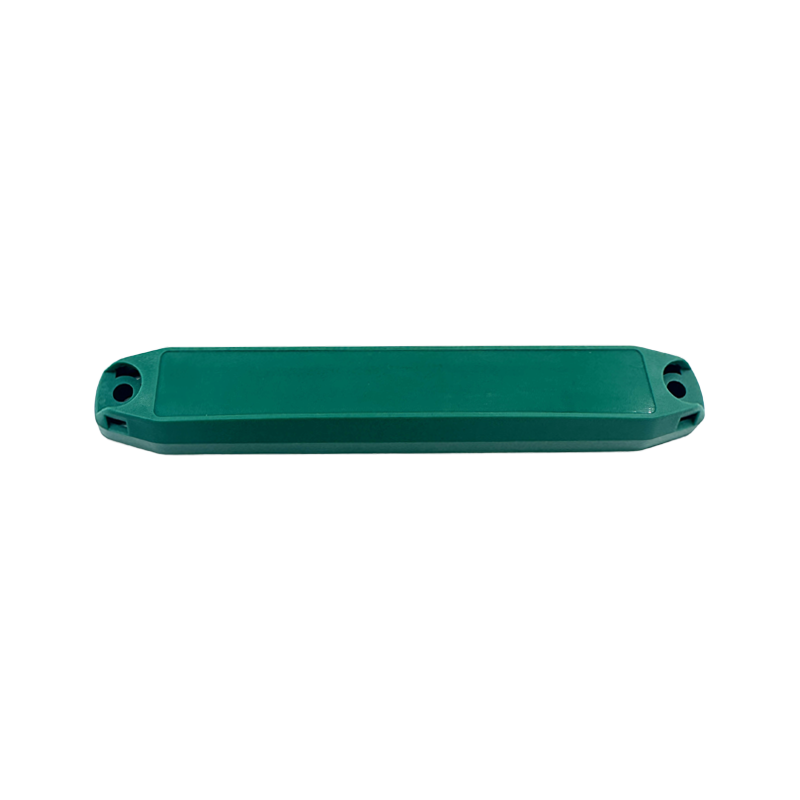
For metal equipment and reusable containers, Seiko Tags offers RFID Metal Labels engineered for on-metal use. Product specifications should be treated as a qualification starting point; final range and reliability must be verified with the selected reader, power level, orientation and facility conditions.
RFID Metal Labels
2. Define environmental exposure
Document normal operation and exceptional events. Consider temperature and dwell time, water and dust ingress, cleaning chemicals, oils, ultraviolet exposure, vibration, impact, pressure and repeated thermal cycling. A peak-temperature statement is incomplete without duration and cycle information. IP ratings address defined dust and water tests; they do not automatically prove resistance to every chemical, impact or sterilization process.
3. Choose a mounting method that survives the lifecycle
Adhesive can simplify installation on clean, prepared surfaces. Screws, rivets, weldable brackets, cable ties or embedded mounting may be better when assets face vibration, weather or rough handling. Mechanical fasteners must not crush the housing or interfere with the antenna. The mounting location should protect the tag while preserving a usable read angle and access for replacement.
4. Engineer the read zone, not just the tag
Long range is not always an advantage. A doorway reader that captures tags from an adjacent lane can create false movement events. A tool cabinet may need controlled near-field behavior, while a yard checkpoint may need a larger zone. Antenna polarization, mounting height, shielding, reader power, asset speed and tag orientation must work together. Reliable systems distinguish the intended zone from surrounding activity.
5. Plan identification and memory
Use a stable unique identifier and keep changeable business data in the enterprise system whenever practical. This reduces synchronization risk and allows the same tag identity to reference maintenance history, calibration status, ownership and location. The GS1 EPC Tag Data Standard defines EPC encoding and Gen2 tag-memory content for organizations that require standards-based identification.
Where Industrial RFID Delivers Value
- Tool control: record issue, return and cabinet presence for production or maintenance tools.
- Work-in-process: identify carriers, fixtures and components at defined manufacturing steps.
- Returnable transport items: track metal bins, racks, stillages and reusable cases across internal or partner locations.
- MRO and inspection: connect equipment identity to maintenance, calibration and inspection workflows.
- Warehouse assets: accelerate cycle counts for high-value equipment, spares and handling devices.
- Field service: confirm which tagged assets are present in a vehicle, job site or service depot.
The strongest use cases combine an avoidable cost with a repeatable capture point. Examples include production delays caused by missing tooling, excessive spare purchases, manual container reconciliation and overdue calibration. An Industrial RFID Tracking Tag is most valuable when its read event changes a decision or removes a manual step.
A Seven-Step Deployment Roadmap
Step 1: Define the business event
Specify the decision the system must support. “Improve visibility” is too broad. “Confirm every calibrated torque tool when it enters or leaves the crib” defines the asset, location, event and exception.
Step 2: Build a clean asset register
Standardize asset IDs, classes, owners, lifecycle states and locations before encoding tags. Duplicate records and inconsistent names will undermine automation even when read performance is excellent.
Step 3: Survey assets and the RF environment
Group assets by material, geometry, mounting space, movement pattern and environmental exposure. Walk proposed read points and note nearby metal, liquids, machinery, Wi-Fi infrastructure and adjacent traffic. Regulatory frequency and power limits differ by region, so specify readers and tags for the country of operation.
Step 4: Run tag and placement tests
Test candidate tags on real assets, not only in free air. Measure read success across required orientations, distances and speeds. Include dirty, stacked, wet or loaded conditions where relevant. Document the approved tag and placement for each asset class so installation can be repeated consistently.
Step 5: Design reader infrastructure and event logic
Choose handheld readers for flexible search and audits; fixed readers for repeatable doors, conveyors or stations; and smart cabinets for controlled storage. Middleware should remove duplicate reads, associate antennas with zones, apply direction or dwell rules and send only relevant events upstream.
Step 6: Integrate with systems of record
Connect RFID events to the ERP, EAM, CMMS, WMS or MES through documented interfaces. Define what happens when an unknown tag appears, a required asset is absent or a movement conflicts with its status. Preserve timestamps, reader identity and event history for troubleshooting and auditability.
Step 7: Pilot, measure and govern
Start with one bounded workflow and representative assets. Test edge cases, offline behavior, damaged tags, unauthorized movement and operator recovery. Train users on the exception process, not only the happy path. Scale after the pilot meets agreed performance and operational targets.
Metrics That Matter to B2B Buyers
Measure the baseline before deployment. Useful KPIs include inventory time, search time, read accuracy at the intended zone, false-read rate, missing-asset incidents, tool utilization, returnable-container cycle time, maintenance compliance and labor per transaction. Track tag loss and physical damage separately from RF read failures; they require different corrective actions.
Total cost should include tags, readers, antennas, installation, network work, middleware, integration, testing, training, replacements and support. Benefits should be linked to observed labor savings, avoided purchases, reduced downtime or improved asset turns. This creates a defensible business case instead of relying on a generic accuracy claim.
Common Implementation Mistakes
- Selecting a tag from a maximum-range figure without testing it on the target material.
- Using ordinary labels directly on metal equipment.
- Treating every raw read as a business event and overwhelming the application with duplicates.
- Installing a portal before defining the intended zone and adjacent-read controls.
- Encoding frequently changing information on the tag when the enterprise database should own it.
- Ignoring attachment failure, cleaning chemistry, impact and thermal cycling.
- Promising continuous location when the design only records periodic handheld or chokepoint reads.
- Scaling before operators can resolve unknown, missing or damaged tags.
Procurement Checklist
Before approving an Industrial RFID Tracking Tag, document the asset material and size, available mounting area, attachment method, operating and peak temperatures, ingress and chemical exposure, impact and vibration, required read zone, reader type, regional frequency, identifier scheme, printing or encoding needs, expected service life and replacement method. Request samples and define acceptance tests using production-representative assets.
FAQ: Industrial RFID Tracking Tags
Does an Industrial RFID Tracking Tag provide real-time GPS location?
Usually not. A passive tag reports when it is energized and read by nearby RFID infrastructure. The system records a last-seen zone, portal or handheld observation. Continuous wide-area location generally requires denser infrastructure or an active technology such as BLE, UWB or GPS, depending on the environment and accuracy requirement.
Can standard RFID labels be attached to metal machinery?
Standard labels often detune or lose range when mounted directly on metal. Use a purpose-designed on-metal tag or label and validate it on the actual machine, including the final mounting method and orientation.
How far can an industrial RFID tag be read?
There is no universal distance. Range depends on the tag antenna and chip, asset material, orientation, reader power, antenna gain and polarization, interference and local regulations. Published figures are useful for comparison, but the deployed read zone should be established through site testing.
What data should be stored on the tag?
Most programs store a stable unique identifier on the tag and maintain descriptive or changing data in the enterprise system. User memory may support specific offline or interoperability requirements, but every field needs ownership, encoding and update rules.
How should a company start an industrial RFID pilot?
Select one costly, repeatable workflow; define measurable success criteria; test several tag placements on representative assets; build one controlled read point; integrate only the necessary event; and run long enough to include real operating exceptions. Use the results to refine the deployment standard before scaling.
Conclusion
An Industrial RFID Tracking Tag can turn tools, containers and equipment into reliably identifiable assets, but durable hardware is only one part of the solution. The best results come from matching tag construction to the asset, engineering controlled read zones, integrating filtered events with operational systems and measuring performance against a clear baseline. For B2B teams, a disciplined pilot is the shortest path from an attractive RFID specification to dependable industrial visibility.