

Hospitals are faced with the need to deal with thousands of pieces of work clothes every year. The RFID Laundry Management System provides an effective solution to track and manage the entire lifecycle of each garment – from clothing handover, washing, ironing, and finishing to storage processes. This advanced system solves the great challenge of monitoring each piece’s washing process, recording wash cycles, tracking inventory status, and enabling effective clothing categorization.

1. Program Overview
- Paper-based handover of laundry tasks, complicated procedures and difficult to query.
- Fear of cross-contamination makes it impossible to count the number of certain laundry items to be washed.
- The number of washed items does not match the task.
- Each step of the washing process cannot be accurately monitored, and the laundry is not processed.
- Accurate categorization of washed laundry to save storage space.
- Inability to accurately arrange the minimum safety stock of each piece of laundry.
The introduction of RFID technology will make the hospital’s laundry management become more transparent, and improve the efficiency of the work, to solve the past can not be realized through other technology management problems, such as: large quantities of laundry to be statistics, handover.
2. Principle of RFID fabric washing management
Sewn in each piece of clothing RFID electronic tags, electronic tags have a globally unique identification code, that is, each piece of clothing will have a unique management identification, until the clothing is scrapped (tags can be reused, but not more than the life of the tag itself). In the whole clothing use, washing management, will be automatically recorded through the RFID reader clothing use status, washing times. Supporting the batch reading of tags during the washing handover, it makes the washing task handover become simple and transparent, and reduces the labor cost. At the same time, by tracking the number of times of washing, the hospital can estimate the service life of the current clothing, providing predictive data for the procurement plan.
3. Business process of RFID fabric washing

3.1 Fabric data entry RFID tags sewn into the laundry

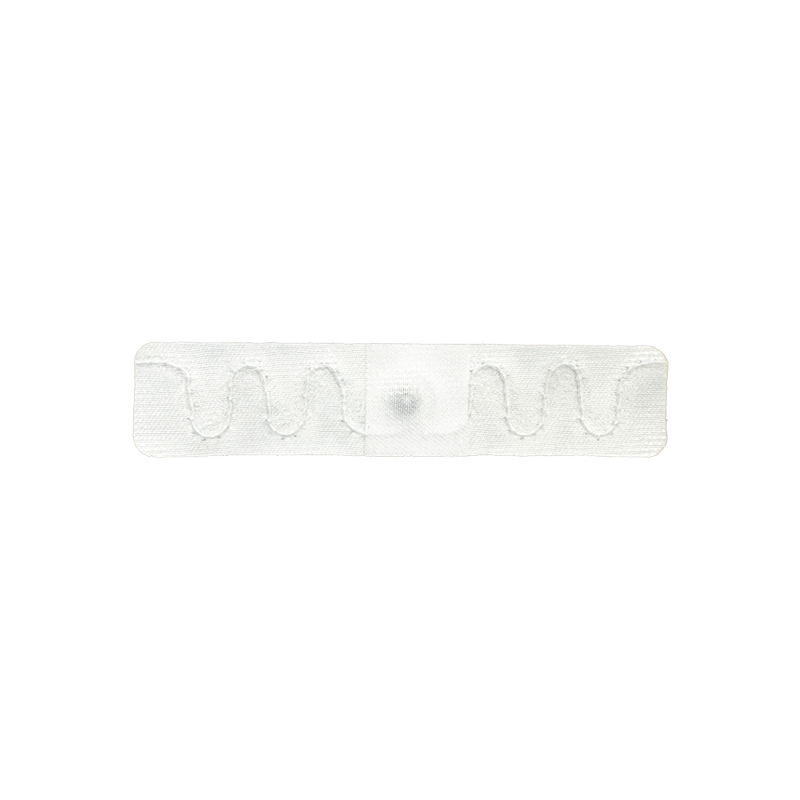
Heat Seal RFID Laundry Tags Manufacturer
The chip in the tag can store data, associate the attributes of each piece of laundry to be managed with the RFID tag ID into the database, record and track the workflow and life cycle of each piece of laundry, and sew directly onto the laundry to be managed, with the sewing location chosen to be easy to find.
3.2 Fabric data collection and reading
Sewn with RFID tags fabrics are packed directly. The quantity is automatically collected by RFID read/write equipment and the ID of each piece of cloth read is recorded. As the data is not manually counted, it improves the work efficiency on the one hand and brings convenience to the management.

Data collection in the receiving and picking area of the workshop warehouse

Push the cart through the weighbridge and read the information

UHF RFID Tag Reader | Long-Range RFID Scanning for Smart Asset Tracking

RFID Reader Writer Built in 6 dBi Antenna

Laundry workshop for clothes washing
3.3 Fabric quantity inventory
Hospital staff can quickly hand over the quantity by configuring the handheld device when handing over.

Hospital staff count the number of clean cloths
4. RFID fabric washing advantages
- Labor can be reduced by 40-50%.
- More than 99% of the visualization of the clothing products, reducing the risk of missing clothing.
- Improved supply chain management will reduce 20-25% of the work service time.
- Improve the accuracy and reliability of storage information.
- Efficient and accurate data collection to provide operational efficiency.
- Automatic data collection for distribution and recycling handover reduces human error.
- Reduce the comprehensive cost of hospital laundry management.
5. Conclusion
The RFID Laundry Management System provides an efficient and intelligent solution for hospitals to tackle the challenges of tracking and managing thousands of work garments throughout their lifecycle—from handover and washing to storage and inventory control. By embedding RFID tags into each piece of clothing, the system enables real-time monitoring of washing cycles, inventory status, and garment categorization, significantly reducing manual errors and labor costs.
6. Frequently Asked Questions
6.1 What is an RFID Laundry Management System?
An RFID Laundry Management System is an automated tracking solution that uses Radio Frequency Identification (RFID) tags to monitor hospital linens, uniforms, and other textiles throughout their lifecycle—from distribution and washing to storage and retirement. Each piece of laundry is tagged with a unique RFID chip, enabling real-time tracking, inventory management, and process optimization.
6.2 How does RFID improve laundry management in hospitals?
RFID technology enhances hospital laundry management by:
Automating inventory tracking – Eliminates manual counting errors.
Reducing loss & misplacement – Tracks every item in real-time.
Improving hygiene control – Monitors washing cycles to prevent contamination.
Optimizing stock levels – Alerts when inventory is low.
Extending linen lifespan – Tracks wash cycles to prevent overuse.
Saving labor costs – Reduces manual handling by 40-50%.
6.3 Are RFID tags durable enough for hospital laundry processes?
Yes. RFID laundry tags are designed to withstand:
High-temperature washing (up to 90°C / 194°F)
Industrial detergents and disinfectants
Repeated ironing and drying
Mechanical stress from washing machines
They remain functional for hundreds of wash cycles, ensuring long-term tracking.
6.4 Can RFID track the number of washes for each linen item?
Yes. The RFID Laundry Management System records each wash cycle, allowing hospitals to:
Monitor fabric wear and tear
Predict replacement needs
Remove damaged linens before they fail
This helps optimize procurement and reduce costs.
6.5 How does RFID prevent linen loss and theft?
Real-time tracking – Every item is scanned at handover points (laundry room, storage, wards).
Automated alerts – Missing items trigger notifications.
Access control – Unauthorized removal can be detected at exits.
This reduces loss rates by over 99% compared to manual systems.
6.6 Does RFID improve laundry handover efficiency?
Absolutely. Traditional paper-based handovers are slow and error-prone. With RFID:
Bulk scanning – Hundreds of items are counted in seconds.
Digital records – No manual data entry required.
Automated reconciliation – Ensures the correct number of items are returned.
This cuts handover time by 20-25%.
6.7 Can RFID help with infection control in hospital linens?
Yes. The system can:
Track washing temperature and disinfection cycles.
Flag improperly washed linens.
Prevent cross-contamination by ensuring correct sorting.
This enhances compliance with hygiene protocols.
6.8 What happens if an RFID tag fails?
Tags are designed for long-term use but can be replaced if damaged.
The system flags missing/unreadable tags for inspection.
Backup barcodes or manual entry can be used as a fallback.
6.9 How does RFID reduce overall laundry costs?
Less labor – Fewer staff needed for counting & tracking.
Longer linen lifespan – Prevents early wear-out.
Lower loss rates – Reduces replacement costs.
Optimized inventory – Avoids overstocking or shortages.
Hospitals typically see a 20-30% reduction in laundry management costs.
6.10 Is RFID laundry management compatible with existing hospital systems?
Yes. The RFID Laundry Management System can integrate with:
Hospital ERP & inventory software
Nursing station management systems
Laundry equipment (industrial washers, dryers)
Mobile devices for staff scanning