

With the rapid development of the logistics and transportation industry, how to efficiently manage truck racks has become the key to improve the transportation efficiency.RFID (Radio Frequency Identification) technology has been widely used in truck rack management system by virtue of its advantages of long-distance range, non-contact identification, multi-tag reading and strong environmental adaptability, etc. This paper will discuss the application of RFID in truck rack management. In this paper, we will discuss the application of RFID in truck frame management, focusing on the analysis of RFID truck tracking, RFID tag for trucks and RFID tag trucking and other key technologies.

1. RFID technology in the truck frame management application
1.1 RFID Truck Tracking
RFID truck frame management system by installing RFID read-write and antenna in the front of the car, and installing RFID electronic tags on the frame to realize the automatic diagnosis and dynamic tracking of the frame. The system works as follows:
- Read-write and tag interaction: RFID read-write through the antenna transmit microwave signals to activate the electronic tags, tags return with a unique identification code of the data to complete the identity verification of the frame.
- Real-time data uploading: The read-write uploads the collected data to the background database through the vehicle terminal to realize the real-time update of the frame status, such as “on board”, “in transit” and “off”. etc.
- Dynamic monitoring: The system can scan the frame tags at regular intervals to ensure the accuracy of the frame status during transportation and avoid loss or misuse.

RFID Metal Tags For the Aerospace Industry
The application of RFID truck tracking technology greatly improves the efficiency of logistics enterprises in supervising truck frames, reduces manual intervention and lowers management costs.
1.2 RFID Tag for Trucks
The key to truck frame management lies in the selection and installation of RFID tags. Since the frame is mostly made of metal, metal-resistant tags need to be used and the following factors should be considered:
- Installation location optimization: tags are usually installed in the frame near the front of the vehicle to enhance signal reception.
- Protective design: In order to prevent collision during transportation or harsh environmental impact, metal baffles or cushioning rubber can be used to protect the tag.
- High Adhesion Fixing: The tags are secured with high temperature resistant, strong adhesive 3M double sided tape to ensure strong adhesion even under vibration or extreme environments.
The stability and durability of RFID tags for trucks directly affects the reliability of the system, so you need to choose a tag product that meets industrial-grade standards.
1.3 RFID Tag Trucking
In the process of freight management, RFID technology can realize automated data collection and full life cycle management of the frame:
- Frame Binding and Initialization: Each frame is equipped with a unique RFID tag and associated with the management system to ensure data accuracy.
- Transportation process monitoring: RFID readers scan the frame tags in real time to record the use status of the frame (e.g. whether it is mounted or not, whether it is in transit or not).
- Anti-Misreading Mechanism: By adjusting the reader power, it avoids misreading the frame tags of other vehicles and improves data accuracy.
The application of RFID tag trucking enables logistics companies to optimize frame scheduling, improve transportation efficiency, and reduce resource waste.
2. System Advantages
Automated management: Reduce manual operation and lower error rate.
Real-time monitoring: dynamic tracking of frame status, improving transportation transparency.
Environmental adaptability: metal-resistant, high and low temperature-resistant, suitable for complex transportation environment.
Expandability: the system can be integrated with other logistics management systems (e.g. GPS, warehouse management) to realize intelligent logistics management.
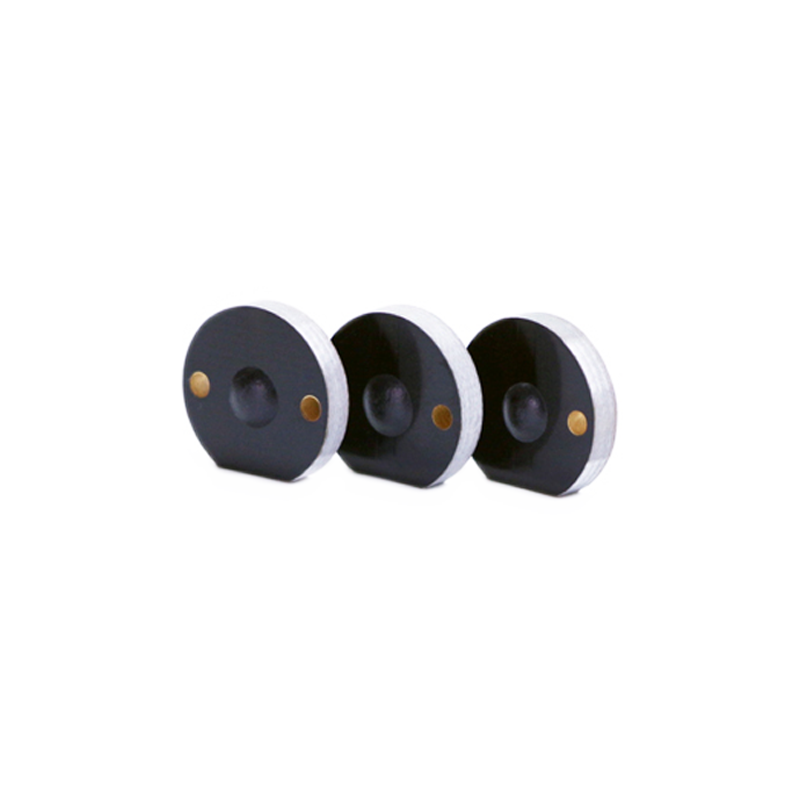
Passive RFID Tags on Metal
3. Conclusion
The application of RFID technology in the management of truck frames realizes the intelligent identification, dynamic tracking and efficient management of frames through key technologies such as RFID truck tracking, RFID tag for trucks and RFID tag trucking. This technology not only improves the automation level of logistics and transportation, but also saves the operation cost for enterprises, which is one of the important directions for the development of intelligent logistics in the future. With the continuous optimization of RFID technology, its application in the field of freight management will be more extensive and in-depth.
4. Frequently Asked Questions
4.1 What makes RFID truck tracking superior to traditional tracking methods?
RFID truck tracking offers three key advantages:
- Non-contact, long-range identification (up to 15m vs. barcode’s <1m)
- Simultaneous reading of multiple tags (50+ tags/second)
- Robust performance in harsh environments (dust, moisture, temperature extremes)
Unlike GPS which only tracks location, RFID provides real-time asset verification and status updates.
4.2 How do RFID tags withstand harsh trucking environments?
Industrial-grade RFID tags for trucks feature:
- Metal-resistant designs with specialized antennas
- IP67-IP69K waterproof ratings
- High-temp adhesives (withstands -40°C to 85°C)
- Impact-resistant coatings (rubber/ABS housings)
Example: Confidex’s Steelwave tags survive 10+ years on mining trucks.
4.3 Can RFID systems track trucks throughout the supply chain?
Yes, through integrated solutions:
- Yard management: Fixed readers at dock doors (e.g., Impinj R700)
- In-transit tracking: Onboard readers + cellular/GPS (like Omni-ID’s Vision series)
- Warehouse handoff: Handheld readers (Zebra MC3300X) for final verification
Data consolidates in platforms like SAP EWM or Oracle Transportation Management.
4.4 What prevents RFID tag misreads in dense truck yards?
Advanced systems use:
- Directional antennas (30° beam width)
- Frequency hopping (902-928MHz in NA)
- Power adjustment (0.1-4W programmable)
- EPC Gen2v2 tags with enhanced encryption
This reduces cross-reads to <0.01% in field tests.
4.5 How does ROI justify RFID truck tracking costs?
Typical payback periods are 6-18 months through:
- Labor reduction: 70% faster inventory checks
- Asset utilization: 20-35% fewer lost trailers
- Compliance: Automated ELD/HOS integration
FedEx reported $8M annual savings after implementing RFID trailer tracking.
4.6 What are the emerging trends in RFID trucking tech?
Three key developments:
- Battery-Assisted Passive (BAP) tags – 100m+ read ranges
- AI-powered analytics for predictive maintenance
- Blockchain integration (e.g., IBM-Maersk TradeLens)
The market is projected to grow at 8.7% CAGR through 2029 (Allied Market Research).