

As businesses grow, they inevitably face increasingly intense competitive environments, making effective management of their assets unavoidable. Therefore, finding a simple and efficient asset management solution has become a necessity.
Fixed assets are characterized by high equipment value, long usage cycles, dispersed usage locations, harsh usage environments, high mobility, and significant challenges in security management. Currently, most companies manage their assets using asset cards or paper barcode labels, manually categorizing and editing equipment information. Maintenance and usage status are still tracked using traditional recording and querying methods, resulting in low efficiency and high error rates.
The rapidly emerging radio frequency identification (RFID) technology in recent years can fundamentally transform the above situation, making it truly possible to achieve rapid and efficient resource management. As a new-generation identification technology, RFID Asset Tracking System offers advantages such as quick reading, high automation, strong environmental adaptability, the ability to store ample information, and durable carrier media, and has long been regarded as having broad application prospects in asset management.

16 Port RFID UHF Tag Reader with Impinj E710
1.What is RFID?
RFID, also known as radio frequency identification, is a communication technology that can identify specific targets and read and write related data through radio signals without establishing mechanical or optical contact between the identification system and the specific target. In RFID technology, tags have advantages that barcodes do not, such as waterproofing, magnetic resistance, high temperature resistance, long service life, and long reading distance. Tags can encrypt data, store larger data capacities, easily modify stored information, and simultaneously identify multiple tags.
In an RFID asset management system, each asset is attached with an electronic tag featuring a unique ID. When the asset enters the RFID handheld device’s antenna detection zone, the antenna activates the electronic tag’s circuit by sending microwave signals. Simultaneously, the electronic tag sends back echo signals, enabling two-way data exchange. The reader then retrieves the relevant information and uploads it in real-time to the RFID system server for format conversion, filtering, and subsequent statistical processing. This serves as a data source for other systems to perform data statistics, queries, and other functions, enabling real-time monitoring, recording, and automatic updating of changes in asset management.
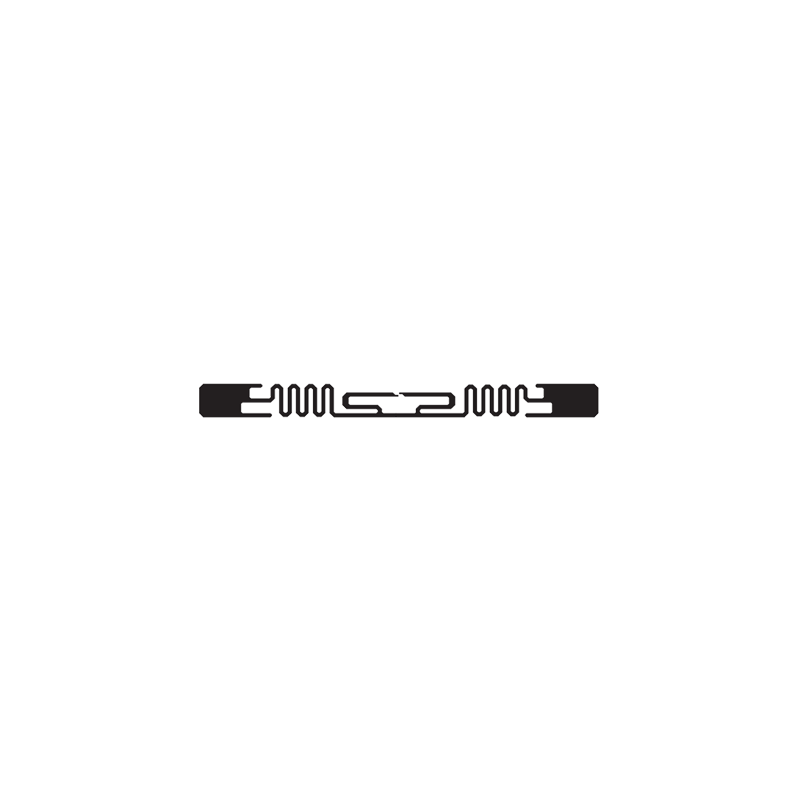
Advanced UHF Solution for RFID Asset Management ALN-9640 Label
2.The system’s hardware structure
The RFID asset management system hardware includes: database server, web server, networked computers in various departments, handheld readers, fixed-position readers, serial port device network server, asset management machine, fixed-position entry/exit readers, asset alarm management machine, and alarm devices.
The asset information, personal information, and department information of the RFID asset management system are all stored in the database server, which serves as the core component of the entire asset management system. The asset management system software is deployed on the backend web server. Computers connected to the network in each department (or region) use the IE browser to manage operations within their respective departments (or regions), such as asset procurement, allocation, issuance, return, maintenance, and scrap registration. Handheld readers primarily perform asset inventory tasks and send the inventory results to the database server. Fixed-position readers continuously monitor and record the location of assets. They connect to the asset management machine via serial port devices, and the asset management machine retrieves the corresponding asset location information and updates the database in real time. Fixed-position in/out readers monitor asset in/out operations in real time and control alarm devices. They are also connected to the asset alarm management system via serial port devices and network servers. The asset alarm management system records asset alarm events and sends them to the database server. Additionally, the asset management system software provides users with feedback on asset inventory and alarm results from the database server, facilitating asset management and querying.
3.System Function Division
The RFID asset management system can be divided into the following overall functions: asset registration, asset circulation, intelligent inventory, asset statistics, manual reduction, and data management.
- Asset Registration: Enables the registration and management of all asset information in the asset room, including functions such as querying, entering, splitting, collecting data identifiers, and displaying data status.
- Asset Circulation: The RFID self-service checkout system allows multiple assets to be checked out simultaneously, significantly enhancing the level of humanized service and operational efficiency during the checkout process.
- Intelligent Inventory: Use handheld inventory devices to perform rapid, contactless inventory of items in designated areas from a distance.
- Asset Statistics: Real-time updated asset reports facilitate managers in uploading or downloading asset lists.
- Reduced Labor: The use of digital and intelligent devices reduces the number of staff required, thereby improving staff efficiency.
- Data Management: Unified management of data related to fixed assets and business operations.
4.The Application Value of the System
The fixed asset management system based on RFID and information technology monitors enterprise resources through the use of RFID electronic tags, RFID readers, and software. Combined with barcode management technology, each physical asset is assigned a unique RFID electronic tag, enabling comprehensive tracking and management of fixed assets throughout their entire lifecycle, from the time they are acquired by the enterprise until they are disposed of. This addresses issues such as discrepancies between records, cards, and physical assets; unclear asset status and equipment details; idle waste, inflated asset values, and asset loss. It provides enterprises and institutions with comprehensive, reliable, and efficient dynamic data and decision-making support for asset management, achieving informatization, standardization, and normalization of asset management processes. This significantly enhances the efficiency and management standards of asset management operations within enterprises and institutions.