

The apparel industry manages thousands of products in different sizes, colors, styles, and seasonal collections. Traditional barcode systems require employees to scan garments individually, making inventory counting slow and vulnerable to human error.
RFID Hang Tags for Clothing offer a faster and more automated way to identify, track, and manage garments throughout manufacturing, warehousing, distribution, and retail operations. With RFID technology, businesses can read multiple clothing items simultaneously without requiring direct line-of-sight scanning.

1.What Are RFID Hang Tags for Clothing?
RFID Hang Tags for Clothing are garment hang tags containing an RFID inlay. The inlay normally consists of an RFID chip and antenna placed inside a printable paper, PET, or synthetic tag.
Each tag stores a unique identification number connected to product information in the retailer’s inventory management system. This information may include:
- Product name and SKU
- Style and collection
- Size and color
- Production batch
- Warehouse location
- Shipping status
- Store information
Unlike conventional clothing tags, RFID hang tags communicate with RFID readers through radio-frequency signals. This allows multiple garments to be identified within seconds.
2.How Do RFID Clothing Hang Tags Work?
An RFID apparel management system usually includes three main components:
RFID Hang Tags
Each garment receives a uniquely encoded RFID tag during production, packaging, or warehouse processing.
RFID Readers
Fixed readers, handheld terminals, desktop readers, or RFID gate readers transmit radio-frequency signals and collect tag data.
Inventory Management Software
The collected information is sent to an ERP, WMS, POS, or retail inventory platform for processing and analysis.
When an RFID reader sends out a radio-frequency signal, the antenna inside the passive RFID hang tag receives energy from the signal. The chip then transmits its stored data back to the reader.
Because RFID does not require direct visual contact, employees can scan an entire carton, clothing rack, shelf, or storage area without handling every garment individually.
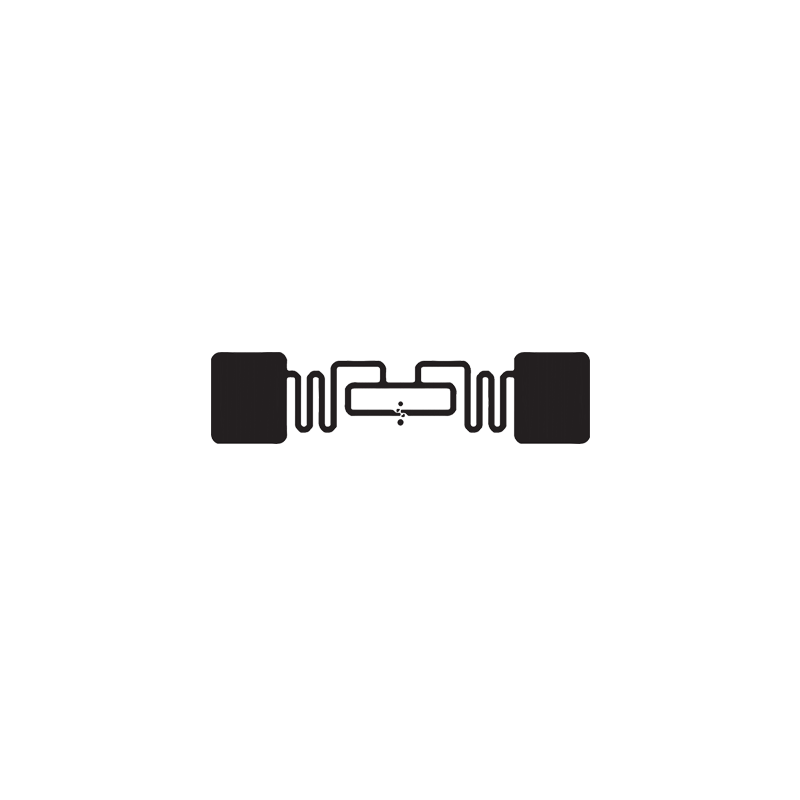
Alien ALN-9662 Short RFID White WET Inlay – High-Performance UHF RFID for Asset Tracking
3.Why Is UHF RFID Commonly Used for Clothing?
Most RFID Hang Tags for Clothing use passive UHF RFID technology. UHF RFID generally operates within the 860–960 MHz frequency range, depending on regional regulations.
UHF RFID is suitable for apparel applications because it provides:
- Fast bulk identification
- Longer reading distances than HF or NFC
- Efficient anti-collision performance
- Compact and lightweight inlay designs
- Low unit costs for large production volumes
- Compatibility with handheld and fixed RFID readers
Common chip options include Impinj, NXP UCODE, Alien, and other UHF RFID chips compliant with the EPC Class 1 Gen 2 / ISO 18000-6C standard.
The exact chip, antenna size, and tag material should be selected according to the garment type, reading environment, encoding requirements, and target read range.
4.Benefits of RFID Hang Tags for Clothing
4.1 Faster Inventory Counting
Barcode inventory requires each label to be located and scanned separately. RFID readers can identify dozens or even hundreds of tagged garments at the same time.
Employees can perform cycle counts using an RFID handheld reader while walking between shelves or clothing racks, substantially reducing the time required for inventory checks.
4.2 Improved Inventory Accuracy
Manual counting, misplaced garments, and missed barcode scans can cause inventory discrepancies. RFID technology automatically captures each garment’s unique identity, helping apparel companies maintain more accurate inventory records.
Reliable inventory data also helps prevent unnecessary replenishment and stock shortages.
4.3 Better Product Availability
When stores have accurate stock information, employees can quickly determine whether a particular style, color, or size is available.
This visibility helps retailers replenish shelves more efficiently and prevents products from remaining unnoticed in stockrooms while sales areas are out of stock.
4.4 Greater Supply Chain Visibility
RFID Hang Tags for Clothing can support garment tracking across multiple stages, including:
- Garment manufacturing
- Quality inspection
- Packing and carton verification
- Warehouse receiving
- Order picking
- Shipping and distribution
- Retail store receiving
- Stock counting
Businesses can use the same RFID identity to monitor products from the factory to the retail store.
4.5 Faster Receiving and Shipping
RFID gate readers installed at warehouse entrances and exits can automatically identify tagged garments passing through the detection area.
This makes it possible to compare actual shipments with purchase orders or packing lists and quickly identify missing, incorrect, or duplicated products.
4.6 Support for Omnichannel Retail
Accurate inventory data is essential for services such as click-and-collect, ship-from-store, and online order fulfillment.
RFID helps retailers understand what inventory is actually available at each location, reducing order cancellations caused by inaccurate stock records.
4.7 Loss Prevention
RFID data can help businesses identify unusual inventory movements and investigate missing products. Depending on the system design, RFID clothing tags may also be integrated with electronic article surveillance and store exit monitoring systems.
5.Applications of RFID Clothing Tags
RFID clothing hang tags can be used in many apparel-related environments:
Apparel Manufacturing
Manufacturers can use RFID to identify work-in-progress garments, monitor production stages, manage quality inspections, and verify packing accuracy.
Warehouses and Distribution Centers
Warehouse teams can use RFID for receiving, location management, stock counting, picking, packing, and outbound shipment verification.
Fashion Retail Stores
Retailers can quickly count clothing on display racks and in stockrooms while improving replenishment and product availability.
Uniform and Workwear Management
RFID can help companies issue, return, count, and manage uniforms assigned to employees or departments.
Footwear and Accessories
In addition to garments, RFID hang tags can be adapted for shoes, handbags, hats, scarves, and other fashion accessories.
6.How to Choose RFID Hang Tags for Clothing
Before selecting an RFID clothing tag, businesses should evaluate several factors.
RFID Chip and Memory
The chip determines the tag’s communication performance, EPC capacity, optional user memory, privacy features, and supported commands.
Inlay and Antenna Size
A larger antenna may provide better reading performance, but the final dimensions must fit the garment tag design. Testing is recommended before mass production.
Tag Material
Paper is commonly used for disposable apparel hang tags, while PET and synthetic materials may be selected when better durability, moisture resistance, or tear resistance is required.
Printing and Encoding
RFID hang tags can be customized with logos, barcodes, QR codes, product information, and care instructions. Each RFID chip can also be encoded with a unique EPC number.
Reading Environment
Garment materials, densely packed products, metal shelving, nearby electronic equipment, and reader placement can all affect RFID performance.
Frequency and Regional Compliance
The tag must support the operating frequency used in the destination market, such as ETSI frequencies in Europe or FCC frequencies in North America.
7.Testing Before Mass Production
Although RFID Hang Tags for Clothing are suitable for large-scale apparel management, performance may vary according to the garment, packaging method, antenna design, reader power, and operating environment.
Before placing a production order, businesses should test samples with their actual RFID readers and clothing products. Recommended tests include:
- Individual tag reading
- Bulk reading on clothing racks
- Carton-level identification
- Warehouse gate reading
- Handheld inventory counting
- Encoding and database integration
- Performance after transportation and handling
Testing helps determine the most appropriate RFID chip, antenna, tag size, and reader configuration.
8.Conclusion
RFID Hang Tags for Clothing provide apparel manufacturers, warehouses, distributors, and retailers with a practical way to automate garment identification and inventory management.
By enabling fast bulk reading, better inventory accuracy, improved stock visibility, and more efficient receiving and shipping, RFID clothing tags can support a more connected apparel supply chain.
SEIKO RFID TECHNOLOGY LTD. supplies customizable RFID inlays, labels, and hang tags for apparel applications. RFID chip options, antenna dimensions, materials, printing, and encoding can be selected according to project requirements. Sample testing is recommended before mass production to confirm performance in the actual operating environment.
Contact us to discuss your RFID clothing tag specifications, required quantity, tag dimensions, chip model, printing design, and target application.