

In recent years, with the rapid development of the economy, people’s lives have evolved beyond basic necessities to embrace lifestyle enjoyment and fashion pursuits. This trend has led families of all ages to spontaneously purchase exquisite jewelry and accessories, fueling rapid growth in the domestic jewelry industry. While jewelers are thriving, they also face intense competition and operational challenges. Retailers are engaged in fierce ‘palace intrigues’ to outperform rivals, placing greater emphasis on tracking and managing jewelry assets throughout the entire supply chain – from procurement and warehousing to sales and inventory. Traditional tracking methods have proven inadequate in meeting these demands, making advanced solutions like RFID Jewelry Management essential. This technology addresses critical pain points while offering unprecedented visibility and control. In this context, we will examine the application of RFID technology in the jewelry supply chain, specifically analyzing how RFID Jewelry Management can transform operations within China’s unique jewelry industry landscape.

RFID Jewelry Labels – Precision Tracking and Inventory Management for Jewelry
1.The History of the Jewelry Retail Supply Chain
The jewelry industry is a fusion of fashion, art, and investment. Jewelry, with its unique natural properties, scarcity, collectible qualities, decorative qualities, and investment value, has become an indispensable component of the fashion industry, a shining pearl in the manufacturing and retail industries.
Jewelry retailers generally analyze jewelry demand based on trends and store sales. They then pass this information on to designers, who then design the designs and place orders with factories for production. Traditional jewelry retail often utilizes a franchise-based sales model, with products undergoing a series of steps, including raw material procurement, design by the brand, production by the processor, and distribution by franchisees, before ultimately reaching consumers. The problem arises: traditional jewelry retail primarily relies on offline sales, lacking understanding of customer information. This makes it impossible to accurately capture customer needs and provide personalized services in a timely manner. Product homogeneity is severe, and passive marketing can only be conducted based on the limited jewelry styles on display. Furthermore, barcode technology is often used in traditional jewelry logistics management. While this technology can improve logistics management efficiency to a certain extent, it still cannot meet the needs of the modern jewelry industry. Problems such as low barcode storage capacity, the inability to append information, fragility, and high reading position requirements are gradually emerging. With so many problems facing the traditional jewelry retail industry, how can we solve them?
2.Principles and Practical Applications of RFID Technology
Radio Frequency Identification (RFID), commonly known as electronic tags, is a communication technology that uses radio signals to identify specific objects and read and write relevant data, without the need for mechanical or optical contact between the identification system and the specific object. Radio signals transmit data from tags attached to objects via electromagnetic fields tuned to radio frequencies, enabling automatic identification and tracking of the objects. In recent years, RFID technology has been applied in numerous fields, including logistics, retail, manufacturing, apparel, healthcare, identity verification, anti-counterfeiting, asset management, food, animal identification, libraries, automotive, aviation, and the military. It has had a significant impact on improving people’s quality of life, enhancing business profitability, strengthening public safety, and advancing the level of social informatization. In my country, RFID technology has been applied in a variety of fields, including railway car number recognition, ID and ticket management, animal identification, special equipment and hazardous materials management, public transportation, and production process management.

LED Light RFID Tag For Jewellery Tagging and Tracking
3.RFID Technology in Jewelry—Taking IGC as an Example
IGC, a jewelry wholesaler, installed an RFID system in 2013. Using RFID technology, the company is able to individually track valuable jewelry, significantly improving inventory efficiency and providing faster and better visibility into the actual inventory status of each item. So how does it work?
First, IGC attaches a passive 13.56 Hz high-frequency RFID tag to each piece of jewelry and the envelope containing the loose diamonds. When the diamond jewelry arrives at the supplier, IGC attaches a diamond tag to the diamond envelope and enters the data into a specialized software program, linking it to the tag’s ID number. The software then updates the item information and issues an immediate alert if any discrepancies are detected. Upon receipt of new items, staff transport them to the warehouse. Upon receiving orders from retail stores, the jewelry and diamonds are removed from the warehouse, recorded using handheld readers, and placed in boxes. If the jewelry or diamonds require processing, IGC employees perform this work at their respective workstations. At the end of the day, unfinished items are placed in boxes at their workstations. Responsible personnel can verify whether items are missing by reading the ID tag inside the box. When the goods are delivered to the customer, staff will read the product tag to create invoice reports and consignment memoranda. When returns are received at retail stores, IGC follows a specific process to verify that the items have not been altered.
Secondly, during the sales process, IGC stores will place RFID mats, or smart display trays, inside which an embedded RFID reader antenna is connected to a reader. When a salesperson places jewelry with an RFID tag on the display tray, the display tray reads the jewelry tag. Software then reads the ID code and forwards it to the backend system, which then takes appropriate action. For example, the system can calculate the number of times a piece of jewelry has been placed on the display tray. Management can use this data to adjust the jewelry type and other aspects. At the checkout counter, when the jewelry is sold, it is placed on the antenna on the same mat. The product tag’s ID is read and forwarded to the backend system, which then indicates that the item has been sold and requires the employee to remove the tag. RFID systems save time scanning barcodes and improve efficiency. With this RFID system, employees only need to read the tag and check to confirm if there are any issues with the product. RFID systems can not only confirm whether items are missing, but also reduce inventory while meeting order requirements. Furthermore, with RFID, companies can collect various data to provide a basis for decision-making.
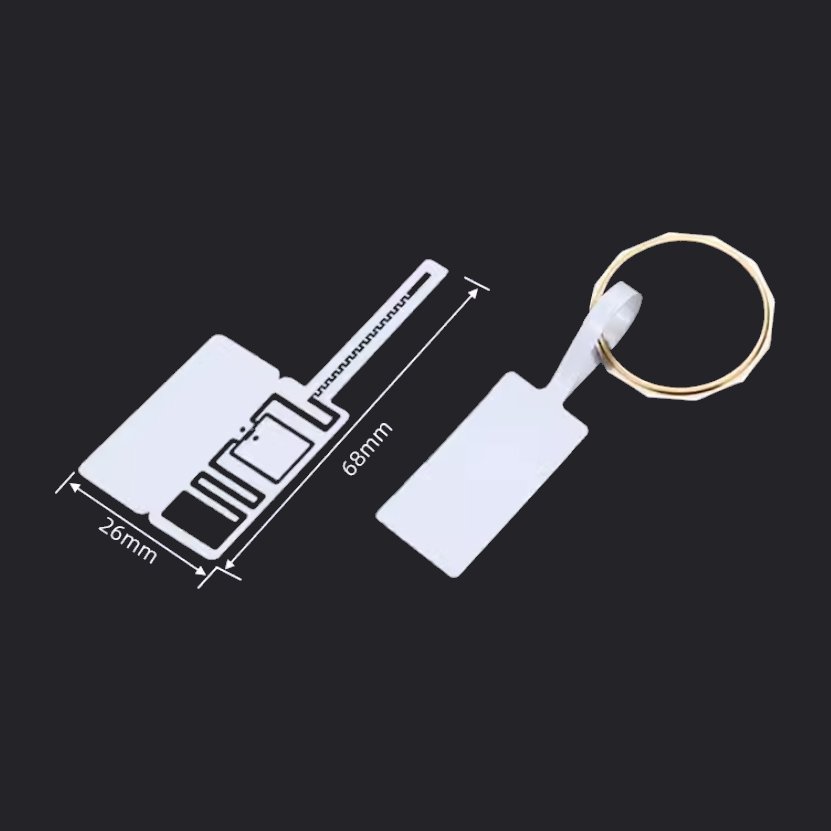
RFID Jewelry Label For the RFID Jewelry Tracking System
4.Similarities and Differences between RFID Technology and Traditional Barcodes
Traditional jewelry retail tracking systems are based on traditional barcodes. With the advancement of technology, many companies are transitioning from barcodes to RFID technology. So, what are the differences between traditional barcodes and RFID technology? Let’s explore their similarities and differences below!
First, both RFID and traditional barcodes can perform barcode recognition (barcode scanning) and quickly and accurately identify the final target object. However, RFID technology has advantages over traditional barcodes. Why? Let’s analyze this from the following perspectives:
- Traditional barcodes rely primarily on image-related optical signals for transmission, while the terminal uses a photoelectric conversion device to obtain digital electrical signals.
- RFID operates by transmitting electromagnetic signals through radio frequency, while the terminal recognizes digital electrical signals converted from radio frequency to baseband.
- Fast scanning speed. RFID readers can simultaneously identify and read multiple RFID tags, while barcodes can only scan one barcode at a time.
- Compact size and diverse shapes. RFID is not restricted by size or shape when reading information, so it doesn’t need to adhere to fixed paper dimensions and print quality for accurate reading. Furthermore, RFID tags can be miniaturized and designed for diverse applications.
- Anti-contamination and durability. Traditional barcodes are based on paper and are easily contaminated, but RFID tags are highly resistant to substances such as water, oil, and chemicals. Furthermore, because barcodes are attached to plastic bags or outer packaging, they are particularly susceptible to damage. RFID tags store data on a chip, making them impervious to contamination.
- Reusability. While current barcodes cannot be altered once printed, RFID tags allow for the repeated addition, modification, and deletion of data stored within them, facilitating information updates.
- Penetration and barrier-free reading. RFID tags can penetrate non-metallic or non-transparent materials such as paper, wood, and plastic, even when covered, and can communicate through them. Barcode scanners, on the other hand, must be at close range and clear of obstructions to read barcodes. 8. Large data storage capacity. A one-dimensional barcode has a capacity of 50 bytes, a two-dimensional barcode can store 2 to 3,000 characters at most, and an RFID tag can store multiple megabytes at most. With the development of memory media, data capacity is also trending upwards. In the future, the amount of data required to be carried by items will continue to increase, requiring greater capacity for tags.
- Security. Because RFID tags carry electronic information, their data content can be password-protected, making it difficult to forge or tamper with.
In recent years, RFID has garnered significant attention for its long-range reading capabilities and high storage capacity. It not only helps businesses significantly improve the efficiency of goods and information management, but also connects retailers and manufacturers, enabling more accurate feedback, controlling demand, and optimizing the entire supply chain.
5.The Impact of RFID Technology on the Jewelry Supply Chain
There’s no doubt that the integration of jewelry and RFID will impact both upstream and downstream supply chains. Supply chain efficiency will be improved through the application of RFID technology in jewelry.
6.What will jewelry retailers gain from this technological revolution
6.1 Accurately manage sales data
The most direct impact is on offline retail stores. In traditional jewelry stores, sales staff often provide one-on-one information about the jewelry to customers, and the stores only record data on jewelry that has already been sold. By using RFID-powered smart display trays, stores can record inquiries about each piece of jewelry. Customers can see the jewelry’s material, size, price, and how many times it’s been viewed by other customers. This information can influence their purchasing decisions; after all, they don’t want to buy the same ring or necklace as everyone else! This data is then transmitted to the store’s back-end terminal, providing more detailed and accurate data. Sales staff can then use this information to recommend jewelry to customers, catering to their preferences.
6.2 Optimizing Inventory Management
High-value items like jewelry carry high inventory costs. But with RFID technology, store owners don’t have to worry! Because each piece of jewelry sold in the store has its own unique barcode, like a personal ID card, the back-end data is updated as soon as the jewelry is sold, along with the latest inventory data. This allows stores to consider implementing VMI and share this data with suppliers. Furthermore, using RFID technology and smart inventory counting can significantly reduce inventory counting time and the number of inventory personnel, significantly lowering inventory costs and ultimately increasing profit margins. 3. Reducing the Bullwhip Effect
The bullwhip effect, simply put, is like asking for just one candy bar, but after passing through layers of channels, by the time it reaches the upstream supplier, my demand has become 100 candies. This is quite exaggerated. If jewelry store owners use RFID technology based on VMI to share inventory data in real time, they can mitigate the impact of the bullwhip effect on the supply chain. This is because real consumer demand data is already transmitted upstream through RFID monitoring, enabling data sharing. Distributors can clearly understand customers’ true needs and provide upstream manufacturers with accurate information on demand. This ensures accurate market data from the very beginning of the supply chain, allowing manufacturers to implement lean production based on real demand. This maximizes the value of the supply chain.
6.3 Security Issues
Of course, the marriage of RFID and jewelry is not perfect; there are always potential issues like the “seven-year itch” and “third-party sabotage.” Why do I say that? Because confidentiality is difficult to guarantee using RFID technology. A saboteur—a radio frequency tag without a security mechanism—can send a signal to a nearby reader, causing information to be leaked. Secondly, RFID tags can also be used by another saboteur—criminals—to hide data, preventing the reader from scanning the code and allowing them to move items without authorization. This deception can fool staff into thinking the merchandise is still on the shelf, leading to potential reprimands from the boss.
7. Conclusion
RFID technology has penetrated deeply into every key aspect of jewelry assets, from warehousing to sales, inventory, and disposal. Combined with computer and network technologies, it enables information-based, precise, and efficient management of jewelry assets. This has significantly improved jewelry supply chain management and temporarily alleviated the concerns of jewelry retailers. However, RFID technology still has flaws in its application and needs improvement. For example, is it secure? Will it infringe on consumer privacy? These issues still need to be examined. However, with the continuous advancement of technology, the variety of RFID products will continue to expand, continuously meeting consumer needs. We look forward to RFID technology playing a greater role in the jewelry supply chain and other industry supply chains.