

In logistics warehousing, retail, and smart manufacturing, RFID technology is no longer novel. However, within the jewelry industry, this cutting-edge technology is emerging as a key breakthrough to address traditional management pain points—from the headache of inventory chaos to the heart-wrenching challenge of theft prevention. The introduction of RFID Jewelry Tracking has achieved a dual upgrade in both efficiency and security for jewelry management. Yet to fully unlock the potential of UHF RFID technology, antenna selection is a critical step. Choosing the right antenna doubles efficiency; choosing the wrong one can negate the technology’s advantages entirely.
1. RFID Technology: The Dual Guardian of Efficiency and Security in Jewelry Management
How challenging is traditional jewelry management? With dozens of pieces in display cases, inventory requires manual item-by-item verification—a time-consuming process prone to errors. New arrivals and retirements rely entirely on manual logging, where information lag often causes inventory and systems to run out of sync. Even more vexing is theft prevention: the moment jewelry leaves sight, risk skyrockets.
The advent of UHF RFID technology has fundamentally transformed this landscape. By attaching electronic tags to each piece of jewelry and deploying corresponding readers and antennas, jewelry management achieves three major breakthroughs: First, inventory efficiency soars—what once took hours can now be completed in minutes with over 99% accuracy. Second, full process visibility enables real-time tracking of every movement—from inventory receipt and display placement to sales and after-sales service. Third, theft prevention becomes more precise, with the system triggering immediate alerts if jewelry leaves designated areas without authorization. However, all these benefits hinge on selecting the right UHF RFID near-field antenna tailored to jewelry environments.

Custom RFID Stickers
2. UHF RFID Antennas: The “Core Difference” Between Near Field and Far Field
To select the right antenna, one must first grasp the fundamental distinction between near-field and far-field antennas. This isn’t merely about “distance,” but rather determined by the propagation characteristics of radio waves.
2.1 Understanding the “Near-Field and Far-Field Distinction” in Electromagnetic Fields
Radio waves are fundamentally electromagnetic waves composed of electric and magnetic fields. When an antenna transmits a signal, it generates an electromagnetic field surrounding the antenna. This field is divided into near-field and far-field regions based on distance from the antenna.
- Near-field region: Close to the antenna, where electromagnetic coupling dominates. Energy is concentrated near the antenna with limited propagation range.
- Far-field region: At greater distances from the antenna, the electromagnetic field primarily propagates via “radiation transmission.” Signals can cover long distances, but energy attenuates with distance.
It is precisely this difference in propagation characteristics that creates fundamentally distinct application scenarios for near-field and far-field antennas.
2.2 Key Comparison: How to Choose Between Near-Field and Far-Field Antennas?
| Feature | Far-Field Antenna | Near-Field Antenna |
|---|---|---|
| Identification Range | Far (typically 1–10 m) | Near (typically 0–1 m) |
| Radiation Angle | Wide, broad coverage | Narrow, concentrated on front surface |
| Misread Risk | High, prone to cross-reading adjacent tags | Low, minimal cross-reading |
| Suitable Scenarios | Long-range batch identification (e.g., large-item warehouse inventory) | Close-range precise identification (e.g., jewelry, electronic components) |
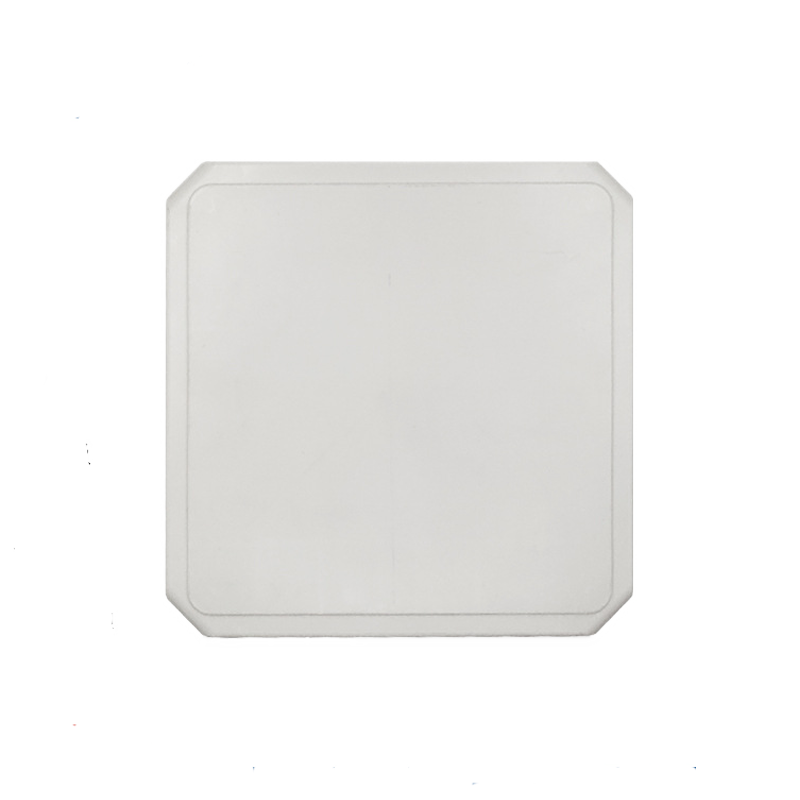
For jewelry management, the “long-range, wide coverage” of far-field antennas actually becomes a disadvantage—with densely packed displays and narrow shelf spacing, far-field antennas easily misread tags from adjacent counters, leading to data confusion. In contrast, the “short-range, precise coverage” of near-field antennas perfectly aligns with the core requirements of jewelry retail environments.

3. Jewelry Management Scenarios: Why Near-Field Antennas Are the Optimal Solution
To determine antenna suitability, one must first understand the essential requirements of jewelry management scenarios. The display and management of jewelry in stores or warehouses feature three unavoidable characteristics
3.1 Dense Display
On a single shelf, jewelry items may be spaced only a few centimeters apart, while the distance between different shelves is often less than 1 meter. Tags “crowded together” is the norm;
3.2 High Identification Precision
Must ensure “no missed identifications and no false reads”—for example, jewelry on Shelf A must never be mistakenly read by Shelf B’s reader/writer;
3.3 Dynamic Tracking Requirements
Frequent operations like shelving, removal for fitting, and return necessitate real-time determination of whether jewelry remains within the “designated zone,” with immediate detection upon zone departure.
These characteristics align perfectly with the strengths of near-field antennas. Their ring-shaped design concentrates electromagnetic energy on the antenna’s front surface, creating a “precision identification zone”: jewelry within the antenna’s coverage is detected 100% of the time. Removal instantly breaks the signal, preventing both missed reads and cross-reading of tags on adjacent shelves.

Label RFID
4. UHF RFID Antennas for Jewelry Applications: 4 Key Selection Criteria
Beyond specifying “near-field antennas,” four critical details directly impact final performance:
4.1 Identification Range
In jewelry management, display areas are typically highly compact, with minimal spacing between shelves and individual pieces. This necessitates a moderate identification range for UHF RFID antennas. Near-field antennas offer distinct advantages here, featuring a shorter identification range that enables precise detection within confined spaces.
This close-range recognition capability allows near-field antennas to strictly confine detection to specific zones. When jewelry is placed on shelves equipped with near-field antennas, the antennas accurately read RFID tag information within that zone, ensuring 100% recognition of every piece. Moreover, due to their limited detection range, once jewelry leaves this designated area, it falls outside the antenna’s effective detection zone and can no longer be read. This effectively prevents cross-reading of tags from adjacent jewelry, guaranteeing the accuracy and independence of information identification.
4.2 Radiation Angle and Directivity
The dense arrangement of jewelry displays imposes stringent demands on antenna radiation angles and directivity. In such environments, antennas with excellent directionality must be selected to ensure tags are reliably identified only when directly facing the antenna surface, with recognition ceasing immediately upon departure.
Near-field antennas typically employ a ring design. This ingenious configuration concentrates the antenna’s radiation efficiency onto its primary surface. Like a spotlight, it focuses all energy within a specific range. When multiple jewelry pieces are densely displayed on shelves, the near-field antenna leverages its unique ring design to achieve efficient recognition of multiple tags. It accurately distinguishes each tag’s information without confusion, regardless of tag quantity or proximity. Simultaneously, this design provides superior control over the radiation angle. Only tags on the front surface of the antenna are detected, while tags in surrounding areas remain undisturbed. This precisely meets the stringent identification requirements of jewelry management.
4.3 Anti-Interference Capability
Jewelry display areas contain multiple sources of electromagnetic interference. Other electronic devices—such as lighting fixtures, electronic displays, and air conditioning systems—emit electromagnetic radiation that may disrupt the normal operation of RFID antennas. The presence of metal shelving further complicates signal interference by causing reflections and scattering of radio frequency signals.
Therefore, selecting antennas with strong anti-interference capabilities is crucial. Some high-performance UHF RFID antennas incorporate specialized anti-interference designs, such as using shielding materials to reduce the impact of external electromagnetic interference and optimizing antenna circuitry to enhance signal stability and interference resistance. In practical applications, these specially designed antennas can operate stably in complex electromagnetic environments, accurately reading jewelry tag information without being affected by other interference sources, providing reliable technical assurance for jewelry management.
4.4 Adaptability
Jewelry encompasses diverse types including diamonds, gold, silver, jade, pearls, and more, each varying in material, shape, and size. Display methods also differ significantly, ranging from hanging displays to tray arrangements and showcase stands.
This necessitates UHF RFID antennas with strong adaptability to accommodate diverse jewelry types and display configurations. Advanced RFID reader antennas feature adjustable detection ranges and radiation angles, allowing users to flexibly adapt settings based on actual jewelry layouts.
5. Case Study
How Near-Field Antennas Solve Jewelry Management Challenges
A chain jewelry brand once faced “slow inventory checks and theft prevention difficulties”: With over 50 stores nationwide, each store required at least two days for monthly inventory checks, often resulting in “discrepancies between recorded and actual counts.” Within a year, three incidents of jewelry theft occurred during customer try-ons.
The brand later implemented a UHF RFID near-field antenna solution: embedding near-field antennas beneath each jewelry display counter and attaching compact jewelry tags to every piece. Results were immediate:
- Inventory efficiency increased by 90%: Single-store inventory time reduced from 2 days to 1 hour with 100% accuracy;
- Zero-delay theft alerts: The system triggers an alert within 3 seconds if jewelry leaves the counter (antenna coverage area) without authorization. No theft incidents occurred within the following six months.
- Real-time inventory synchronization: Upon new product listing or sales fulfillment, the system instantly updates inventory levels to prevent overselling or stockouts.
6. Conclusion: Choosing the Right Antenna to Maximize RFID Technology’s Potential
For the jewelry industry, the practical value of UHF RFID technology hinges on selecting antennas that precisely match application scenarios. Near-field antennas, with their characteristics of “precise coverage, no cross-reading, and high stability,” emerge as the optimal solution for jewelry management.
Looking ahead, as UHF RFID technology advances, near-field antennas will evolve toward “smaller size, lower power consumption, and higher integration.” Examples include micro-antennas directly integrated into jewelry display cases or smart antennas supporting rapid simultaneous identification of multiple tags. For jewelry enterprises, proactively implementing compatible UHF RFID antenna solutions not only resolves current management challenges but also lays the groundwork for future digital transformation.