

The RFID Laundry Management System provides a definitive solution to the significant challenges faced by hotels, hospitals, bathhouses, and professional laundry companies. These industries grapple with complex processes involving the handover, washing, ironing, sorting, and storage of vast quantities of workwear and linens. Key management difficulties include:
- Inefficient Handovers: Traditional paper-based task handovers are cumbersome and create difficulties in tracking and querying data.
- Inventory Inaccuracy & Disputes: Manual counting is prone to errors, leading to mismatches between soiled and clean linen quantities, which can result in commercial disputes. Concerns about cross-infection further complicate the process.
- Lack of Process Visibility: The inability to accurately monitor each step of the washing process results in linens being overlooked or lost.
- Ineffective Sorting & Storage: Without automated classification, clean linens are often sorted incorrectly, wasting valuable storage space and operational time.
- Poor Inventory Planning: The inability to track usage and lifecycle data makes it impossible to accurately determine minimum safety stock levels for each linen item.
The RFID Laundry Management System directly addresses these issues by leveraging RFID technology to automate tracking, enhance traceability, and provide data-driven insights for optimal inventory control.
1. System Introduction
The RFID washing management system introduces RFID wireless radio frequency identification technology, making the management of linen more transparent, improving work efficiency, and solving management problems that could not be achieved through other technologies in the past, such as the statistics and handover of large quantities of linen to be washed.
The system sews a strip shaped electronic tag on each piece of linen, which contains a globally unique identification code. Each piece of linen has a unique management identification code. During the entire linen usage and washing management process, the system automatically records the usage status and washing times of the linen through an RFID reader. The system supports batch reading of tags during washing task handover, simplifies the handover process, and reduces business disputes. By tracking the washing times, the system can estimate the current lifespan of the linen and provide predictive data support for procurement plans.
2. System advantages
- The manual workload can be reduced by 40-50%;
- The visualization level of linen products reaches over 99%, reducing the risk of missing linen;
- Improved supply chain management can reduce work service time by 20-25%;
- Improve the accuracy and reliability of stored information;
- Efficient and accurate data collection to improve operational efficiency;
- Automatically collect, distribute, and collect handover data to reduce human errors;
- Reduce the comprehensive cost of user linen washing management.

3. System composition
- RFID electronic tags;
- RFID tag card dispenser;
- Fixed RFID reader/writer;
- RFID handheld terminal;
- Intelligent laundry management system.
4.System design
Tag sewing: Sew RFID electronic tags in the shape of strips for each piece of linen, and it is recommended to sew them uniformly in an easily accessible location.

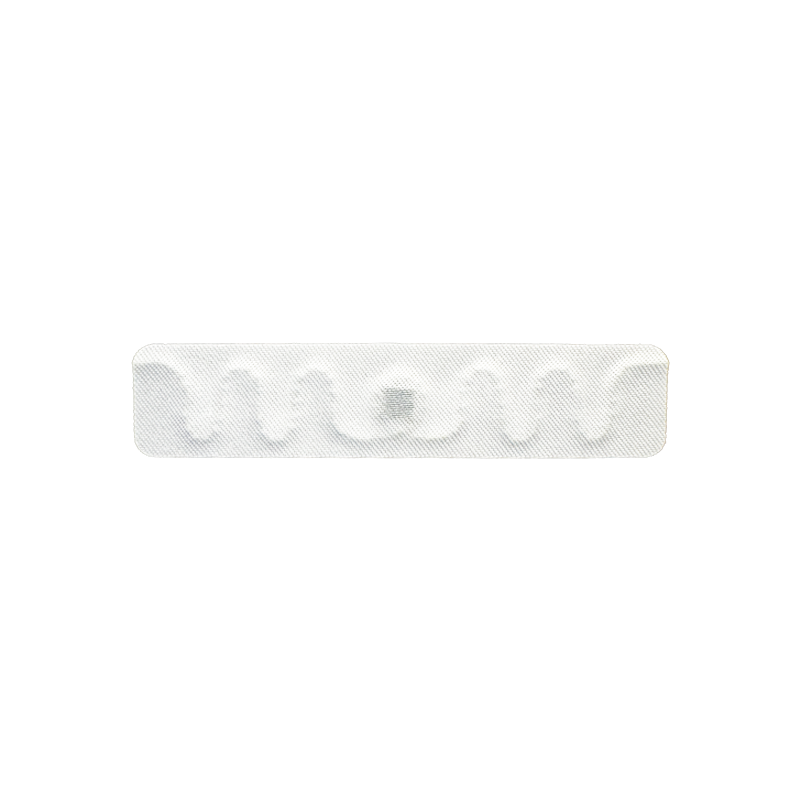
rfid laundry tags
Customer management: Add and modify customer information, including unit lists, contacts, phone numbers, and addresses.
Tag entry: Associate the information of each laundry item to be managed with the RFID tag ID in the database, and record the workflow and lifecycle of each work uniform and linen item.
Waste counting and verification: Pack the waste with RFID tags directly, automatically collect the quantity through a fixed RFID reader channel, and record the ID of each piece of waste read, improving work efficiency and reducing commercial disputes.
Clean linen counting: After cleaning, the linen is checked again through a fixed RFID reader channel to confirm if there is any missing linen during the washing process, and a list is generated for handover to the user.
Sorting and classification of linens: Using the uniqueness of RFID tags, help sort linens from various wards, and confirm whether they are placed in the wrong position through RFID readers before packaging.
Cloth query: By scanning the label of the cloth, the information of each piece of cloth can be queried to prevent loss and confusion.

5. System assembly process
Product identification: Sew buttons with RFID electronic tags on each item of laundry that needs to be managed to identify each piece of clothing. The RFID smart tag chip has a globally unique ID number and writes specific attributes of the clothing based on customer information, such as clothing owner, lifespan, number of washes, and model.
Automatic counting: It is divided into incoming counting and outgoing counting, accurately recording the quantity of each handover. For packaged waste, it can be accurately counted through an RFID tunnel reader with an accuracy rate of up to 100%. These data are objective and scientific, and can be used to verify the handover quantity with the user. Clean clothes that are ready to be returned to the user can also be accurately counted through an RFID tunnel reader and a list generated.
Automatic sorting: Through the uniqueness of RFID tags, clean clothes are automatically sorted in the washing plant area, directly sorted to the smallest user unit and packaged for listing.
Data management: The system stores information and washing process data of all laundry items in a database, including washing times, service life, washing records, etc. Users can query detailed information of each laundry item through the system, such as washing times, last washing date, etc., for maintenance and management purposes.
Report generation: The system can generate various reports based on user needs, such as detergent usage reports, washing frequency statistics reports, etc., to assist users in data analysis and decision-making.
Warning function: The system can issue warnings in advance based on the service life and number of washes of the laundry, prompting users to perform maintenance and replacement to avoid affecting the effectiveness of use due to aging or damage of the laundry.

RFID Handheld Reader
6.System application scenarios
Hotel: Room linens can be managed, including bed sheets, duvet covers, pillowcases, etc., to ensure that each piece of linens is washed and the number of washes is recorded to avoid the risk of cross infection of linens.
Hospitals can manage ward linens, including bed sheets, duvet covers, pillowcases, surgical gowns, etc., to ensure that each linen item is washed and the number of washes is recorded to avoid the risk of cross infection.
Bathing area: It is possible to manage towels, bathrobes, and other linens to ensure that each item is washed and the number of washes is recorded, thereby improving the service life of the linens.
Professional laundry company: can manage customers’ linens, including work clothes, napkins, tablecloths, etc., ensuring that each piece of linen is washed and recording the number of washes, providing customers with traceable washing data.
7. System advantages
Improve work efficiency: By automatically counting and sorting, reduce manual operations, improve the processing speed and accuracy of laundry, and save human resources.
Improving washing quality: By recording the number of washes and washing process data, problems during the washing process can be detected and solved in a timely manner, thereby improving washing quality.
Reduce costs: By reducing manual operations and extending the lifespan of laundry, reduce washing costs.
Provide data support: The system can generate various reports and data analysis to help users understand the usage and trends of laundry products, and make decisions and plans accordingly.