

1. RFID Library
In today’s fast-evolving digital landscape, libraries are embracing advanced technologies to enhance efficiency, security, and user experience. Among these innovations, RFID Library Management Systems have emerged as a game-changer, revolutionizing traditional library operations. By replacing outdated barcode and manual tracking methods, RFID enables seamless automation—from inventory control and self-checkouts to anti-theft protection and real-time asset tracking.
Unlike conventional systems, RFID offers contactless scanning, faster processing, and unparalleled accuracy, reducing human error and operational costs. Whether streamlining book circulation, improving patron satisfaction, or safeguarding valuable collections, RFID is redefining what it means to run a modern, smart library. This article explores how RFID technology works, its key benefits, and why it’s becoming the gold standard for libraries worldwide.

Library RFID Vendors
2. Traditional Library EAS Anti-theft Systems
Electronic Articulate Surveillance (EAS) originated in the United States in the 1960s, driven by the severe theft in the retail industry at the time. It is a high-tech electronic anti-theft device that uses advanced technology to give merchandise a self-defense capability, effectively protecting it and preventing theft. Internationally, 90% of retailers use EAS systems to reduce theft rates. In China, EAS systems are also gradually gaining acceptance and adoption by businesses. To date, businesses generally consider the widespread use of EAS systems to be the most reliable and economical high-tech management tool for reducing theft and minimizing losses.
There are many types of EAS anti-theft devices, but the basic operating principle is the same: a tag that generates a unique signal is attached to the protected item. A set of antennas capable of detecting the tag signal is installed at the library’s exit. When an item passes through the exit, the antenna detects the tag signal and triggers an alarm. If the item is allowed to pass, the signal generator within the tag is preemptively deactivated, preventing the alarm from being triggered when the item passes the antenna. According to the different signal characteristics emitted by the tag, EAS anti-theft systems can be divided into electromagnetic systems, radio systems, acousto-magnetic systems, etc. Now let’s discuss the principles of each system.
2.1 Electromagnetic Systems
Electromagnetic systems use electromagnetic waves as detection signals. They were introduced around the same time as radio frequency systems and have a history of over 30 years. Electromagnetic systems have a high detection rate. However, they are susceptible to magnetic or metallic interference, resulting in false alarms or non-detection. Their advantages are minimal, highly concealed tags, low cost, and repeatable demagnetization, making them suitable for protecting specific products such as books. Electromagnetic systems are available in both vertical and tunnel configurations, with an outlet width generally around 0.9 meters. They are commonly used in libraries, educational institutions, and audio-visual stores.
2.2 Radio Systems
Radio frequency (RF) systems have been around for over 30 years and are one of the earliest electronic anti-theft systems. They use radio frequency (RF) as the system’s transmitting and receiving detection signals, with a detection frequency range generally between 7.5 and 8.5 MHz. RF systems generally have a detection rate of around 80%. Because the anti-theft tags are ring-shaped coils, many coiled objects or electronic products with a similar frequency to the tag can trigger the system, causing false alarms. Furthermore, radio frequency systems are completely shielded by metal foil. If the security tag is placed close to or attached to the foil, it will become ineffective and the system will miss detections. The greatest advantage of radio frequency systems is their extremely low system cost. Radio frequency systems are available in both soft and hard versions, and can protect most items in shopping malls. The distance between the two supports is generally limited to 1.2 meters.
2.3 Acousto-Magnetic System
A tuning fork resonates only when its oscillation frequency is the same. The acousto-magnetic system utilizes this physical principle to achieve virtually zero false alarms. When an acousto-magnetic system tag attached to a product enters the system’s detection area, it resonates. However, the system will only sound an alarm after the receiver receives four consecutive resonant signals (one every 1/50 second).
The characteristics of the acousto-magnetic system include a high detection rate, virtually zero false alarms, resistance to metal foil shielding, excellent interference resistance, and a wide protected exit area (a single system can cover up to 4 meters). Acousto-magnetic systems offer both soft and hard anti-theft tags, protecting most types of merchandise in shopping malls. However, these tags are relatively large and expensive. Acousto-magnetic systems come in various styles, including vertical, channel, and concealed systems, with over 10 models available. They are primarily used in department stores, supermarkets, specialty stores, audio-visual stores, grocery stores, and pharmacies, but can also be used in office buildings. Acousto-magnetic systems represent the latest in theft prevention technology.
2.4 Comparison of Electromagnetic, Radio, and Acousto-Magnetic Systems
Of the above systems, electromagnetic systems utilize relatively inexpensive magnetic stripes, significantly reducing user investment in consumables. Furthermore, the thin, compact strips allow for quick and easy deactivation and activation, are highly concealed, and can be repeatedly demagnetized. They are the most effective in combating theft and are affordable for every library budget, making them widely used in libraries. Installing an electromagnetic system does not disrupt library operations and can reduce book losses by over 95%. Radio systems have the advantages of compact racks and low cost, but they lack the ability to cycle deactivation and activation, and the tags are less discreet within books, making them less widely used in libraries than electromagnetic systems. Acousto-magnetic systems offer a more attractive appearance, the lowest false alarm rate, the widest rack spacing, and reusable tags. However, due to their thickness, the tags are least discreet within books, making them generally used for shoplifting prevention.
3.RFID Library Management’s Anti-Theft Requirements
No one doubts that RFID will completely replace the basic management model (barcode + EAS) in the near future. However, during the realistic transition period, RFID industry professionals need to understand library expectations and requirements to significantly shorten this transition period.
3.1 Price Requirements for RFID Systems
Currently, RFID costs are tens to hundreds of times higher than a barcode + EAS system. Hopefully, with the development of the RFID industry, this price will rapidly decrease.
3.2 Anti-Theft Requirements for RFID Systems
In theory, RFID technology has inherent anti-theft capabilities. However, because its tags resemble radio-based EAS tags in appearance—a thin 3×3 cm or 4×4 cm sheet—they are less discreet within books, thus limiting their effectiveness. The industry has developed slender RFID antenna tags that look similar to magnetic strips. However, due to the antenna’s shape, their long-range read/write sensitivity is lower than that of traditional EAS, similarly impacting anti-theft effectiveness. Solving these problems requires continuous improvement in RFID technology. 3.3 Requirements for RFID Access Control Appearance
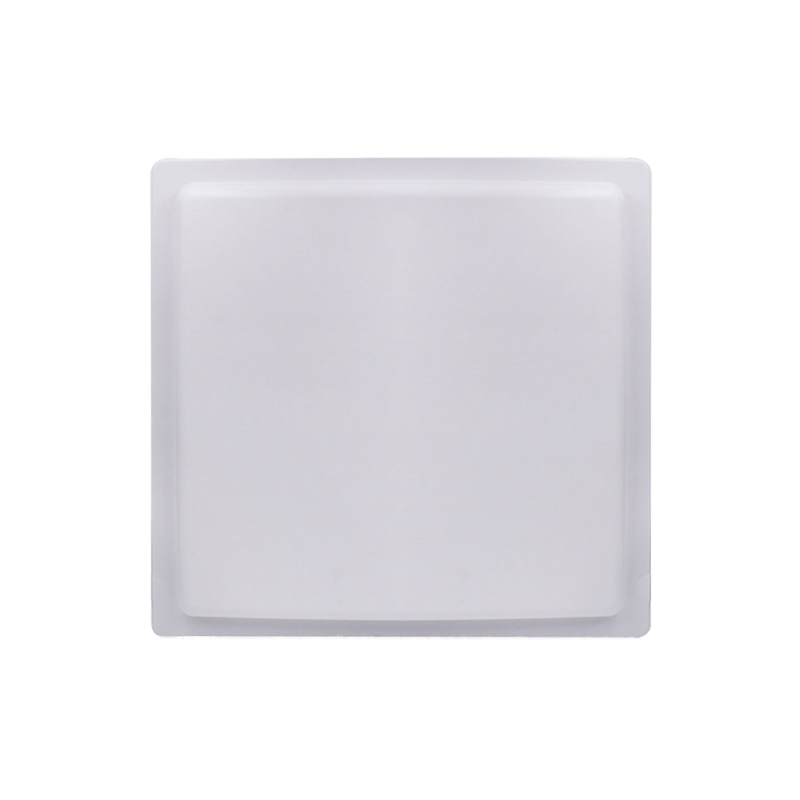
12dBi Circular Linear RFD UHF Reader Antenna
Traditional EAS systems offer a variety of appearances, meeting the needs of various library clients. However, RFID access control systems are still relatively simple in appearance, requiring continued development by developers.
3.4 Requirements for a Smooth Transition Between Old and New Technologies
Even disregarding the high cost of RFID during the transition period, the workload for a large library to completely transition from traditional technology to full RFID management would be enormous. Therefore, it is essential that both the main RFID device and its accessories be compatible with the combined (barcode + EAS) management model. This is not a technically challenging task. This has been successfully implemented internationally. Domestic counterparts are also beginning to follow suit, and we hope to see continued improvement.
4.RFID Library Anti-theft Models
Libraries previously mostly used magnetic stripes for anti-theft measures, with a smaller number employing active EAS tags. The introduction of RFID technology has led to a shift in the way libraries implement their anti-theft systems. Currently, some libraries rely solely on RFID tags for both management and anti-theft. RFID tags generally utilize rewritable security bits stored within the tags. However, magnetic stripe anti-theft measures haven’t been phased out with the advent of RFID. This is partly due to the need for some libraries to maintain a unified anti-theft system. Furthermore, given the uncertain social environment and the effectiveness of RFID in anti-theft measures, magnetic stripes continue to maintain their place. Compared to RFID tags (high-quality RFID tags come with a 10-year warranty and 100,000 reads and writes), magnetic stripes offer advantages such as relative concealment and permanent usability.
Different RFID vendors have different system design philosophies, resulting in varying anti-theft approaches and front-end software. The anti-theft modes in the actual application of RFID libraries are summarized as follows: (1) magnetic stripe anti-theft; (2) RFID-EAS-TTF security bit detection; (3) RFID tag security bit anti-theft; (4) database status verification detection anti-theft; (5) access control UID detection anti-theft.
4.1 Magnetic stripe anti-theft
The system design concept is to maintain the original magnetic stripe security access control system unchanged and install RFID tags to realize self-service circulation and shelf area management. The advantages of magnetic stripe anti-theft are concealment and long life. Magnetic stripe security access control is independent of the network and system. It does not provide any problem collection information when alarming, and the door frame cannot be used for other RFID detection statistics.
4.2 RFID-EAS-TTF security bit detection
The tag contains an erasable EAS security bit. After the collection is borrowed/returned, the EAS security bit is written with the corresponding status information. When a reader passes the access control with a book, the collection (tag) that has not completed the borrowing procedure will actively send information to the anti-theft door frame, causing an alarm. This system utilizes a tag-talk-first (TTF) mode. After the tags are powered on, the access control antenna performs group detection, eliminating the need for sleep-wake-up checks. The system ensures that all user-stored information in the tag chip is fully read. This method is similar to magnetic stripe detection, and manufacturers claim a detection efficiency of up to 95%. A typical example is the Philips I-CODE-II chip. This anti-theft access control system is independent of the network or system. No information about problematic items is provided during an alarm, and the door frame cannot be used for other RFID detection statistics.
4.3 RFID Tag Security Bit Anti-Theft
The tags contain an erasable security bit. After a borrow/return operation, the corresponding status information is written to the security bit. When a reader passes through the access control system with a book, the book (tag) is individually scanned and checked after it passes the anti-theft door frame. Unchecked items (tags) will trigger an alarm at the door frame. Theoretically, the detection efficiency of this system is slightly lower than that of the RFID-EAS-TTF model. This anti-theft access control system is independent of the network and system. It provides (or does not provide) any problematic collection information during an alarm, and the door frame can be used for other RFID detection and statistics.
4.4 Database Status Verification Detection Anti-theft
This means that when a borrowed item passes through the anti-theft door frame, the borrowed/unborrowed status of each item is checked against the database. If the item has not been checked out, an alarm is triggered. This anti-theft method requires the most steps and is most dependent on the network and database, making it a less efficient method. This anti-theft access control system is network- and system-dependent. It provides problematic collection information during an alarm, and the door frame can be used for other RFID detection and statistics.
4.5 Access Control UID Detection Anti-theft
When all items are checked out or returned, the front-end RFID system broadcasts the tag’s UID information over the network to all access control terminal databases (or removes it from them). When a patron passes through the access control system with an item, the access control system compares each item’s UID against the access control system’s inventory. If the item’s information is missing, an alarm is triggered. This anti-theft access control system is highly dependent on the network and system. It provides information about problematic collections when an alarm is triggered, and the door frame can be used for other RFID detection and statistics.
The above five anti-theft modes each have their own unique characteristics, and the specific choice should be determined based on specific needs.
5.Summary
During the transition from traditional library management models to RFID technology, it is crucial for the library and RFID industries to strengthen communication and understand each other’s needs and the characteristics of the new technology to shorten the transition period. Furthermore, the library’s anti-theft model should be determined based on its actual needs, and the appropriate anti-theft equipment should be selected to ensure the library’s anti-theft functions are fully implemented and achieve a smooth transition.