

In today’s digital age, RFID (Radio Frequency Identification) technology has permeated every aspect of our lives—from self-checkout systems in supermarkets and library book management to access control systems, logistics tracking, and even microchips implanted in pets. At the heart of it all lies a crucial device: the RFID reader. Acting as the “brain” and “senses” of the RFID system, it communicates with tags and processes information. This article will explain how RFID readers work in simple, easy-to-understand terms.
Traditionally, RFID readers were often standalone, specialized devices. However, with the proliferation of smartphones, the landscape has dramatically changed. Imagine carrying a versatile RFID reader in your pocket every day—this is now a reality. An RFID Reader App Android can transform your compatible smartphone or tablet into a powerful RFID scanner. By connecting a compact, often plug-and-play external RFID reader module (via USB-C, Lightning, or Bluetooth) to your Android device, these apps unlock the ability to read and write data to RFID tags anytime, anywhere.
This fusion of mobile convenience and RFID technology brings professional-grade functionality to a broader audience. Whether you’re a small business owner needing to manage inventory, an event organizer verifying tickets, a hobbyist creating smart home solutions, or simply a tech enthusiast exploring the Internet of Things (IoT), an RFID Reader App Android provides an accessible and cost-effective entry point.
1.Basic Components of an RFID System
To understand the reader, one must first grasp its operational context. A complete RFID system typically comprises three parts:
Electronic Tag (Tag): Consisting of a chip and antenna, it is attached to the object being identified and stores unique identification information (such as an EPC code) or related data. Tags are categorized into passive (powered by the reader’s electromagnetic field), active (self-powered with batteries, actively transmitting signals), and semi-active types.
Reader/Interrogator: The central component, responsible for transmitting radio frequency signals, activating tags, and communicating with them.
Host System: Typically a computer or server running databases and management software, processing data uploaded by readers and making decisions.
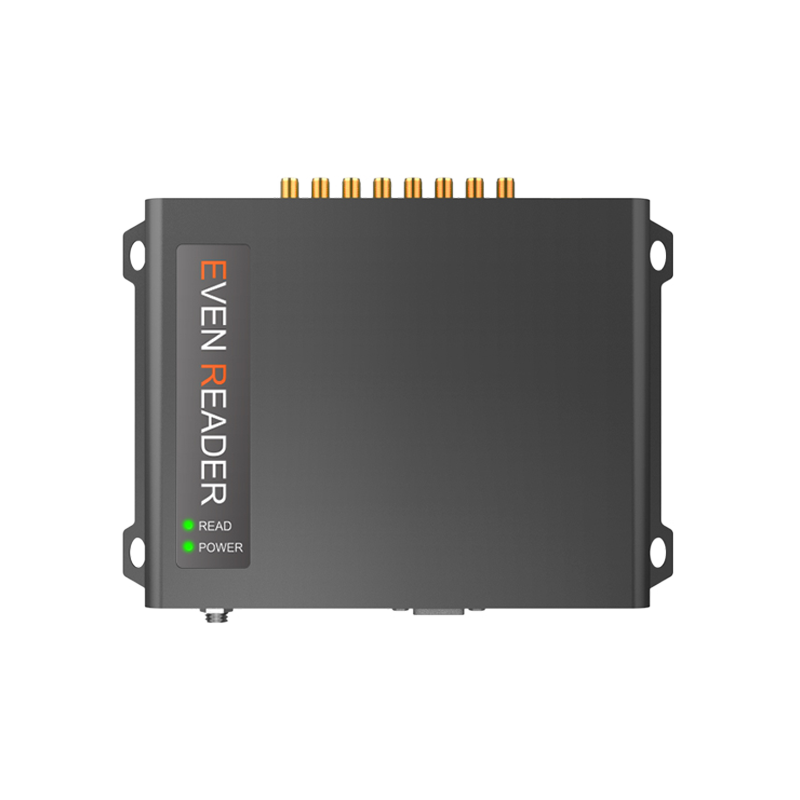
RFID Separated Reader Equiped with 8 Port Antenna
2.Core Working Principle of RFID Readers
The operation of an RFID reader involves a sophisticated wireless communication process, with its core principle based on electromagnetic induction or electromagnetic wave propagation. The entire process can be summarized as an “interrogation-response” mode, primarily divided into the following steps:
Step 1: Transmitting RF Energy to Activate Tags
The reader continuously emits radio-frequency electromagnetic waves at specific frequencies (e.g., low-frequency 125 kHz, high-frequency 13.56 MHz, ultra-high-frequency 860-960 MHz) through its internal antenna, creating an effective “interrogation zone.”
For passive tags: When the tag antenna enters this electromagnetic field, electromagnetic induction generates a weak current that momentarily powers the tag chip, “waking” it up. This is the most remarkable aspect of passive RFID technology—wireless power delivery.
For active tags: These tags have their own power source and remain in a sleep or low-power listening state. They activate and prepare to respond only when they receive specific command signals from the reader.
Step 2: Establish Communication, Send Commands
After activation, the reader transmits a series of digital commands modulated onto the RF carrier to the tag. These commands may include: “Who are you? (Read ID)”, “What data do you store? (Read Memory)”, “Please rewrite data to X (Write Data)”, etc.
Communication relies on complex encoding and modulation techniques (such as ASK, PSK, FSK, etc.) to ensure accurate transmission of commands.
Step 3: Tag Response, Back Scatter
Upon receiving the reader’s commands, the tag’s chip begins executing the corresponding operations.
The ingenuity of passive tags: They cannot actively transmit strong signals like a walkie-talkie. Instead, they “reflect” the electromagnetic waves emitted by the reader by intelligently controlling the impedance matching between their antenna and chip. By systematically varying the reflection intensity (i.e., backscatter), they “encode” their stored data information into this faint reflected signal. It’s akin to reflecting sunlight with a mirror and sending Morse code by tilting the mirror.
Active tags: These can directly utilize their own energy to actively transmit radio frequency signals carrying data via their antennas.
Step 4: Signal Reception and Decoding
The reader’s antenna not only transmits but also continuously receives. It captures the extremely faint modulated signal reflected back (or actively transmitted) by the tag.
The reader’s internal RF receiver module and digital signal processor amplify, filter, and demodulate this signal. They strip away the high-frequency carrier wave to recover the original digital data stream transmitted by the tag.
Step 5: Data Processing and Transmission
The decoded data (e.g., “Item ID: 123456789”) is transmitted to the reader’s microprocessor. The reader may perform preliminary checks (such as CRC verification) and formatting before uploading the data to the backend computer system via its communication interface (e.g., USB, Ethernet, RS232, Wi-Fi), completing the full reading process.

RFID Tag Reader Android System with 8 Port Antenna
3. Internal Architecture of an RFID Reader
A typical RFID reader usually comprises the following core modules:
RF Module:
Transmitter: Generates a high-frequency carrier wave and modulates it with the commands to be sent.
Receiver: Receives and demodulates the weak signals from the tags.
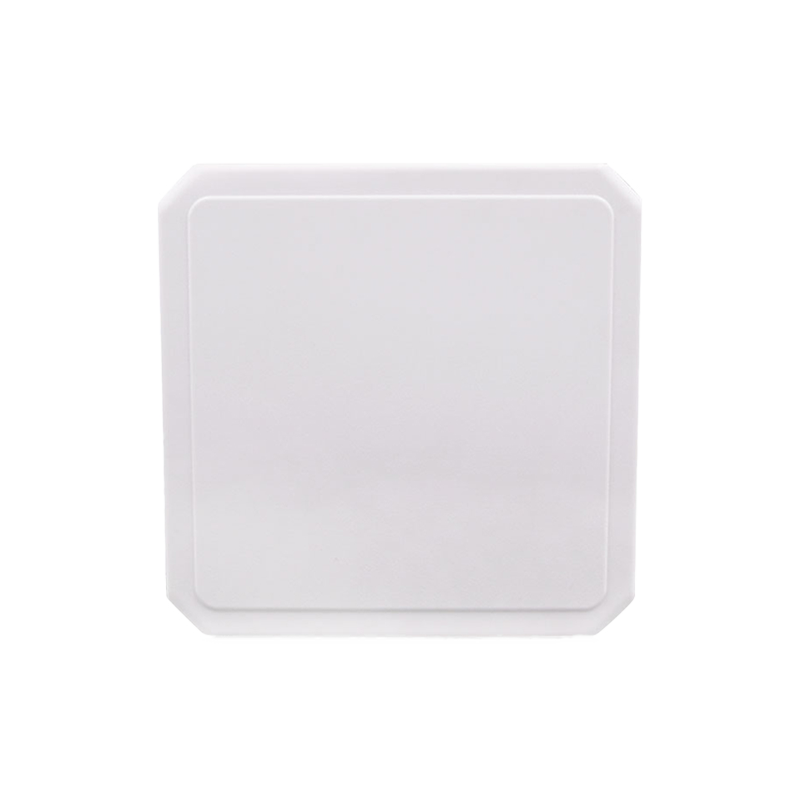
Antenna: The physical interface for energy transmission and signal reception. Its design directly determines the range and shape of the read/write area.
Processing Module:
Microprocessor/Microcontroller: The “brain” of the reader, responsible for controlling communication protocols, encoding/decoding data, executing anti-collision algorithms (ensuring orderly reading when multiple tags enter the area simultaneously), and communicating with the host via interfaces.
Interface and Power Module:
Provides power (external or POE) and includes standard interfaces for networking and data transmission.
4.Key Technology: Anti-Collision Algorithm
In practical applications, multiple tags often enter the reader’s operational zone simultaneously. Without specialized mechanisms, their signals would interfere with each other, causing reading failures. RFID readers efficiently and rapidly identify all tags sequentially by executing anti-collision algorithms (such as the ALOHA protocol or binary tree search protocol). This process resembles a teacher asking students in a classroom to raise their hands and state their names one by one, rather than shouting simultaneously.
5. Characteristics of Different Frequency Readers
Low Frequency (LF, 125 kHz): Low reader power consumption, short communication range (<10cm), strong penetration through water and organic tissue. Commonly used in animal management and access control cards.
High Frequency (HF, 13.56 MHz): The most widely adopted standard (e.g., ISO 14443 A/B for ID cards and bank cards, ISO 15693 for library cards). Communication range typically spans 10 cm to 1 m with faster speeds, forming the foundation of NFC technology.
Ultra-high frequency (UHF, 860-960 MHz): Features high reader transmission power and extended communication range (passive tags can reach tens of meters). It offers extremely fast read speeds and can process hundreds of tags simultaneously, making it the mainstream choice for retail, logistics, and asset management.
6.Conclusion
From transmitting energy to “wake up” tags, to engaging in dialogue through sophisticated backscatter mechanisms, to managing noisy “scenes” with multiple tags, the operation of RFID readers integrates the wisdom of radio engineering, digital signal processing, and computer science. It is precisely this non-contact, rapid, and bulk-identification capability that makes RFID technology the cornerstone for the Internet of Things to sense the physical world. With advances in chip technology and algorithms, future RFID readers will evolve toward greater intelligence, higher integration, and lower costs, continuing to silently yet profoundly transform our production and daily lives.