

As industries accelerate their digital transformation, the demand for reliable and efficient identification technology continues to grow. From automated production lines to intelligent warehouses, RFID technology plays an increasingly important role in improving operational efficiency, inventory visibility, and asset traceability.
An RFID Reader Module is a key hardware component that enables RFID functionality to be integrated into industrial equipment, embedded systems, handheld terminals, and Internet of Things (IoT) devices.
Compared with standalone RFID readers, embedded RFID reader modules offer greater integration flexibility, allowing equipment manufacturers and system integrators to develop customized RFID-enabled devices.
1.What Is an RFID Reader Module?
An RFID Reader Module is a compact electronic component designed to communicate with RFID tags through radio frequency signals.
It typically contains RF circuitry, signal-processing components, and communication interfaces that enable a host device to identify and exchange information with compatible RFID tags.
Depending on the operating frequency and design, RFID reader modules can support different identification applications.
For example, a UHF RFID Reader Module commonly operates in regional UHF frequency bands, such as 860–960 MHz, depending on hardware specifications and regulatory requirements.
UHF RFID technology is widely used in logistics, warehouse management, industrial asset tracking, and automated identification systems because it can support longer reading distances and multiple-tag identification.
Key Functions of RFID Reader Modules
RFID reader modules can provide several important capabilities:
- RFID tag identification and data collection
- Communication with compatible passive RFID tags
- Multiple-tag reading and anti-collision processing
- Integration with industrial controllers and embedded systems
- Communication with host devices through supported interfaces
- RFID data transmission to external software applications
These functions allow manufacturers to incorporate RFID identification capabilities into existing equipment without developing the complete RF reader hardware from scratch.
2.Why UHF RFID Reader Modules Are Important for Industrial Automation
Industrial automation requires accurate, consistent, and timely data collection.
Traditional barcode systems require optical visibility, which may limit identification efficiency in certain production and warehouse environments.
By contrast, UHF RFID technology enables compatible tags to be identified without direct line-of-sight scanning.
This makes RFID particularly useful for automated identification processes.
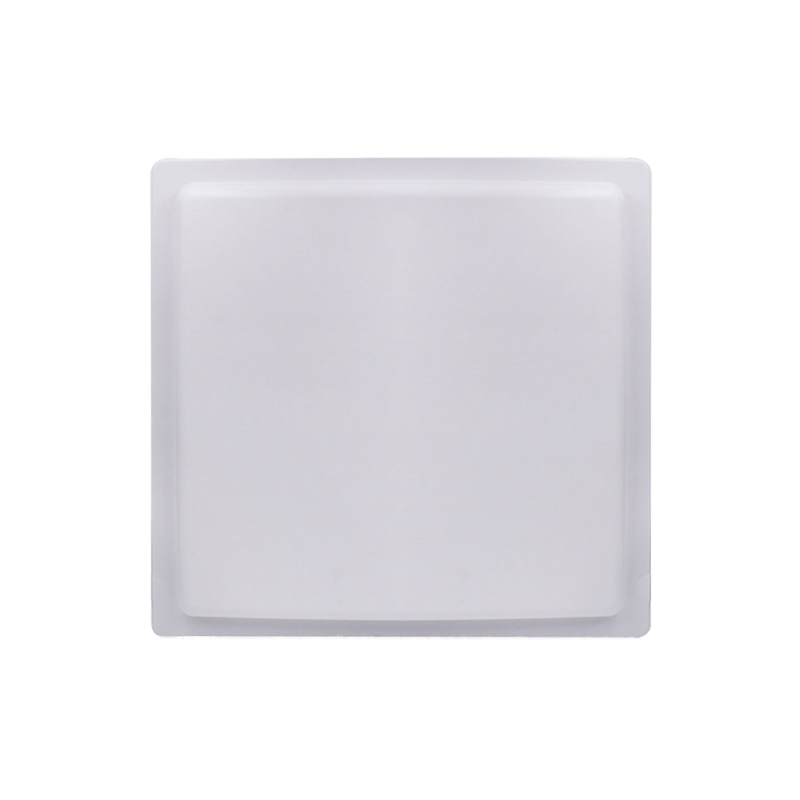
12dBi Circular Linear RFD UHF Reader Antenna
2.1Automated Production Line Tracking
Manufacturers can integrate an Industrial RFID Reader Module into production equipment to identify tagged products, components, or workpieces as they move through different manufacturing stages.
RFID identification data can be transmitted to a host controller or manufacturing execution system through the appropriate integration software.
This enables manufacturers to improve production traceability, reduce manual data entry, and support automated workflow management.
2.2Warehouse and Inventory Management
Warehouse operations often involve large quantities of products moving between storage locations, receiving areas, and shipping stations.
An Embedded RFID Reader Module can be integrated into warehouse terminals, conveyor equipment, and automated scanning devices.
When combined with suitable RFID antennas and tags, these systems can identify multiple tagged items and transmit inventory information to warehouse management software.
Potential benefits include:
- Faster inventory data collection
- Reduced manual scanning requirements
- Improved stock visibility
- More efficient receiving and dispatch processes
- Better product movement traceability
Actual performance depends on antenna configuration, tag selection, installation environment, and system design.
2.3Industrial Asset Tracking
Industrial facilities frequently need to track tools, equipment, reusable containers, and other valuable assets.
An RFID Reader Module for Asset Tracking can provide identification capabilities within customized asset management devices.
By combining RFID hardware with independently developed management software, businesses can record asset identification events and maintain more accurate asset records.
This approach is particularly valuable in manufacturing plants, logistics centers, maintenance facilities, and equipment management applications.
3.RFID Reader Modules for IoT and Embedded Systems
The expansion of Industrial IoT has increased demand for compact and flexible RFID hardware.
An RFID Reader Module for IoT enables device manufacturers to incorporate identification functions into connected equipment.
RFID modules can be integrated into:
- Smart cabinets and automated storage systems
- Industrial handheld terminals
- Automated identification stations
- Intelligent production equipment
- Self-service terminals
- Logistics tracking devices
- Customized RFID scanning equipment
Depending on the module design, integration may involve interfaces such as UART, USB, SPI, or other supported communication methods.
RFID modules do not independently provide complete IoT connectivity or cloud management. These functions must be implemented through compatible host hardware, communication networks, and software platforms.
4.How to Choose the Right RFID Reader Module
Selecting a suitable RFID reader module is essential for successful system integration.
Several technical factors should be evaluated before purchasing.
Operating Frequency
Different RFID applications require different operating frequencies.
For long-range identification and multi-tag inventory applications, UHF RFID reader modules are commonly used.
HF RFID modules operating at 13.56 MHz are often selected for applications requiring compatible HF or NFC technologies.
The reader frequency must match the intended RFID tag technology and applicable regional regulations.
Reading Performance
Reading performance depends on several factors, including RF output power, antenna gain, tag sensitivity, orientation, surrounding materials, and electromagnetic interference.
Equipment manufacturers should evaluate module performance under realistic operating conditions rather than relying only on theoretical maximum reading distances.
Communication Interface
The selected RFID Reader Module should provide an interface compatible with the host system.
Supported interfaces vary by product and may include UART, USB, SPI, or other communication options.
Module Size and Power Requirements
For embedded applications, module dimensions, power consumption, operating voltage, and heat dissipation are important design considerations.
Compact RFID modules are particularly useful when integrating RFID technology into portable or space-constrained equipment.
SDK and Integration Support
For system integrators, access to an SDK, communication protocol documentation, and development resources can simplify RFID hardware integration.
These resources help developers connect RFID modules with their own software, embedded controllers, or industrial applications.
5.RFID Reader Module vs. Complete RFID Reader
Although RFID reader modules and complete RFID readers perform similar identification functions, their designs and applications differ.
An RFID Reader Module is generally intended to be integrated into another electronic device or customized system.
A complete RFID reader typically includes additional hardware, such as an enclosure, power management components, communication ports, and application-specific interfaces.
For equipment manufacturers developing customized products, embedded RFID reader modules offer greater flexibility.
For businesses requiring ready-to-install identification hardware, complete RFID readers may be more appropriate.
The final choice depends on the application’s technical requirements, integration capabilities, and deployment environment.
Choosing a Reliable RFID Reader Module Supplier
As RFID applications expand across manufacturing, logistics, retail, and industrial IoT, selecting a reliable hardware supplier becomes increasingly important.
A suitable RFID Reader Module Manufacturer or Supplier should be able to provide consistent hardware quality, relevant technical specifications, integration documentation, and product support.
For OEM and system integration projects, hardware compatibility and development resources are especially important.
SEIKO RFID TECHNOLOGY LTD., established in 2008, specializes in RFID hardware products, including RFID tags, RFID readers, antennas, and related identification equipment.
We support customers developing RFID applications across industrial automation, warehouse management, asset tracking, and other identification environments.
Our focus is on supplying RFID hardware and supporting integration through available SDKs and communication protocols. Customers and system integrators can develop their own software platforms according to their application requirements.
6.Conclusion
The RFID Reader Module is an essential building block for modern RFID-enabled equipment.
From industrial automation and warehouse tracking to embedded IoT devices, RFID modules provide flexible identification capabilities for a wide range of applications.
As businesses seek more efficient data collection and greater operational visibility, demand for embedded RFID reader technology is expected to remain an important part of industrial digitalization.
For equipment manufacturers, OEM developers, and system integrators, choosing the right RFID reader module can help simplify hardware integration and support the development of reliable RFID identification systems.
Looking for an RFID Reader Module for your next project?
Contact SEIKO RFID TECHNOLOGY LTD. to discuss your RFID hardware requirements, compatible reader options, and available technical integration support.