

RFID is becoming an important technology for inventory management, logistics, manufacturing, retail, asset tracking, access control, and many other applications. But what does RFID actually mean, and how does the technology identify an object without scanning a visible barcode?
The RFID technology meaning is Radio Frequency Identification: a method of identifying and tracking objects through radio-frequency communication. An RFID system typically consists of RFID tags, RFID readers, antennas, and software that receives and manages the collected information.
Depending on the RFID frequency, tag design, reader configuration, and operating environment, the system can identify objects without direct line of sight and may read multiple tags within the same read zone. This makes RFID especially useful for operations that require faster data collection and better inventory visibility.
1.What Is the RFID Technology Meaning?
RFID stands for Radio Frequency Identification.
The name explains the basic function of the technology:
- Radio Frequency: The system uses radio waves to transmit information.
- Identification: Each RFID tag contains an identifier or other stored data that allows the attached object to be recognized.
An RFID tag can be attached to a product, carton, pallet, tool, garment, vehicle, book, access card, or industrial asset. When the tag enters a compatible reader’s RF field, it communicates with the reader. The reader then sends the collected data to the connected management system.
RFID is not a complete inventory or asset-management platform by itself. RFID tags and readers provide the hardware layer for automatic identification, while software uses the resulting data to perform functions such as inventory updates, alerts, reporting, access decisions, and movement tracking.
2.How Does RFID Technology Work?
The RFID identification process usually follows four steps:
- The RFID reader generates an RF field.
The reader sends energy and commands through one or more antennas. - The RFID tag receives the signal.
A passive tag obtains operating energy from the reader’s field, while an active tag uses its own battery. - The tag responds with stored data.
The RFID chip processes the command and transmits its identifier or other permitted information back to the reader. - The reader forwards the data.
The information is delivered to a computer, mobile device, middleware platform, or business management system through the reader’s communication interface, SDK, API, or protocol.
Actual RFID performance depends on the tag, antenna, reader power, frequency band, object material, tag orientation, installation position, and surrounding RF environment.
3.Main Components of an RFID System
RFID Tag
An RFID tag normally contains an RFID chip and an antenna. The chip stores data, while the antenna receives and transmits radio-frequency signals. The chip and antenna may be manufactured as an inlay and then converted into an adhesive label, card, hard tag, laundry tag, on-metal tag, or another finished product.
RFID Reader
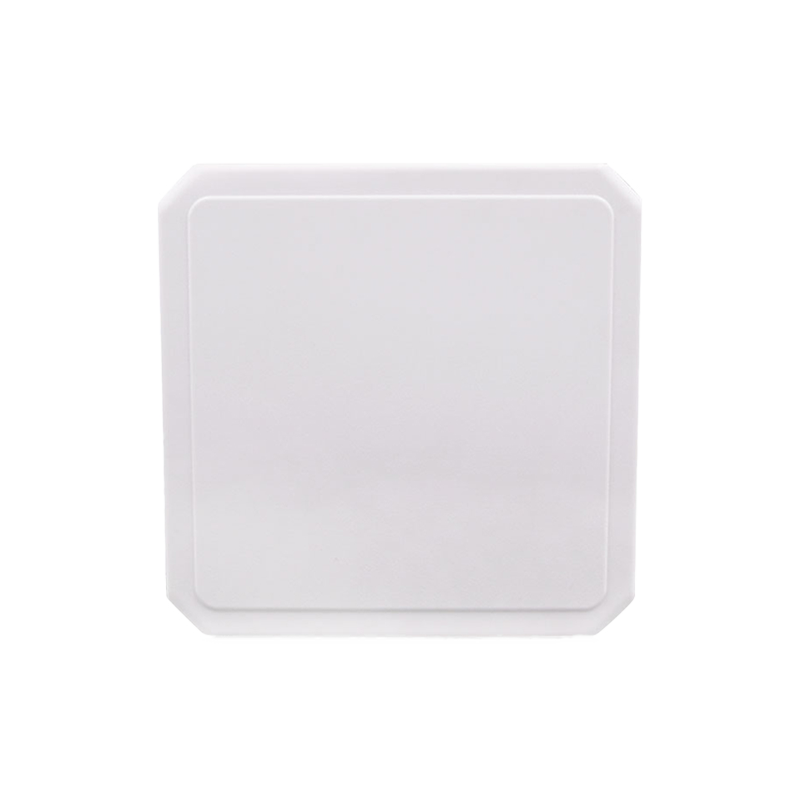
The RFID reader controls communication with the tags and transfers the captured information to the software system. Reader formats include fixed readers, integrated readers, handheld terminals, desktop readers, and RFID gate devices.
RFID Antenna
The antenna creates the read zone between the reader and tag. Antenna gain, polarization, beam direction, installation angle, and cable loss can all affect reading performance.
Software and Database
Software interprets and manages the tag data. It may connect RFID hardware to an ERP, WMS, MES, inventory platform, access-control system, or a customized application developed by a system integrator.
4.Active, Passive, and Semi-Passive RFID Tags
RFID tags can be grouped according to their power source.
Passive RFID Tags
Passive tags do not contain an internal battery. They receive energy from the RFID reader’s RF field. They are widely used for product labeling, retail inventory, logistics, access cards, libraries, laundry management, and asset identification.
Active RFID Tags
Active tags contain a battery and can support longer-range communication or periodic signal transmission. They are often used for tracking vehicles, containers, large assets, or equipment where greater range and continuous monitoring may be required.
Battery-Assisted Passive Tags
Battery-assisted passive tags contain a battery that powers the chip or sensor, but they usually communicate in response to a reader. They may be selected for specialized sensing or monitoring applications.
RFID Frequency Types
Understanding the RFID technology meaning also requires knowing that RFID operates across different frequency ranges.
Low Frequency RFID
LF RFID commonly operates around 125 kHz or 134.2 kHz. It is often used for animal identification, basic access control, and short-range identification. LF generally offers a shorter reading distance but can perform reliably in certain challenging environments.
High Frequency RFID and NFC
HF RFID normally operates at 13.56 MHz. Common applications include access cards, library systems, ticketing, product authentication, and close-range identification. NFC is based on HF technology and is used for compatible smartphone interactions and short-range data exchange.
Ultra-High Frequency RFID
UHF RFID systems operate in regional frequency bands commonly found within approximately 860–960 MHz. UHF is widely used for retail inventory, warehouse management, logistics, manufacturing, and asset tracking because it can provide longer read ranges and efficient multiple-tag identification.
The correct frequency must be selected according to the application, local regulations, target material, required reading distance, and existing reader compatibility.
5.Common RFID Technology Applications
RFID hardware is used in many industries, including:
- Retail and apparel: Item-level inventory, stock counting, replenishment, and order fulfillment
- Warehousing and logistics: Carton, pallet, and shipment identification at receiving and dispatch points
- Manufacturing: Work-in-process tracking, material identification, and tool or mold management
- Asset management: Identification of computers, equipment, furniture, and fixed assets
- Healthcare: Medical equipment, supply, textile, and asset management
- Industrial laundry: Identification and circulation management of uniforms, towels, and linens
- Libraries: Book circulation, self-service borrowing, returns, and shelf inventory
- Access control: RFID cards, key fobs, and wristbands for identity verification
- Livestock management: Electronic animal identification using ear tags or transponders
- Vehicle management: Parking access, fleet identification, and controlled vehicle entry
Each application requires a suitable combination of tag type, chip, antenna, reader, and installation method.
6.RFID vs. Barcode: What Is the Difference?
RFID and barcodes both help identify objects, but they work differently. A barcode scanner generally needs to see and align with the printed code, and items are usually scanned individually. RFID uses radio waves, so direct visual alignment is normally unnecessary. Some RFID systems can also identify multiple tags within a defined read zone.
However, RFID is not automatically the better choice for every project. Barcodes are simple and economical, while RFID can offer advantages when businesses need faster counting, reusable identification, automation, or improved visibility. The best option depends on the required workflow, budget, environment, and integration needs.
7.How to Choose the Right RFID Hardware
Before choosing RFID tags or readers, confirm the following requirements:
- What object will be tagged?
- Is the attachment surface paper, plastic, glass, metal, textile, or another material?
- What read distance is required?
- Will one tag or multiple tags be read at the same time?
- Which regional operating frequency is required?
- How much EPC or user memory is needed?
- Will the product face water, chemicals, heat, pressure, impact, or repeated washing?
- Is a fixed reader, handheld reader, desktop reader, or RFID gate required?
- Which communication interface, SDK, API, or protocol must connect with the software?
Testing the proposed hardware on the actual object and in the real operating environment is strongly recommended before mass production or large-scale deployment.
8.Conclusion
In simple terms, the RFID technology meaning is the use of radio-frequency communication to identify and track tagged objects. RFID tags store identification data, readers capture that data, antennas establish the read zone, and software turns the collected information into useful business records.
From retail inventory and warehouse logistics to industrial production, laundry, libraries, healthcare, livestock, and vehicle management, RFID can provide a faster and more automated method of data collection.
SEIKO RFID TECHNOLOGY LTD. supplies RFID hardware, including LF, HF, and UHF RFID tags and inlays, industrial and on-metal tags, laundry tags, RFID cards, antennas, handheld readers, fixed readers, and RFID gate equipment. SDKs, APIs, and communication protocols are available to support system integrators with secondary development. Contact us with your application, tag size, quantity, surface material, required read distance, and operating environment so that we can recommend suitable RFID hardware for testing.
9.Frequently Asked Questions
What does RFID mean?
RFID means Radio Frequency Identification. It uses radio waves to identify and exchange data with RFID tags attached to objects.
What information can an RFID tag store?
Depending on the chip, an RFID tag may contain a unique identifier, EPC data, TID information, user memory, or other application-specific data.
Can RFID tags be read through objects?
RFID normally does not require direct line of sight, but metal, liquids, the human body, dense products, and tag orientation may affect signal performance.
Does a passive RFID tag need a battery?
No. A passive RFID tag obtains the energy needed for operation from the RF field generated by a compatible reader.
What is the typical RFID reading distance?
There is no universal reading distance. It varies according to frequency, tag size, chip sensitivity, antenna design, reader power, tagged material, orientation, and environmental conditions.
Internal Link Suggestions
- Link RFID tags and readers to the main RFID hardware category.
- Link passive RFID tags to a related educational article or product category.
- Link UHF RFID systems to the UHF RFID inlay or label page.
- Link on-metal RFID tags to the anti-metal tag category.
- Link RFID frequency types to the existing frequency guide.
- Link RFID technology applications to the “Radio Frequency Identification Examples” article.
Publishing Checklist
- Use the article title as the only H1 on the page.
- Add the primary keyword to the SEO title, META description, URL, introduction, one subheading, and conclusion.
- Add two to four relevant internal links using descriptive anchor text.
- Use one original feature image without text, logos, or watermarks.
- Compress the image and use WebP where supported.
- Add the recommended ALT text or a more accurate description of the final image.
- Add a clear inquiry button linking to the contact page.
- Use Article and FAQ structured data only when the marked-up content is visible on the page.
- Add the published page to the XML sitemap and submit it through Google Search Console.