

In an era where large-scale events demand seamless entry solutions and robust anti-counterfeiting measures, RFID tickets have emerged as a game-changing technology. By embedding ultra-high-frequency (UHF) RFID chips into tickets or wristbands, organizers can enable contactless access, real-time attendance tracking, and dynamic data management—all while eliminating fraud risks associated with traditional paper tickets.

In today’s society where various forms of public exchanges such as exhibitions, conferences, performances and sports events are becoming more and more frequent, exhibitions have even developed into a new industry. The participants of these public activities are numerous and relatively complex, which brings a great test to the staff of the exhibition, performance organizers and venue management, as well as their activity management and security prevention. At present, the vast majority of performances, exhibitions or events using manual ticket inspection. For some major (important) exhibitions and conferences, performances, sports events, the traditional ticket issuance and management mainly has the following problems: driven by interests, the market is increasingly rampant with counterfeit and shoddy products. These fake and shoddy products not only damage the normal market order, but also threaten people’s life safety. Due to the relative lag of anti-counterfeiting technology, many products are not effectively regulated.
The more widely used anti-counterfeiting technologies in the market include paper watermarking technology, ink technology, laser hologram anti-counterfeiting technology, barcode technology and telephone code technology applications, etc. These anti-counterfeiting technologies have been quite mature. These anti-counterfeiting technologies are already quite mature, and the price of anti-counterfeiting equipment is low, which is conducive to the promotion of anti-counterfeiting technology in a wide range, but because the cost of forgery is equally low, the anti-counterfeiting effect is not good. Traditional anti-counterfeiting technology has the following problems:
- Low technological content, easy to be imitated, for example, after a new visual anti-counterfeiting mark is on the market, a large number of imitations usually appear after 3~6 months;
- Anti-counterfeiting labels are not stain-resistant, and the cost of counterfeiting is also low.
- Anti-counterfeiting labels are not stain-resistant, once stained, they cannot be recognized.
- The use of telephone code anti-counterfeiting, as long as the correct anti-counterfeiting number is forged, the anti-counterfeiting telephone system can be fooled.
The current anti-counterfeiting technology is easy to be imitated, seriously disrupting the legitimate market competition mechanism, to the regular exhibitors and consumers have brought great losses, the market urgently needs high technology content, can effectively monitor the market anti-counterfeiting technology and products. And RFID technology precisely has the advantages in this regard, it can effectively improve the product supply chain, to solve the problem of product counterfeiting.
RFID is an automatic identification technology that emerged from the 1990s and gradually matured, which utilizes radio frequency for non-contact two-way communication. Because rfid exhibition ticket system need to utilize special equipment, counterfeiters imitation, copy is almost impossible.
1. RFID technology features and advantages
RFID is an easy to manipulate, simple and practical and especially suitable for automation control of the flexibility of the application of technology, identification work without human intervention, it can support read-only mode of operation can also support the read-write mode of operation, and do not need to contact or aiming; free to work in a variety of harsh environments: short-range RF products are not afraid of grease, dust contamination and other harsh environments, can be used for barcode, such as the use of long-time workers and the use of RFID. Substitute bar code, for example, with long assembly line tracking things; long-distance range radio frequency products are mostly used in transportation, recognition distance up to dozens of meters, such as automatic charging or identification of vehicle identity. The unique superiority it has is incomparable to other recognition technology. There are mainly the following aspects:
1) read convenient and fast: the reading of data without light source, and even through the outer packaging to carry out. Effective recognition distance is longer, the use of active tags with batteries, the effective recognition distance can reach more than 30 meters.
2) recognition speed: the label has entered the magnetic field, the reader can instantly read the information, and can simultaneously deal with multiple tags to achieve batch identification; 3) large data capacity: the data can be read without a light source, and even through the outer packaging.
3) large data capacity: data usage of the largest two-dimensional bar (PDF417), up to 2725 numbers can only be stored; if the letters are included, the amount of storage will be less; RFID tags can be based on the user’s needs Xieng Khouang to dozens of K; 4) long service life, application, and can be used in the field of magnetic field, the reader can instantly read the information contained therein, and can handle multiple tags at the same time to achieve batch identification.
4) long service life, wide range of applications: its wireless communication, so that it can be applied to dust, oil and other highly polluted environments and radioactive environments, and its closed packaging makes its life greatly exceeds the printed bar code;.
5) label data can be dynamically changed: the use of programmers can write data to the electronic label, thus giving RFID tags interactive portable data files, and write time is shorter than typing bar codes;.
6) better security: RFID tags can not only be submerged or attached to different shapes, types of products, and can be set up for the tag data read and write password protection, thus having a higher level of security;.
7) Dynamic real-time communication: the tag to 50 ~ 100 times per second frequency of communication with the reader, so as long as the object attached to the RFID tag appears in the effective identification of the decoder within the scope of the location can be dynamic tracking and monitoring.
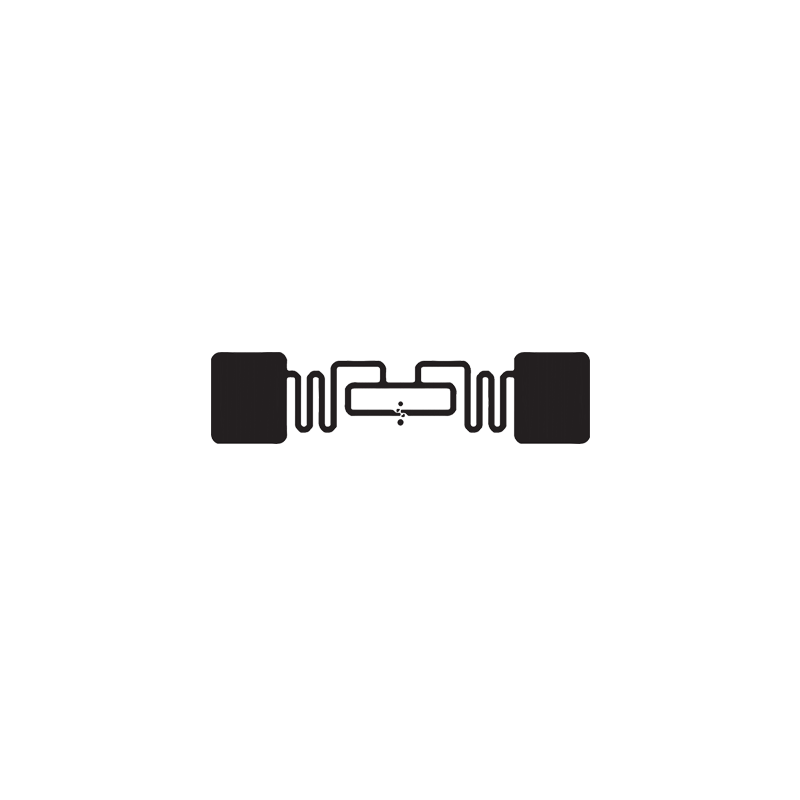
Alien ALN-9662 Short RFID White WET Inlay – High-Performance UHF RFID for Asset Tracking
2. RFID intelligent ticket management system design
network connection using LAN form, has the following characteristics: connection simplicity; LAN configuration is simple, no specialized network equipment, and then the data communication between the host; security; the entire system does not connect with the outside world how the network to ensure the security and reliability of data transmission; LAN technology is mature, in the case of normal operation of the equipment is very little data loss, high stability; for the LAN connection mode, the system architecture can be used in a client/server mode: the central server stores all the business information data, at any time for the terminal equipment to provide a variety of data required for business operations. Data loss occurs under normal operation of the equipment, high stability; for the LAN connection, the system architecture can be used in a client/server mode: the central server stores all the business information data, and provides all kinds of data required for business operations for each terminal device at any time; each terminal provides users with various types of business operations in the foreground, in addition to completing the function of data display and sending requests, while also being responsible for the realization of simple business and all the local applications, such as device control, data management, data management, and so on. Local applications, such as equipment control, packet format conversion, data buffering, data management, software registration and system management, etc.; the central server to undertake the main core business applications, such as ticket sales authorization, equipment access verification and report data generation staff management.

RFID Handheld Reader
3. Main features of the system
The system adopts modern scientific management, and makes scientific and objective comparative analysis of domestic and foreign admission and ticketing systems, so as to realize the scientific and intelligent management of Xinjia Network Pavilion from ticketing, ticketing to ticketing and so on by means of advanced and optimal solutions and reasonable investment. On the basis of known conditions, the system has 3 automatic ticket gate 3, 2 ticket windows, which can realize: automatic ticket checking and entry/exit control; instantaneous flow through the ticket gate; centralized management, distributed control; eliminate economic losses caused by forged tickets; standardize the procedures of selling and checking the tickets, eliminate the drawbacks of manual checking of tickets, and increase the level of management and work efficiency; automatically generate a variety of reports to provide a sound basis for passenger flow, capital and financial analysis. It can automatically generate various reports and provide a perfect basis for passenger flow, capital and financial analysis; fast and accurate statistics and real-time query of tickets and audience flow.
4. The main modules of the backstage system and their functions
Ticket in/out privilege verification. With real-time verification of ticket rights; automatic control of equipment switching; automatic control of switching devices according to the verification results; manual management of equipment switching; provide manual control of switching devices, in order to facilitate the handling of special situations; equipment status monitoring and detection; provide regular detection and status monitoring of directly connected switching devices, and regularly update the status of the equipment to the central server, in order to facilitate centralized monitoring and control of the system management. Various device management; users can define, add, modify, delete various devices (including ticket reading devices, switching devices, control devices) as needed; doorway access records. Real-time generation of doorway entry event records.
5. Data communication module
equipment communication data formatting; support for different types of switching equipment data communication protocols, data format can be defined by the user, the format information saved by the central database; to provide access control equipment switching control function, the status of the display function. According to the authority management to control the use of personnel, the sales terminal business includes: general ticketing, group ticketing, refunds, replenishment, reprinting, etc. The sales staff can choose the type of tickets to sell and the way of discounts. Ticket types include disposable tickets and multiple-use tickets or sets of tickets using RFID cards; automatic calculation of the amount receivable according to the type of ticket, discount method; team ticket sales and team sales quantity confirmation; ticket sellers can automatically count the amount of sales on the shift before the end of the work, in order to carry out the handover; record the use of the ticket ticket number, to prevent the loss of the ticket.