

The widespread application of RFID technology stems from its rich product forms, diverse RFID types, and flexible frequency band selection. The differences in environmental adaptability, recognition distance, and functional requirements in different scenarios have given rise to multiple types of products divided by product form (embedded, hard tags, etc.) and operating frequency bands (LF, HF, UHF). Understanding the core features and adaptation logic of these products is the key to achieving ‘technology matching requirements’.
1.Divide the “physical carrier” of adaptation scenarios according to product form
RFID products can be divided into four categories based on their form: embedded, hard tags, dual frequency tags, and sensor tags. Each category of product precisely meets the environmental and functional requirements of different industries through differences in packaging processes and functional integration.
1.1 Inlays and Universal Labels/Tags: Basic Data Carriers
Embedded and universal tags are the most basic product forms of RFID, with the core function of “storing ID data+achieving wireless communication”. The difference between the two lies in the degree of packaging:
1.2 Inlays
Refers to the “bare core combination” that has not been finally packaged, consisting of a microchip, antenna (usually copper foil or aluminum foil), and substrate (such as PET film), without an outer protective shell. Its advantages are light and thin size, extremely low cost, mainly used in industrial grade scenarios – for example, label manufacturers purchase embedded bodies and perform secondary packaging according to customer needs (such as making tags and cards); Or directly embedded within the product (such as the chip layer of ID cards, bank cards, and the sensing module of car keys).

ALN-9962 Short Higgs 9 Clear Wet Inlay
1.3 Universal Labels/Tags
Finished products packaged on the basis of embedded materials can be divided into paper labels, plastic labels, etc. according to the packaging material, which are the most common RFID products. Paper labels are low-cost and suitable for disposable scenarios such as retail clothing tags and express waybills; Plastic labels have certain waterproof properties and can be used for storing goods, books, and other scenarios that require short-term reuse.
This type of product covers the full frequency range of UHF, HF, and NFC, with the core characteristics of “low cost and standardization”. It is suitable for large-scale identification scenarios without special environmental requirements, such as retail inventory management, book borrowing, identity recognition, etc.

China RFID UHF UCODE 9 Label Manufactuer
2.1 Core Features and Advantages
2.1.1 Strong environmental tolerance
The protection level usually reaches IP65 (dustproof, anti low pressure water spray) to IP68 (completely waterproof, can be soaked), and some industrial grade hard labels can withstand extreme temperatures of -40 ℃ to 125 ℃, as well as chemical corrosion such as strong acids and oil stains;
2.1.2 Customizable functions
Can integrate anti metal layer (with built-in ferrite absorbing material), directly attached to metal surfaces (such as mechanical equipment, automotive components); Some models support high temperature resistance (such as workpiece tracking in paint workshops, which can withstand temperatures above 200 ℃);
2.1.3 Long lifespan
The packaging material is anti-aging and anti physical impact, with a service life of 5-10 years, suitable for the full life cycle tracking of high-value assets.
2.2 Typical Application Scenarios
2.2.1 Industrial Manufacturing
Metal components on the production line are labeled with anti metal hard tags, which can still be stably identified during welding, painting, and other processes, achieving traceability of the production process;
2.2.2 Medical and Health Care
The sterile hard label on surgical instruments can withstand high temperature sterilization (such as 134 ℃ high-pressure steam sterilization), record the disinfection frequency and usage trajectory of the instruments;
2.2.3 Outdoor Assets
Hard labels are used for power inspection poles and communication base stations to withstand wind, rain, and ultraviolet radiation, enabling remote inventory of outdoor assets.
Hard tags cover all frequency bands of LF, HF, and UHF, with UHF hard tags being the most widely used in industrial and logistics scenarios due to their long reading distance; LF hard tags are commonly used in scenarios such as car keys and animal ear tags due to their strong anti-interference ability.
3.Dual Frequency Tags: Flexible Adaptors Across Scenarios
The dual band tag has built-in antennas and chips for two frequency bands (commonly combined as “LF+HF” or “HF+UHF”), which can automatically switch the operating frequency band according to the reader type. It also has the technical advantages of two frequency bands, solving the limitations of a single frequency band in cross scenario applications.
3.1 Core Features and Advantages
3.1.1 Flexible frequency band switching
Without manual intervention, the tag can automatically recognize the frequency band of surrounding readers and adapt to communication – for example, the “HF+UHF” dual band tag can achieve remote batch inventory through UHF readers in the warehouse, and achieve close range payment or product information query through HF/NFC readers at the store cashier;
3.1.2 Full Link Coverage
Adapt to the needs of multiple stages from production to consumption, avoiding the cost of changing labels across different scenarios. For example, in luxury goods management, factories use UHF for fast sorting, stores use NFC for customers to check authenticity, logistics use UHF for tracking and transportation, and there is no need to change labels throughout the process;
3.1.3 Strong compatibility
It can be integrated with existing RFID systems in different frequency bands of enterprises to reduce system upgrade costs – for example, a retail enterprise has both HF access control system and UHF inventory system, and dual band tags can be adapted to two sets of equipment at the same time.
3.2 Typical Application Scenarios
3.2.1 Full chain management of luxury goods
From production, logistics to store sales, seamless integration of “remote sorting+close interaction” is achieved through dual frequency tags;
3.2.2 Cross regional tracking of medical equipment
The hospital warehouse uses UHF to inventory large equipment, and the department uses HF to confirm the location of equipment up close, achieving unified management of assets throughout the hospital;
3.2.3 Smart Retail
The goods are stored in bulk through UHF in the warehouse, interacted with smart shelves through HF/NFC on the shelves, and settled quickly through NFC at the checkout counter.
4.Sensor Tags: “Intelligent Terminal” for Environmental Monitoring
Sensor tags are composite products that integrate environmental sensors such as temperature, humidity, vibration, lighting, and pressure sensors. They can not only recognize objects, but also collect and store environmental data in real time. They upgrade RFID’s “identity recognition” function to “status monitoring” function and are suitable for scenarios that are sensitive to environmental conditions.
4.1 Core Features and Advantages
4.1.1 Data Collection Automation
The sensor can automatically collect data at a preset frequency (such as every 5 minutes, every hour) and store it in the EEPROM memory of the tag (usually with a capacity of several KB to tens of KB), without the need for manual recording;
Real time warning capability
Some active sensor tags can actively send warning signals to the reader when the data exceeds the standard (such as temperature exceeding 25 ℃), achieving immediate intervention of risks;
4.1.2 Full cycle traceability
The stored historical data can be read by a reader to achieve full traceability of environmental conditions – for example, in cold chain cargo transportation, the temperature curve from outbound to inbound can be replayed.
4.2 Typical Application Scenarios
4.2.1 Cold chain logistics
Temperature sensor labels are used for fresh food and drug transportation to record real-time temperature changes during transportation, ensuring compliance with cold chain standards (such as maintaining 2-8 ℃ for drugs);
4.2.2 High Value Asset Monitoring
The servers in the data center are equipped with vibration sensor tags to monitor the amplitude of vibration during equipment operation and alert hardware failures; Museum artifacts are labeled with temperature and humidity sensors to monitor the environment inside display cabinets, protecting them from moisture and exposure to sunlight;
4.2.3 Logistics Loss Prevention
Fragile items (such as glass and precision instruments) are labeled with impact sensors to record the impact force during transportation and determine whether the goods have been damaged due to collision.
Sensor tags are mainly active and semi passive (requiring battery power for the sensor), and the frequency bands are mostly UHF (suitable for long-distance data reading) and HF (suitable for close range precision acquisition).
5.Divide passive RFID into “performance cores” by frequency band
Passive RFID tags can be divided into three categories based on their operating frequency bands: low frequency (LF), high frequency (HF/NFC), and ultra-high frequency (UHF). The frequency band directly determines the tag’s reading distance, anti-interference ability, data rate, and cost, and is the core basis for product selection. The core differences among the three are shown in the following table and detailed breakdown:


5.1 Low frequency (LF) RFID tags with strong anti-interference capabilities as “close range experts”
Embedded and universal tags are the most basic product forms of RFID, with the core function of “storing ID data+achieving wireless communication”. The difference between the two lies in the degree of packaging:
5.1.1 Typical application scenarios
Animal Recognition
Ear tags or subcutaneous implantable tags for pets and livestock, which can penetrate hair and skin to achieve animal identity tracing and health management;
Car access control
The car key is equipped with an LF tag, which can be recognized by the vehicle reader even when the key is in the pocket and close to the door, achieving keyless entry;
industrial equipment
Equipment with metal casing is labeled with LF tags, which can be attached to the metal surface and read stably, achieving maintenance record traceability of the equipment.
5.2 Flexible “mid-range selection” for high-frequency (HF/NFC) RFID tag interaction
HF tags work in the 13.56MHz frequency band and are also based on electromagnetic induction principles. They have a slightly farther reading distance (decimeter level) than LF, higher data rates, and support parallel recognition of multiple tags (10-20 tags can be recognized at once). Among them, NFC (Near Field Communication) is a subset of HF, with a shorter reading distance (usually ≤ 10 centimeters), but supports bidirectional data interaction (such as writing information when a phone is close to a tag), suitable for close range interaction scenarios.
HF tags can penetrate non-metallic obstacles such as paper and plastic, have strong resistance to liquid interference, but are still sensitive to metals (requiring special anti metal packaging). The cost is at a medium to low level, suitable for medium batch and medium distance recognition scenarios.
5.2.1 Typical Application Scenarios
Retail and Consumer Electronics
Clothing tags and HF labels for cosmetic packaging enable quick inventory in stores; NFC tags are used for electronic products such as mobile phones and computers to enable consumers to verify authenticity and user manuals;
identity recognition
The ID card, campus one card, and access card are mostly HF/NFC tags, supporting close range card swiping verification;
Books and Archives
The book back cover is labeled with HF tags, and the library can achieve batch borrowing and returning. The filing cabinet can locate and inventory files.
5.3 High frequency (UHF) RFID tags are the “main force” for efficient identification at long distances
UHF tags work in the 860-960MHz frequency band and use the principle of backscatter. Their core advantages are long reading distance, fast speed, and low cost – the reading distance can reach 1-20 meters, the data rate is more than 10 times that of HF, and they support the recognition of 50-100 tags at once. Moreover, when purchasing in large quantities, the cost of a single tag can be as low as a few cents, making them the mainstream choice for large-scale scenarios such as logistics and warehousing.
But its disadvantage is weak anti-interference ability: metal will reflect UHF signals, liquid will absorb signals, resulting in reading failure, so it needs to be equipped with anti metal packaging or avoid metal/liquid dense environments.
5.3.1 Typical application scenarios
Supply Chain and Logistics
UHF tags are used for containers and freight pallets, and fixed readers in ports and logistics parks can be used for remote batch recognition, achieving automatic entry and exit of goods;
Warehouse Management
The goods on the warehouse shelves are tagged with UHF tags, and handheld readers can achieve “scanning while walking”, greatly improving inventory efficiency;
Retail scale application
Large supermarkets and fast-moving consumer goods brands can use UHF tags to complete inventory of 10000 items in the entire warehouse within 2 hours.
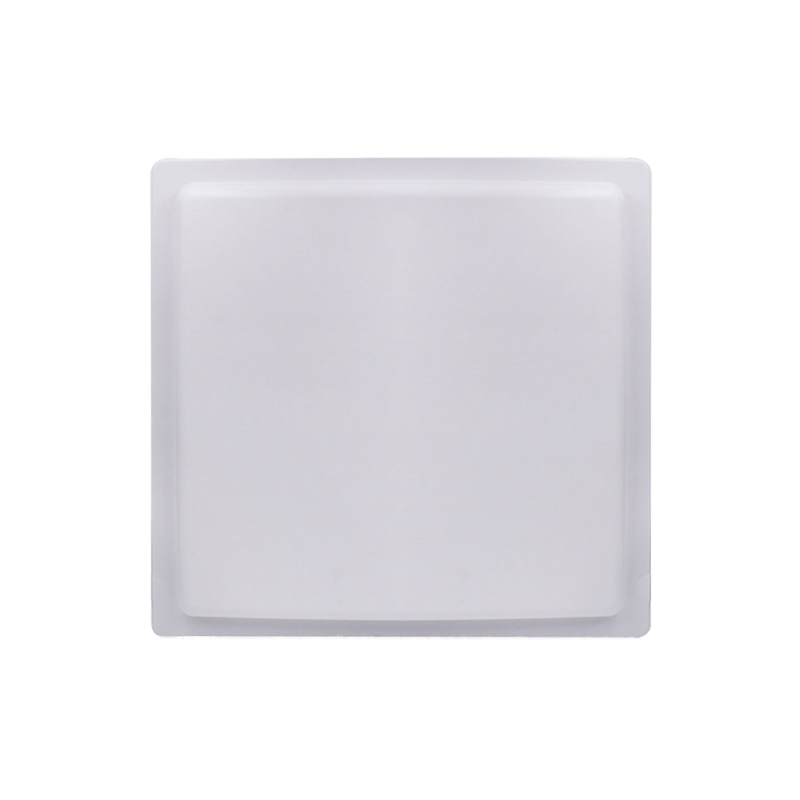
12dBi Circular Linear RFD UHF Reader Antenna
6.Product selection logic from “requirement” to “matching”
The selection of RFID products should revolve around the core of “scenario requirements” and comprehensively consider the following four dimensions:
six point one
environmental conditions
If it is in harsh environments such as industrial, outdoor, medical, etc., hard labels are preferred; If it is a regular retail or office scenario, select a universal label or inlay.
6.2 Identification distance
Select LF, HF/NFC for close range (≤ 1 meter); Select UHF for medium to long distances (1-20 meters); Cross scene needs to consider both distance and proximity, choose dual band tags.
6.3 Functional Requirements
Only identity recognition is required, select the basic label; Monitor environmental data such as temperature and vibration, and select sensor labels.
6.4 Cost Budget
Select UHF universal tags for large-scale scenarios (such as retail goods); Small batch, high-value scenarios (such as medical equipment) can accept the higher cost of hard tags and dual band tags.
For example, in cold chain logistics scenarios that require “remote identification+temperature monitoring+low temperature resistance”, UHF active sensor hard tags should be selected; Library book management requires “medium distance batch identification+wear resistance”, and HF universal plastic labels should be selected; The full chain management of luxury goods requires “remote sorting+close interaction”, and HF+UHF dual band tags should be selected.

7.Summary
The diversity of RFID products is the core reason for their adaptability to various industries – divided by form, from basic embedded and universal tags to reinforced hard tags, composite dual frequency and sensor tags, covering the entire scene environment from ordinary to extreme; Divided by frequency band, LF’s anti-interference, HF’s flexible interaction, and UHF’s efficient long-distance constitute a clear performance gradient selection spectrum.
The essence of selection is “precise matching of requirements and performance”: there is no need to pursue “the most complete functionality” or “the farthest distance”, but to combine the four elements of environment, distance, functionality, and cost to find the most suitable product type for business needs, in order to maximize the cost reduction and efficiency value of RFID technology.