

In modern warehouse management, the inbound and outbound process, as the core node of material circulation, directly determines the efficiency and accuracy of warehouse operation, impacting costs, customer satisfaction, and overall supply chain response speed. The traditional management model, which relies on manual scanning and paper ledgers, is plagued by pain points such as lagging data entry, high inventory error rates (typically ≥ 3%), difficulty in document tracing, and soaring labor costs. This model struggles to meet the demanding requirements of industries like e-commerce and manufacturing, which necessitate “high-frequency inbound/outbound, massive SKU management, and precise traceability.”
This proposal is built upon the core advantages of RFID Warehouse solutions. Leveraging RFID (Radio Frequency Identification) technology—including non-contact identification, batch reading of multiple tags, and robust information traceability—we construct a comprehensive, intelligent inbound and outbound management system. This system is founded on the triad of “Hardware Perception + Software Management + Data Empowerment,” ultimately achieving the operational goals of Fast Inbound, Accurate Outbound, Complete Traceability, and Intelligent Management for warehouse materials.
1.Core objectives of the plan
This plan focuses on “cost reduction and efficiency improvement, precise control, and data visualization”, and deeply integrates RFID technology with warehouse management processes to achieve the following core values:
Improve the efficiency of inbound and outbound operations, achieve batch identification of multiple materials in the inbound process, and increase processing efficiency by over 60%; Accurately locate the cargo location during the outbound process, improve picking efficiency by 50%, and prevent wrong or missed shipments;
Optimize the accuracy of data and automatically collect material information, reducing the data error rate to below 0.1% and eliminating manual input errors;
The full process traceability can be controlled to achieve the full lifecycle data traceability of materials from warehousing, storage, outbound to final signing, meeting the requirements of compliance auditing;
Reduce labor costs by 80% for manual scanning and ledger entry, and reduce warehouse management labor costs by 30% to 40%;
Inventory dynamics can be visualized and synchronized in real-time with inbound and outbound data, with inventory update delays of ≤ 10 seconds. It supports inventory warning and obsolete material reminders to improve inventory turnover.
2. Core architecture of the plan
The system adopts a “layered architecture+end cloud collaboration” mode, which is divided from top to bottom into perception layer, transmission layer, platform layer, and application layer. Each layer is seamlessly connected to ensure efficient, secure, and controllable data flow throughout the entire process of inbound and outbound.

2.1 Perception layer: the “front-end entrance” for material information collection
As the core of data collection, the perception layer achieves rapid and batch collection of material information through RFID tags, reading and writing devices, and auxiliary devices, providing a data foundation for subsequent management. The core equipment configuration is as follows:
2.2 Transport Layer: The ‘High Speed Channel’ for Data Flow
- Adopting a dual-mode transmission architecture of “wired+wireless”, ensuring real-time and stable uploading of inbound and outbound data to the platform, and adapting to different warehousing network environments:
- Fixed equipment transmission: Fixed readers such as storage platforms and access doors are connected to the storage LAN via Ethernet to achieve high-speed data upload with a delay of ≤ 1 second;
- Mobile device transmission
- Handheld terminals transmit data through Wi Fi or 4G/5G, support local storage in offline mode, and automatically supplement transmission after network recovery to avoid data loss;
Data encryption uses SSL encryption protocol to encrypt transmitted data, and device access requires permission authentication to ensure data transmission security.
2.3 Platform Layer: The “Intelligent Brain” of Warehouse Management
- Building an intelligent warehouse management platform (WMS) based on cloud native architecture, integrating three core capabilities of data processing, process control, and intelligent decision-making, to achieve automated management of the entire inbound and outbound process:
- The data processing module adopts MySQL+Redis architecture, with MySQL storing structured data such as material basic information and inbound/outbound records, Redis caching real-time inventory data, and supporting millions of data second level queries;
- The process control module is equipped with standardized process engines for inbound, outbound, inventory, and traceability, and supports custom process configuration (such as adjusting the inbound verification process according to industry needs); Triggering process nodes through RFID data to achieve “automatic data flow and automatic process advancement”;
- The intelligent decision-making module is based on historical inbound and outbound data, and uses AI algorithms to analyze material turnover and peak demand periods. It outputs location optimization suggestions (such as placing high-frequency outbound materials on near export shelves) and replenishment warnings (automatic reminders when inventory falls below safety thresholds);
- The interface integration module supports integration with ERP (Enterprise Resource Planning), TMS (Transportation Management System), MES (Manufacturing Execution System) and other systems to achieve cross platform data sharing and avoid information silos.
2.4 Application Layer: “Interactive Window” for User Operations
Provide three operation entrances: computer management platform, handheld terminal APP, and mobile phone, to meet the management needs in different scenarios. The core functions cover the entire process of inbound and outbound:
- Warehouse management supports import of purchase orders, batch scanning of RFID codes for warehousing, automatic allocation of storage locations, and automatic generation of warehouse receipts;
- Outbound management supports sales order association, picking task issuance, RFID outbound verification, and sound and light alarms for incorrect or missing shipments;
- Real time display of inventory details, location distribution, and obsolete material statistics in inventory management; Support RFID batch inventory, increase inventory efficiency by 80%;
- Traceability management can input RFID tag ID or material code to query the entire lifecycle data (inbound time, supplier, storage location, outbound time, recipient, etc.);
Report analysis automatically generates daily/monthly reports on inventory, inventory turnover rate, labor efficiency, and other reports, supporting data export and visualization display.
3. Detailed explanation of core business processes
The inventory management process based on RFID technology is centered around “automatic data collection and intelligent process promotion”, covering the entire process of warehousing, storage, and outbound, completely replacing traditional manual operation modes.
3.1 Warehousing process: Batch collection, automatic archiving (efficiency improved by 60%)
- Order preprocessing: The procurement department creates purchase orders in the ERP system, which are automatically synchronized to the warehouse management platform. The platform generates a warehouse task order, specifying the material name, specifications, quantity, and expected storage time;
- Label coding: After the materials arrive at the storage platform, the staff uses a label printer to attach RFID tags to each item/pallet of materials. The tag ID is bound to the material information (batch import binding is supported);
- Batch verification and warehousing: The labeled materials are passed through the RFID channel door, and the fixed reader/writer reads the label information in batches. The platform automatically verifies whether the quantity, specifications, and orders of the materials are consistent; After verification, the system automatically allocates storage locations based on location optimization algorithms and generates storage guidelines;
- Location confirmation: The staff will deliver the materials to the designated location according to the instructions, scan the RFID tag and material tag of the location with a handheld terminal, and complete the location binding; The platform automatically updates inventory data, generates electronic warehouse receipts, and the process ends.
Key advantages: Traditional manual scanning for storage requires individual scanning, and 100 items require more than 30 minutes; RFID batch reading only takes 3-5 minutes, and the verification accuracy reaches 99.9%.
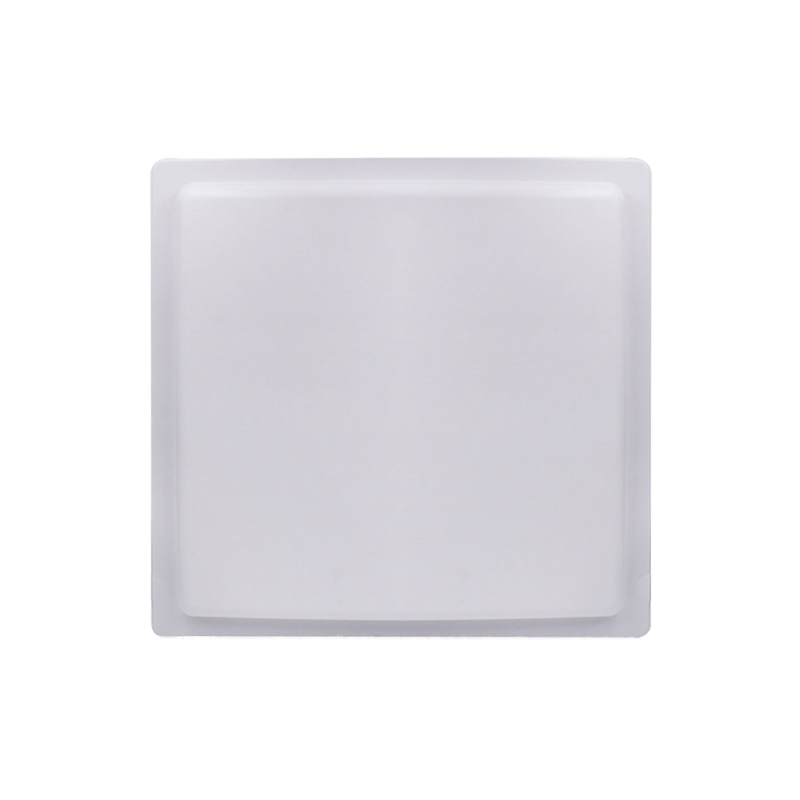
12dBi Circular Linear RFD UHF Reader Antenna
3.2 Outbound process: precise picking, verification and error prevention (error rate reduced to 0.1%)
- After the sales order is synchronized to the platform, the system generates an outbound task order and automatically generates the optimal picking path based on the distribution of storage locations, and distributes it to the picking personnel’s handheld terminal;
- Intelligent picking personnel follow the guidance of handheld terminals to reach the target location, scan the location tag for confirmation, and then scan the RFID tag of the material. The system automatically verifies whether it is the target material to avoid picking errors; After picking is completed, the handheld terminal marks the completion of the task and synchronizes it to the platform;
- After verification and selection, the materials are sent to the outbound channel. When passing through the RFID channel door, the reader reads the tag information in batches and compares it with the outbound order; If there is a mistake or omission in sending, the channel door will immediately sound and light an alarm, and the staff will check and adjust it on site;
After the document generation verification is passed, the platform automatically generates an electronic outbound order and synchronizes it to the TMS system to arrange transportation; Real time deduction of inventory data, process ends.
3.3 Inventory check: Batch scanning, real-time verification (efficiency increased by 80%)
Traditional manual inventory requires checking shelves and materials one by one, which is time-consuming, labor-intensive, and prone to errors; The RFID inventory process is as follows:
- Create inventory tasks on the inventory task platform, with the option to choose between full inventory or partitioned inventory;
- Batch scanning staff hold handheld RFID terminals and walk around the warehouse area. The terminals automatically read the material label information on the shelves in batches and upload it to the platform in real time;
- The automatic verification platform will automatically compare the scanned data with the book inventory and generate an inventory discrepancy table (inventory surplus, inventory deficit, location discrepancy, etc.);
- The discrepancy handling staff will verify the discrepancy table on site, adjust the platform to update inventory data, and complete the inventory.
4.Core advantages of the plan
4.1 Efficiency Doubling: From “Piece by Piece Operation” to “Batch Processing”
RFID technology supports simultaneous reading of multiple tags (up to 50 tags can be read at a time), completely replacing the traditional manual scanning mode. The processing time for 1000 items in the warehouse has been reduced from the traditional 2 hours to 20 minutes; The efficiency of outbound picking has increased by 50%, the efficiency of inventory has increased by 80%, and the warehousing operation cycle has been significantly reduced.
4.2 Precise Control: From “Manual Verification” to “Intelligent Error Prevention”
By using RFID tags for unique identification and automatic verification throughout the entire process, the risk of errors caused by manual input and visual verification is eliminated. The error rate of inbound and outbound data has decreased from traditional 3% to below 0.1%, and the rate of wrong or missed shipments is approaching zero, reducing the cost of returns and claims caused by errors.
4.3 Full chain traceability: from “document traceability” to “data traceability”
The full lifecycle data of materials from storage to outbound (supplier, batch, location, operator, time, etc.) is automatically associated with RFID tags, achieving “one item, one code, full traceability”. When encountering quality issues, the full process information of problematic materials can be located within 10 seconds, quickly completing recalls and defining responsibilities, and meeting compliance requirements in industries such as food and medicine.
4.4 Flexible Adaptation: From “Single Scene” to “Multiple Needs”
The solution supports different scale warehousing scenarios (small warehouses, large parks, multi warehouse collaboration) and is suitable for different industries (e-commerce, manufacturing, pharmaceuticals, cold chain); Support seamless integration with existing ERP, TMS and other systems, without the need to restructure existing IT architecture, reducing upgrade costs.
4.5 Data Empowerment: From “Experience Management” to “Data Decision making”
The platform provides data support for optimizing storage locations, adjusting procurement plans, and scheduling personnel by analyzing historical data on inventory turnover, material demand trends, labor efficiency, and other dimensions. For example, through analysis, it was found that a certain type of material accounts for 40% of the outbound volume from the 1st to the 10th of each month. It can be allocated to nearby export locations in advance to further improve outbound efficiency.

16 Port RFID UHF Tag Reader with Impinj E710
5.Adaptation scenarios and implementation guarantees
5.1 Adaptation scenarios
In the scenario of high-frequency inventory and massive SKU in e-commerce warehousing, orders need to be processed quickly to avoid errors and omissions;
The raw material/finished product warehouse in the manufacturing industry needs to accurately manage the inbound and outbound of raw materials and finished products, and achieve coordination with the production process;
Pharmaceutical warehousing must strictly follow GSP standards to achieve full lifecycle traceability and temperature and humidity monitoring of drugs;
Cold chain storage adopts low-temperature resistant RFID tags, suitable for -40 ℃ low temperature environment, to achieve full traceability of cold chain materials;
Third party logistics warehousing has multiple customer and category management needs, and needs to flexibly adapt to the inbound and outbound rules of different customers.

5.2 Implementation Process
- Conduct demand research and planning, conduct on-site surveys of warehouse scale, existing processes, IT architecture, clarify pain points and core requirements for inbound and outbound inventory, and develop personalized plans;
- Hardware deployment and debugging: Install RFID readers, channel doors, handheld terminals, and other devices to complete network configuration and device debugging;
- Software development and integration deployment of warehouse management platform, development of customized functions, completion of interface integration with ERP, TMS and other systems;
- Tag coding and data migration: Attach RFID tags to existing materials and complete the migration of historical data to the new platform;
- Conduct personnel training and trial operation operation training (equipment use, platform operation), conduct a 15 day trial operation, optimize processes and parameters;
- Formally launched and the operation and maintenance system is officially launched, providing continuous operation and maintenance support, and regularly optimizing and upgrading.
5.3 Service Guarantee
Hardware guarantee: Core equipment comes with a 1-year warranty, with free maintenance and replacement during the warranty period; Provide regular equipment inspection services;
The software assurance platform provides lifelong free upgrades, a 24/7 technical support hotline, and remote assistance to solve system problems;
Data protection adopts a dual backup mode of local and cloud to ensure that data is not lost; Provide data security audit services;
Training guarantee provides on-site training, video tutorials, and operation manuals to ensure that staff are proficient in system operation.