

Commercial laundries process thousands of visually similar textiles every day. Sheets, towels, uniforms, gowns, mats, and reusable cleaning products move through receiving, sorting, washing, drying, finishing, packing, dispatch, and return. When identification depends on handwritten counts or line-of-sight barcode scans, errors can accumulate at every handoff. A rfid washing label gives each textile item a durable digital identity that can be read automatically, even when many tagged items are inside a laundry cart or bag.
RFID does more than accelerate counting. When readers, software, and operating procedures are designed as one system, commercial laundry operators can see which customer owns an item, when it entered a process, how often it has been washed, where it was last detected, and whether it was returned. This guide explains how RFID works in commercial laundry, where the technology creates value, and what B2B buyers should validate before deployment.
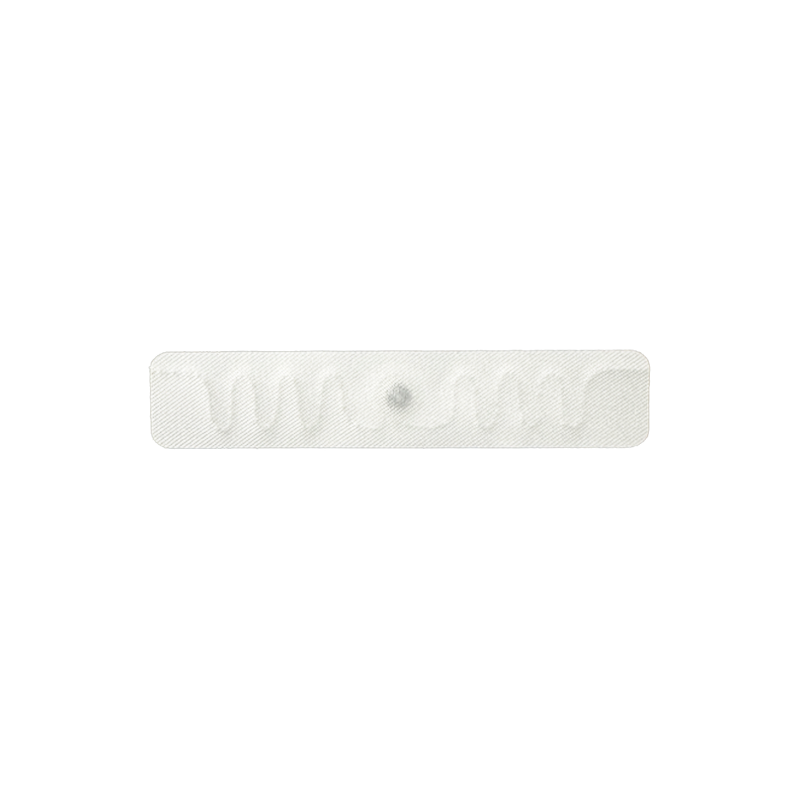
Textile RFID Laundry Tag
What Is an RFID Washing Label?
An RFID washing label is a compact radio frequency identification tag engineered to remain attached to a textile throughout repeated industrial laundry processes. It normally contains an integrated circuit and antenna protected by a textile-compatible enclosure. The chip stores a unique identifier, while the antenna exchanges data with an RFID reader through radio waves.
For many commercial laundry applications, passive UHF RFID is used because it requires no battery and supports fast reading of multiple items. The label can be sewn into a hem, installed in a fabric pocket, or attached through another supplier-approved method. A purpose-designed textile RFID laundry tag should be selected according to the fabric, attachment process, laundry chemistry, equipment, operating temperature, pressure, and expected service life.
How RFID Works in Commercial Laundry
The basic principle is simple: an RFID reader transmits a radio signal through one or more antennas. A passive label harvests energy from that signal, activates its chip, and returns its stored identifier. Middleware filters the reads and sends useful events to laundry management software. The software then connects the identifier with business information such as item type, customer, site, department, purchase date, wash count, or service status.
The operational value comes from placing read points at meaningful transitions. Instead of asking employees to scan every item individually, a properly tuned RFID station can identify a group of textiles as they pass through a portal, move on a conveyor, or sit inside a cart. The system records an event only when the read supports a defined workflow.
1. Tagging and Encoding
Each textile receives a label with a unique electronic identity. During commissioning, the identifier is associated with the asset record in the laundry database. Depending on the operation, that record may include garment size, linen category, customer account, rental pool, cost center, employee assignment, or replacement value. Good data governance matters: the identifier should be unique, the association should be verified, and authorized users should control changes.
2. Receiving and Bulk Counting
Soiled textiles arriving from a hotel, hospital, factory, or service customer can be read at the receiving area. Readers may be installed at a portal, conveyor, tabletop station, tunnel, or enclosed cabinet. Hundreds of items can potentially be identified without exposing employees to unnecessary manual handling. The system compares received quantities with dispatch records and flags shortages, unexpected items, or textiles assigned to another customer.
3. Sorting and Process Routing
RFID data can support sorting by customer, material, color, wash program, garment owner, or contamination class. The technology does not replace proper textile classification, but it can help software and operators confirm that the right batch follows the correct route. In automated plants, read events may trigger conveyor decisions or display instructions at workstations. In manual plants, a clear exception screen can prevent a wrong-customer item from progressing unnoticed.
4. Washing, Drying, and Finishing
The label remains with the textile through the wash cycle and subsequent finishing steps. Readers are usually positioned around process transitions rather than inside every machine. For example, a batch may be identified before loading and confirmed after unloading or finishing. This creates traceability while limiting unnecessary hardware. The exact architecture should reflect the facility layout, metal structures, moisture, cart design, workflow speed, and required level of certainty.
5. Packing, Dispatch, and Return
Clean textiles can be counted as they are folded, bundled, placed into carts, or prepared for delivery. The dispatch record provides a digital manifest for the customer. On the next collection, returned items can be compared with that manifest. This closed loop helps a rental laundry understand circulating inventory and distinguish processing losses from customer-site losses, delayed returns, and normal retirement.
Why UHF RFID Is Common in Commercial Laundry
Passive UHF RFID is attractive for high-volume operations because labels do not need batteries, multiple items can be read quickly, and read zones can cover carts, conveyors, and doorways. Industry-standard air interfaces also make it possible to build a system with compatible readers and tags, although interoperability and regional frequency settings must still be confirmed.
Performance is application-specific. Water absorbs RF energy, metal reflects it, dense tag populations can create challenging orientations, and nearby read zones can interfere with event accuracy. A site survey and pilot test should reproduce actual loads, wet and dry conditions, cart types, line speeds, and operator behavior. Published laboratory data alone cannot predict every plant.
RFID Washing Label vs. Barcode Label
Barcodes are inexpensive and useful where an operator can expose and scan one label at a time. However, commercial laundry often handles textiles in bulk, and labels may be hidden inside folds or bags. RFID does not require direct line of sight and can identify multiple items in one reading event. That can reduce touches at receiving, counting, and dispatch.
RFID is not automatically the right answer for every process. It requires tags, readers, software, installation, testing, and maintenance. Some businesses use both technologies: RFID for automated internal tracking and a printed barcode or human-readable code for backup, customer processes, or visual identification. The choice should be based on total workflow cost and data requirements, not tag price alone.
Business Benefits for B2B Laundry Operations
- Faster inventory counts: Bulk reading can reduce repetitive one-by-one scanning and manual tallying.
- Better asset visibility: Item-level records show what entered, moved through, and left the facility.
- Reduced loss and shrinkage: Dispatch and return comparisons help locate where discrepancies occur.
- Improved customer accountability: Digital manifests support more objective conversations about delivered and returned quantities.
- Lifecycle insight: Wash counts and service dates can inform inspection, repair, and replacement policies.
- Process control: Exceptions can identify wrong-customer items, incomplete batches, or route deviations.
- Planning data: Reliable circulation history supports purchasing, par-level decisions, and demand forecasting.
Durability and Attachment Requirements
A laundry label must tolerate the full process, not only water. Relevant stresses can include detergent and chemicals, repeated flexing, extraction pressure, impacts, drying heat, finishing equipment, and mechanical abrasion. Requirements vary significantly between hospitality linen, healthcare textiles, workwear, mats, and specialty cleaning processes.
Request supplier documentation for the exact label model and attachment method. Confirm validated temperature ranges, pressure limits, chemical compatibility, expected wash-cycle performance, chip memory, read performance, and applicable material declarations. Then test samples in the real process. A cycle rating should be treated as a test result under stated conditions, not a universal service-life guarantee.
Sew-in installation is common for textile labels, while some designs support heat sealing, pockets, or other integration methods. Placement affects wearer comfort, appearance, durability, and RF orientation. The tag should not create a hard edge against skin, interfere with textile function, or sit where finishing machinery will repeatedly damage it. Follow the tag manufacturer’s attachment instructions.
A Practical RFID Implementation Roadmap
Define the Business Case
Start with a measurable problem such as receiving labor, unexplained linen loss, inaccurate customer billing, slow uniform distribution, or limited wash-history data. Establish a baseline before installing RFID. Without current labor hours, discrepancy rates, asset replacement costs, and processing volumes, it is difficult to prove improvement.
Map the Workflow
Document every movement from customer collection to redelivery. Identify where custody changes, counts are needed, or errors occur. Choose only the read points that create useful decisions. A small number of reliable checkpoints is often easier to operate than a network of poorly defined detections.
Run a Representative Pilot
Pilot with real textile types, carts, operators, wash programs, and production speeds. Include difficult conditions such as tightly packed wet loads, mixed orientations, adjacent read zones, and peak throughput. Measure read accuracy at each checkpoint as well as operational impact. Staff feedback often exposes practical issues that a technical bench test misses.
Integrate and Train
Define how RFID events enter the laundry management, ERP, route accounting, or customer portal system. Provide simple exception workflows for missing, duplicate, damaged, or unreadable labels. Train operators on the reason for each checkpoint and the correct response to an alert. Technology works best when the surrounding process is explicit and easy to follow.
Scale With Governance
After the pilot meets agreed acceptance criteria, expand by customer, textile class, or production area. Assign ownership for tag commissioning, hardware health, software rules, data quality, and KPI review. Keep spare equipment and a documented fallback process for maintenance periods.
Measuring ROI
RFID ROI should include more than counting speed. Useful indicators include labor minutes per thousand items, receiving-to-processing time, dispatch accuracy, unexplained loss rate, customer claims, average inventory days, emergency purchases, linen utilization, garment issue time, and average wash count at retirement. Compare results with the pre-project baseline and account for tags, readers, installation, integration, software, support, training, and replacement equipment.
A strong business case connects each RFID event to a financial or service outcome. For example, faster receipt data may release production capacity, while accurate return records may reduce replacement purchases and disputes. Benefits should be validated over a representative operating period rather than inferred from a short demonstration.
Common Risks and How to Control Them
- Missed reads: Test antenna placement, tag orientation, load density, moisture, and line speed.
- Unwanted reads: Tune power, shield zones where appropriate, and apply software location rules.
- Tag damage: Validate the exact construction and attachment method through repeated real wash cycles.
- Poor master data: Use controlled encoding and verification procedures when tags are assigned.
- Workflow resistance: Involve operators early and make exception handling faster than manual workarounds.
- Integration gaps: Specify event formats, ownership, error recovery, and system-of-record responsibilities.
How to Choose an RFID Laundry Solution Supplier
Ask suppliers for evidence that relates directly to your application. Useful evidence includes model-specific test reports, material information, protocol and frequency details, sample tags, attachment guidance, reader compatibility, quality-control procedures, and traceable technical support. Discuss the textile types, wash chemistry, machines, temperatures, pressures, cart construction, regional frequency plan, and required reading method.
A credible supplier should be willing to define limitations and support a pilot. Avoid selecting solely by maximum advertised read range or nominal cycle count. Consistent performance in your facility, supported by appropriate documentation and a repeatable acceptance test, is a better purchasing criterion.
Conclusion
RFID works in commercial laundry by giving every textile a durable identity and capturing that identity at meaningful process points. The combination of suitable labels, controlled read zones, reliable software, and disciplined operations can improve counting, traceability, customer accountability, lifecycle analysis, and inventory planning. Success depends on realistic testing: select a label for the actual laundry environment, pilot complete workflows, measure business outcomes, and scale only after the data proves the system is dependable.
Frequently Asked Questions
What information is stored on an RFID washing label?
The tag commonly stores a unique identifier and may provide additional memory, depending on the chip. Detailed business data is usually kept in a secure database and linked to that identifier rather than written entirely to the label.
Can RFID labels be read through a laundry bag or cart?
Passive UHF labels can often be read without line of sight, including in suitable bags and carts. Actual performance depends on moisture, load density, tag orientation, cart material, reader design, and nearby RF conditions, so it must be verified in a pilot.
How long does an RFID laundry label last?
Service life depends on the label model, attachment, textile, chemistry, temperature, pressure, finishing equipment, and handling. Review model-specific supplier test conditions and conduct repeated trials in the intended process instead of relying on a general cycle claim.
Does RFID replace barcodes in a laundry?
Not always. RFID is well suited to automated bulk identification, while barcodes remain useful for visual or one-at-a-time processes and as a backup identifier. Many operations use both according to workflow needs.
Can RFID track a textile everywhere in real time?
Passive RFID reports an item when it enters a configured read zone; it is not continuous GPS tracking. Visibility depends on where readers are installed and how events are processed. Strategic checkpoints normally provide the most economical operational traceability.
What read accuracy should a commercial laundry expect?
There is no universal percentage that applies to every plant. Set acceptance criteria for each read point and test representative loads under normal and difficult conditions. Accuracy should be measured as reliable business events, not only raw tag detections.
What is the best way to start an RFID laundry project?
Choose one measurable business problem, map the workflow, establish baseline KPIs, and run a limited pilot with real textiles and production conditions. Use the results to refine tag selection, read-zone design, software rules, training, and the financial case before expanding.