

In our daily lives, there are two ‘silent assistants’ quietly changing the world: one can instantly count the entire shelf of goods from a few steps away, and the other silently lets go when we hold our handbag close to the gate. They are the two main forces of RFID technology – ultra-high frequency (UHF) and high frequency (HF). Although their names are similar, their abilities and purposes are vastly different. Today, let’s unveil their mysterious veil.
1. A contest between “shouting from afar” and “whispering”
Imagine two ways of communication:
UHF RFID is like a person shouting from a loudspeaker in a sports arena. The sound is loud and can be heard throughout the entire venue (with a long reading distance). But if many people shout at the same time, it is easy to interfere with each other (with weak anti-interference ability), and if there are obstacles between the speaker and the listener, the sound will be affected.
High frequency (HF) RFID is like two people whispering to each other. The sound transmission is not far (short reading distance), but it is very accurate, not afraid of surrounding noise (strong anti-interference ability), and the communication content is very secure, not easy to be eavesdropped by others.
This contrast of images stems from their fundamental technical differences:
1.1 Working frequency and standards
High frequency (HF): The operating frequency is 13.56 MHz. Following the globally unified ISO 14443A (such as bus cards, access cards) and ISO 15693 (such as product anti-counterfeiting) standards, the compatibility is excellent.
Ultra high frequency (UHF): The operating frequency range is wide, usually between 860-960 MHz. The standards vary in different regions (such as 920-925MHz in China and 865-868MHz in the European Union), just like how radios need to tune different channels in different countries.
1.2 Reading distance and speed
HF: The typical reading distance is within a few centimeters to 1 meter, and it needs to be very close to the reader/writer. Usually only one tag can be read at a time, suitable for precise one-on-one operations.
UHF: The reading distance can reach more than 3 meters, even tens of meters. The most crucial thing is that it can achieve high-speed batch reading, recognize hundreds of tags in one second, and can be called a “second level inventory” artifact.
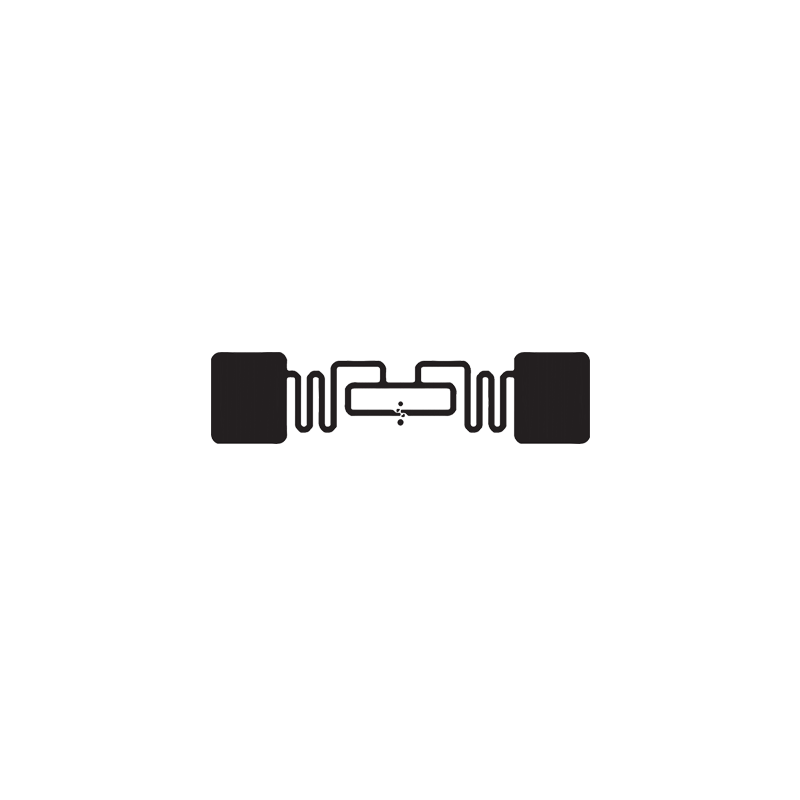
Alien ALN-9662 Short RFID White WET Inlay – High-Performance UHF RFID for Asset Tracking
1.3 Anti interference and safety
HF: Electromagnetic waves have a short wavelength, strong ability to bypass obstacles, and relatively low sensitivity to the surrounding environment (especially metals and water). Data encryption has better performance and is very secure, making it the preferred choice for financial payments and identity authentication.
UHF: Electromagnetic waves have a long wavelength and reflect when they come into contact with metals, but are absorbed when they come into contact with liquids (water), resulting in signal attenuation or inability to read. There are also corresponding solutions now, such as anti metal electronic tags and anti liquid electronic tags.
2. Application scenario: A stage where various talents are displayed
Because of their different characteristics, they play completely different roles in our lives.
2.1 The “exquisite” world of high-frequency HF
Smart Life: The bus cards, access cards, ID cards, and electronic passports we use every day are all manifestations of HF technology. It is safe, reliable, and suitable for scenarios that require close range identity confirmation.
Financial payment: bank card “flash payment” (contactless payment) and mobile NFC payment, the core of which is HF RFID. It ensures the safety and speed of the transaction process.
Book management and anti-counterfeiting: The library’s book borrowing and returning system, as well as the anti-counterfeiting labels for high-end products, all utilize the precise and individual reading characteristics of HF tags.
2.2 The ‘bold’ world of ultra-high frequency UHF
Smart Logistics and Retail: This is the main battlefield of UHF. In the warehouse, workers can instantly take inventory of all the goods inside the boxes by scanning them with a handheld device; At the supermarket exit, there is no need to scan the QR code one by one for the shopping cart. Simply push through the sensing area to complete the settlement; The inventory management of clothing stores has also become efficient due to it.
Intelligent manufacturing: On the automotive assembly line, UHF tags are attached to the vehicle body and automatically recognized throughout the entire production process, achieving automated management and traceability.
Asset management: Remote batch tracking and management of large asset equipment in factories and hospitals, saving time and effort.

RFID in Transportation and Logistics
3. So how do we choose
Comparison between High Frequency RFID and Ultra High Frequency RFID