

In today’s era of pursuing efficient and precise asset management, the core practice of Uniglo Uses RFID tags is leading the industry transformation. By integrating advanced radio frequency identification technology into its solutions, Uniglo has achieved unprecedented real-time tracking and intelligent management of inventory, logistics, or specific assets. This not only greatly improves operational transparency and efficiency, but also ensures the high accuracy of data, building a digital management cornerstone for enterprises that is interconnected. Choosing Uniglo means choosing a future that seamlessly connects physical assets with the digital world using RFID technology.
1. Uniqlo’s new RFID tag
Recently, while shopping at Uniqlo, I noticed that the cashier did not use the traditional scanning method to read the QR code information on the label, but instead gently placed the clothing label on a square black seat. What surprised me was that such a simple operation could quickly input information into the computer. After confirming with the cashier, I learned that this small label actually contains a big secret.
Although I had heard of RFID tags before, I was still quite surprised to truly understand that they could be cleverly made into paper tags. After returning home, I conducted a thorough exploration with great interest.
1.1 Observation of RFID tags
Let’s shine a light on it first! You will find that those two black objects resembling cow horns are actually metal antennas. They are responsible for collecting the RF signal energy emitted by the card reader and providing the required power for the RFID chip. Meanwhile, these antennas also communicate with the card reader. To observe its internal structure more clearly, we can try dissolving the label.


1.2 Unveiling RFID Chips
In the picture, the black object in the middle, resembling a grain of rice, is the RFID chip. Next, let’s briefly understand RFID.
2. RFID related standards
2.1 Low frequency band standards
RFID, The radio frequency identification chip has numerous related standards, including ISO11784/ISO11785 (low frequency), ISO14223 (low frequency), etc. These standards mainly target low-frequency identification RFID and animal identification RFID. In this frequency band, chips such as EM4095, EM4097, EM4450 (EM Microelectronics), and HITAG (NXP) are widely used.
2.2 13.56MHz frequency band standard
The 13.56 MHz frequency band covers multiple standards, such as ISO14443 Type A&B, ISO15693, etc. These standards have wide applications in production automation, access control attendance, security and other fields. The ISO14443 Type A standard is particularly noteworthy for its wide range of applications, covering multiple key areas such as production automation, access control attendance, and security.

2.3 Other frequency band standards
860~960MHz frequency band
This frequency band covers multiple standards such as ISO18000-6 Type A, B, C, as well as EPC UHF Class 0 and 1. In addition, EPC Class 1 Generation2 is also one of the important standards in this frequency band. These standard read and write distances typically exceed 1 meter, and can typically reach 4 to 6 meters, representing chips such as UCODE (produced by NXP) and RI-UHF-OOC02-03 (produced by TI).

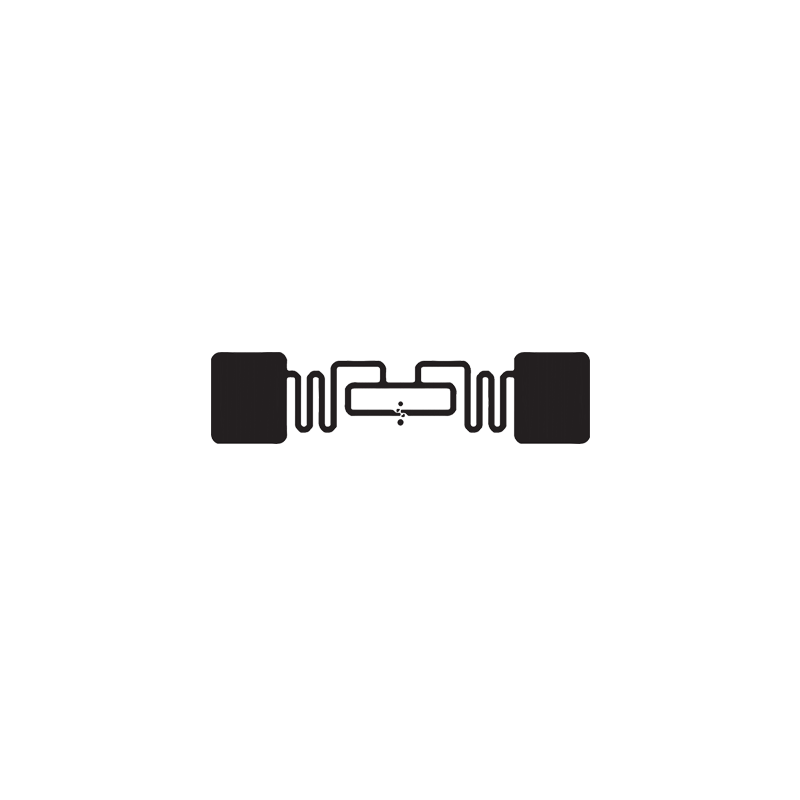
Alien ALN-9662 Short RFID White WET Inlay – High-Performance UHF RFID for Asset Tracking
2.4 5GHz frequency band: ISO 18000-4 Mode 1&2
In the 2.45GHz frequency band, the ISO 18000-4 standard defines two modes: Mode 1 and Mode 2. These modes have a read and write distance of up to 3 to 5 meters, and they can all provide stable performance within this frequency band.

