

Washable RFID Tag play an important role in the daily management and maintenance of textiles. With the development of technology, traditional printing or sewing washing labels are gradually showing limitations, such as wear and tear, limited information capacity, and difficulty in achieving rapid batch reading. The emergence of RFID (Radio Frequency Identification) washing tags provides a new solution for the identification, tracking, and care management of textiles. This type of tag has a built-in microchip and antenna, which can store and transmit data, and communicate with reading and writing devices through radio waves, achieving non-contact recognition and management.
The core advantages of RFID washing tags lie in their durability and data management capabilities. Compared with traditional labels, it can withstand repeated washing, high-temperature drying, and chemical treatment, while also storing more information such as textile material, washing conditions, usage records, etc. This makes it widely applicable in industries such as hotels, hospitals, industrial cleaning, and clothing rental.
1. Basic structure and working principle of RFID washing tags
RFID washing tags usually consist of three parts: chip, antenna, and packaging material. Chips are used to store data, antennas are responsible for receiving and transmitting radio signals, and packaging materials protect internal components from moisture, high temperatures, and physical impacts. Label packaging often uses flexible materials such as PET or epoxy resin to ensure its flexibility and durability.
When working, the reader emits a radio signal to activate the chip inside the tag, and the chip transmits the stored information back to the reader through the antenna. The entire process does not require physical contact and can be quickly completed within a few meters, suitable for high-speed assembly lines or batch counting scenarios.
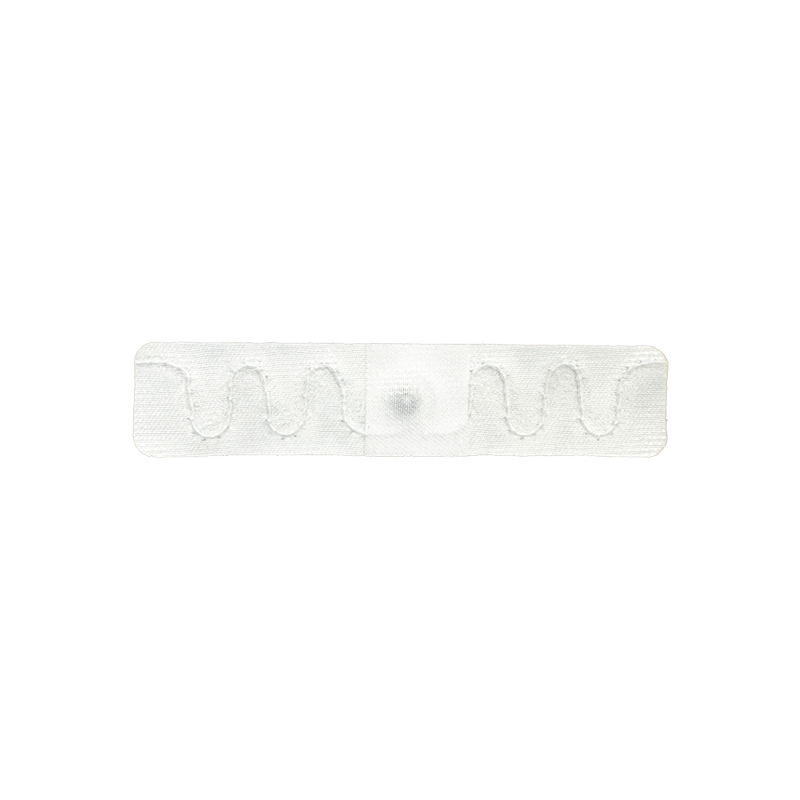
Heat Seal RFID Laundry Tags Manufacturer
2. Main types and application characteristics
According to different frequencies, RFID washing tags can be classified into low frequency (LF), high frequency (HF), and ultra-high frequency (UHF) types. Low frequency tags have strong anti-interference ability and are suitable for metal or liquid environments, but have a short reading distance; High frequency tags are commonly used in the fields of access control and payment, balancing distance and stability; Ultra high frequency tags have a long reading distance and fast speed, making them suitable for logistics and warehousing management.
The washing label needs to have characteristics such as high temperature resistance, acid and alkali resistance, and mechanical damage resistance. For example, in the hotel industry, the management of linens (such as bed sheets and towels) often uses ultra-high frequency tags to achieve fast shipping and inventory counting; In the medical field, labels need to withstand multiple disinfections and high-temperature sterilization, while recording the number of uses to ensure hygiene and safety.

Laundry RFID Tags
3. Production and Quality Control
The production of RFID washing tags involves multiple stages such as design, mounting, packaging, and testing. Quality control is the core of production. The factory has obtained ISO9001:2015 and ISO14001:2015 certifications to ensure that its products comply with international standards. Each label must undergo environmental testing (such as high temperature and humidity, acid-base immersion) and performance testing (such as reading distance and data accuracy) before leaving the factory to meet the strict requirements of different industries.
4. Practical application cases
In hotel linen management, RFID washing tags can track the washing frequency, circulation status, and inventory of each textile item, reducing loss and wear. For example, after a certain hotel group introduced the system, the fabric loss rate significantly decreased, the cleaning efficiency improved, and the cost of manual counting was reduced.
The industrial cleaning industry uses labels to record the type of stains and cleaning process, optimizing the treatment process. Clothing rental companies manage the clothing usage cycle through labels to ensure timely maintenance and updates.

RFID Handheld Reader
5. Development Trends and Challenges
With the popularization of IoT technology, RFID washing tags are developing towards smaller sizes, lower costs, and higher reliability. In the future, it may be combined with sensors to monitor the humidity, temperature, or damage status of textiles in real time, further expanding intelligent management functions.
However, the industry still faces some challenges. For example, the cost of labeling needs to be further reduced to adapt to low value textiles; Inconsistent standards may lead to compatibility issues; Data security and privacy protection also need to be strengthened.
In summary, RFID washing tags have improved the efficiency and accuracy of textile management through technological innovation, and their application in multiple fields reflects the practical value of IoT technology. With the maturity of production processes and the improvement of industry standards, such labels are expected to become important tools for textile care and management.