

In today’s fast-moving logistics and retail industries, businesses are constantly looking for smarter ways to improve inventory visibility, reduce human error, and optimize operations. One of the most important technologies driving this transformation is RFID. Many people often ask, What Is A RFID Reader? Understanding RFID readers is essential because they are the core devices that make RFID systems function efficiently across the entire supply chain.
This article explains what an RFID reader is, how it works, and how RFID technology is widely used in supply chain management to improve tracking, automation, and operational efficiency.
1.What Is A RFID Reader?
An RFID reader is an electronic device used to communicate with RFID tags through radio waves. It captures, reads, and sometimes writes data stored on RFID tags without requiring direct contact or line-of-sight scanning.
RFID readers are a key component of any RFID system, which typically includes:
- RFID tags
- RFID readers
- Antennas
- Software systems
The reader sends radio signals through its antenna. When an RFID tag enters the reader’s range, the tag responds by transmitting its stored information back to the reader. The data is then processed by management software for tracking and monitoring purposes.
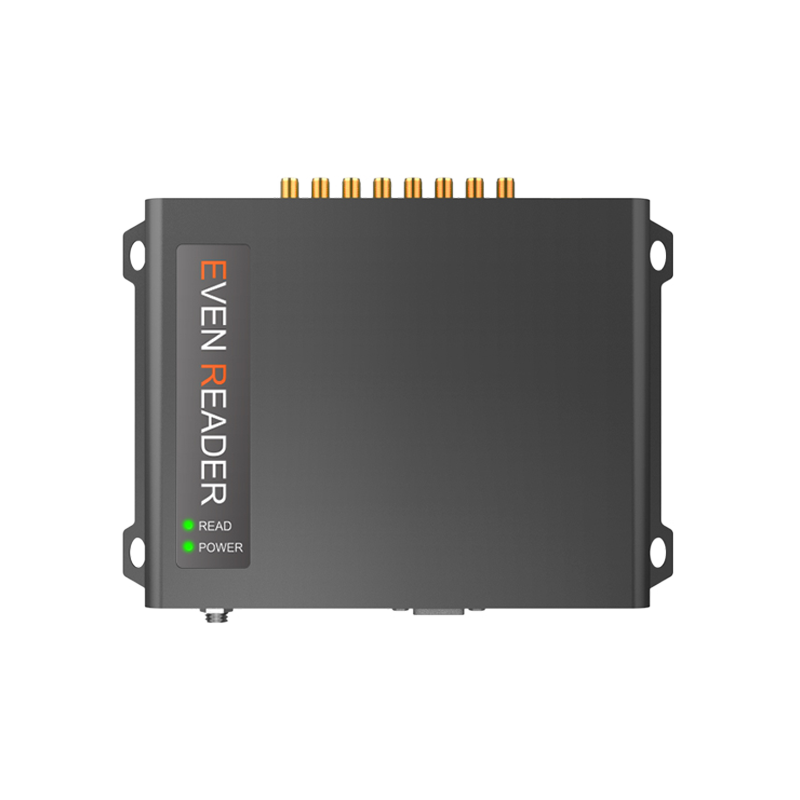
RFID Separated Reader Equiped with 8 Port Antenna
2.How Does An RFID Reader Work?
2.1 Signal Transmission
The RFID reader emits radio frequency signals through an antenna.
2.2 Tag Activation
When an RFID tag enters the signal range, it becomes activated and responds with its stored information.
2.3 Data Collection
The reader captures the tag’s unique identification data.
2.4 System Processing
The collected data is transferred to backend software systems such as warehouse management systems (WMS) or enterprise resource planning (ERP) systems.
This entire process occurs within seconds and often without human intervention.

Antenna RFID Reader | High-Gain RFID Scanning for Precision Tracking & Automation
3.Types Of RFID Readers
3.1 Fixed RFID Readers
Fixed readers are permanently installed at locations such as:
- Warehouse entrances
- Conveyor belts
- Dock doors
- Retail store exits
They provide continuous automated scanning.
3.2 Handheld RFID Readers
Handheld readers are portable devices commonly used for:
- Inventory counting
- Asset tracking
- Shelf management
- Field inspections

RFID Handheld Reader
3.3 Mobile RFID Readers
Mobile readers are integrated into smartphones, tablets, or vehicle-mounted systems for flexible scanning operations.
4.Why RFID Readers Matter In Supply Chain Management
Supply chains involve the movement of goods from manufacturers to warehouses, distributors, retailers, and customers. Traditional barcode systems require manual scanning and direct visibility, which can slow operations and increase errors.
RFID readers solve these challenges by enabling:
- Real-time tracking
- Bulk scanning
- Automated identification
- Faster inventory management
- Improved operational accuracy
This is why RFID technology has become increasingly important in modern supply chain management.
5.How RFID Is Used In Supply Chain Management
5.1 Inventory Management
RFID readers help businesses monitor inventory levels automatically. Instead of scanning products one by one, RFID readers can scan hundreds of tagged items simultaneously.
Benefits include:
- Faster stock counting
- Reduced labor costs
- Improved inventory accuracy
- Real-time inventory visibility
Retailers and warehouses can quickly identify missing or misplaced items.
5.2 Warehouse Automation
In warehouses, fixed RFID readers are installed at receiving docks and storage areas to automatically record incoming and outgoing goods.
This helps companies:
- Reduce manual paperwork
- Improve receiving speed
- Minimize shipping errors
- Optimize storage management
Automated warehouse tracking significantly improves operational efficiency.
5.3 Shipment Tracking
RFID readers enable real-time shipment monitoring throughout the supply chain.
When products pass through checkpoints, RFID readers instantly capture tag information and update tracking systems.
This allows companies to:
- Monitor shipment movement
- Improve delivery accuracy
- Reduce lost shipments
- Increase supply chain transparency
5.4 Asset Tracking
Supply chain companies often manage valuable assets such as:
- Pallets
- Containers
- Tools
- Returnable transport items
RFID readers help track these assets automatically, reducing loss and improving asset utilization.
6.Retail Supply Chain Visibility
Retailers use RFID readers to monitor products from distribution centers to store shelves.
This improves:
- Product availability
- Shelf replenishment
- Omnichannel fulfillment
- Theft prevention
Many large retailers now rely heavily on RFID technology for inventory visibility.
7.Cold Chain Monitoring
In food and pharmaceutical supply chains, RFID readers can work with sensor-enabled RFID tags to monitor temperature-sensitive products.
This helps ensure:
- Food safety
- Pharmaceutical compliance
- Quality control
- Regulatory compliance
8.Advantages Of RFID Readers In Supply Chains
8.1 Faster Data Collection
RFID readers can scan multiple tags at once, greatly improving efficiency.
8.2 Reduced Human Error
Automated scanning minimizes manual mistakes during inventory handling.
8.3 Real-Time Visibility
Businesses gain instant access to product locations and movement data.
8.4 Improved Efficiency
RFID reduces labor-intensive processes and accelerates operations.
8.5 Better Customer Satisfaction
Accurate inventory and faster deliveries improve customer experiences.
8.6 Industries Using RFID Readers In Supply Chain Management
RFID readers are widely used in many industries, including:
| Industry | RFID Application |
| Retail | Inventory management |
| Logistics | Shipment tracking |
| Manufacturing | Production monitoring |
| Healthcare | Medical asset tracking |
| Food Industry | Cold chain management |
| Automotive | Parts traceability |
8.7 Challenges Of RFID Implementation
Although RFID offers many benefits, companies may face some challenges during implementation.
8.8 Initial Investment
RFID systems require investment in readers, tags, antennas, and software.
8.9 Signal Interference
Metal surfaces and liquids can sometimes affect RFID signal performance.
8.10 System Integration
Businesses may need to integrate RFID systems with existing ERP or WMS platforms.
Despite these challenges, the long-term efficiency gains often outweigh the costs.
8.11 Future Of RFID Readers In Supply Chain Management
RFID technology continues to evolve with advancements in:
- IoT integration
- Cloud computing
- AI-driven analytics
- Smart warehouses
- Real-time data platforms
Modern RFID readers are becoming faster, smarter, and more connected, making supply chains increasingly automated and data-driven.
As global logistics becomes more complex, RFID readers will continue to play a critical role in improving supply chain visibility and operational efficiency.
9.Conclusion
So, What Is A RFID Reader? An RFID reader is a device that communicates with RFID tags using radio waves to automatically identify, track, and manage items. In supply chain management, RFID readers are essential tools for improving inventory accuracy, warehouse automation, shipment tracking, and operational visibility.
From retail and logistics to healthcare and manufacturing, RFID readers are transforming how businesses manage supply chains in a faster, smarter, and more efficient way. As technology advances, RFID systems will continue to become a cornerstone of intelligent supply chain management.