

In an increasingly connected world, the ability to seamlessly bridge the physical and digital realms is powered by small, unassuming technologies. So, what is an NFC tag? At its core, an NFC tag is a tiny, wireless chip that can store information and transmit it to nearby devices, like your smartphone, without needing batteries or an internet connection of its own. Think of it as a modern, more powerful version of a barcode; instead of requiring a precise line-of-sight scan, you simply tap or bring your phone within a few centimeters to read it. These versatile tags are the silent enablers behind contactless payments, smart business cards, and interactive museum exhibits, embedding intelligence into everyday objects.
The topic we are going to talk about today is NFC.
I believe everyone will not feel unfamiliar with it.
As a convenient communication technology, NFC has silently served everyone for many years.
In our daily lives, we occasionally see its presence.
For example, subway and bus:

Mobile payment:

But who actually invented NFC? When was it invented? What technology is it based on? What are the advantages and disadvantages? I believe most students cannot explain it clearly.
Today, I’m here to talk to everyone——
NFC, The full name is Near Field Communication, also known as “Near Field Communication” or “Near Field Wireless Communication”.
It was born in 2003 and jointly developed by two mobile device giants, Philips and Sony.
At that time, Philips sent a team to Japan and, together with SONY engineers, went into seclusion for three months. They came up with this big trick, which was NFC.

In 2004, the two giants, together with Nokia, created the NFC Forum and began promoting the application of NFC.

From then on, NFC, as a baby, began its difficult journey of growth.
NFC is a short-range high-frequency wireless communication technology that allows for contactless point-to-point data transmission between electronic devices.
Have you noticed these keywords? Short distance, high frequency, non-contact, point-to-point.

When it comes to NFC, we have to talk about its big brother, RFID.
RFID,Radio Frequency Identification, Radio frequency identification, also known as electronic tags.
As the name suggests, the working principle of RFID is to attach an RFID circuit containing an RFID radio frequency part and an antenna loop to each item.

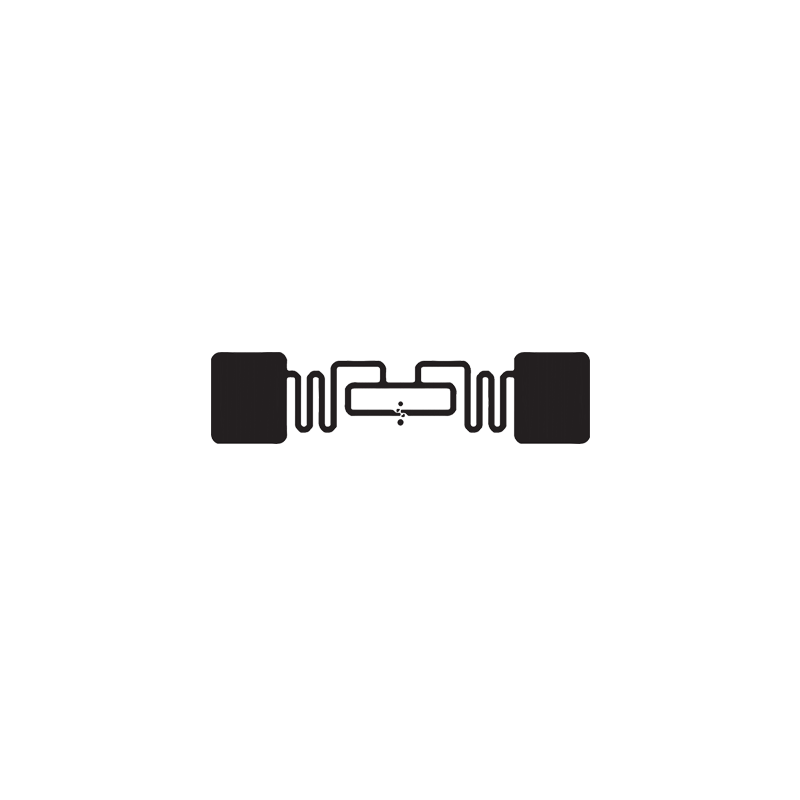
Alien ALN-9662 Short RFID White WET Inlay – High-Performance UHF RFID for Asset Tracking
After the item carrying the tag enters a specific magnetic field set by humans, it will emit a signal of a specific frequency, and the reader can obtain the information previously written on the item.
This is a bit like a badge hanging around the neck of a staff member, and you are his supervisor. When he comes into your sight, you can know his name, occupation, and other information, and even rewrite the content of his badge.

If RFID is about a person wearing a badge to make it easier for others to understand them, then NFC is about two people wearing badges, and they can change the content on the badge and the information received by the other person at will after seeing each other.

NFC and RFID may appear similar on a physical level, but they are actually two completely different fields because RFID is essentially an identification technology, while NFC belongs to a communication technology.

At the beginning of its birth, NFC was compatible with Sony’s FeliCaTM standard and ISO14443 A, B, which is Philips’ MIFARE standard. In the industry, it is commonly referred to as Type A, Type B, and Type F, where A and B are Mifare standards and F is Felica standard


NTAG 215 Amiibo NFC Tags – Customizable Tags for Amiibo Figurines and Digital Interactions
NFC has three working modes:
1. Active mode
In active mode, NFC terminals can function as card readers, emitting radio frequency fields to identify and read/write information from other NFC devices.

2. Passive mode
This mode is exactly the opposite of the active mode, where the NFC terminal is simulated as a card that only passively responds in the RF field emitted by other devices and is read/written information.

3. Bidirectional mode
In this mode, both NFC terminals actively emit radio frequency fields to establish point-to-point communication. Equivalent to both NFC devices being in active mode.
Taking passive mode as an example:
The device that initiates NFC communication, also known as the NFC initiating device, provides a radio frequency field (RF field) throughout the entire communication process. It can choose one of the transmission speeds of 106kbps, 212kbps, or 424kbps to send data to another device.
The other device is called the NFC target device, which does not need to generate an RF field and uses load modulation technology to transmit data back to the initiating device at the same speed.
Both have achieved communication.

Mobile devices mainly operate in passive mode, which can significantly reduce power consumption and extend battery life.
After the release of NFC, the two giants can be said to be full of confidence, believing that this is another product that can change the world.
After all, compared to Bluetooth, NFC is not only more secure, but also establishes a connection in less than 0.1 seconds. Not to mention the card emulation function of NFC, which allows mobile phones to become bus cards, access cards, and even bank cards at the same time. It can be said that NFC surpasses Bluetooth in all aspects.

But in fact, NFC has not even taken the step of promotion.
Although NFC is more convenient and secure, and has a lower cost compared to Bluetooth, its weakness lies in the need for close range or even physical contact to establish a connection.
Moreover, NFC also falls short in terms of file transfer speed. In theory, NFC can only reach a maximum transmission speed of 868 Kbps, while Bluetooth can reach 2.1 Mbps.


Card simulation
This is one of the earliest functions of NFC.
Allowing mobile phones to be used as bus and bank cards can greatly reduce the number of cards needed for travel nowadays. However, due to software issues, this feature was never popularized in the early days.
Now that this feature has finally received sufficient software support, mobile phone manufacturers such as Xiaomi, Huawei, Samsung, Nubia, OnePlus, and Meizu have launched exclusive apps that can simulate public transportation cards. Unfortunately, this feature can only be used in a few first tier cities and it will take time to popularize.

Similar to Bluetooth on mobile phones, after both phones have enabled NFC function, you can establish a connection by bringing your phone close and then choose to transfer or receive files.

Nowadays, many cameras and photo printers also use NFC for fast image transmission, as it is very convenient and fast.
Mobike and ofo, the two major shared bicycles, have also released new models that support NFC. Users can skip the scanning step and directly unlock their phones by placing them near the smart lock, providing a better user experience. However, this feature still has certain limitations at present.

For example, NFC business cards, making phone calls, accessing websites, and even obtaining product information through NFC tags are still in the research and development stage and have not yet entered our lives.
Let’s give it a little more time, maybe in the near future, it will usher in its own spring.