
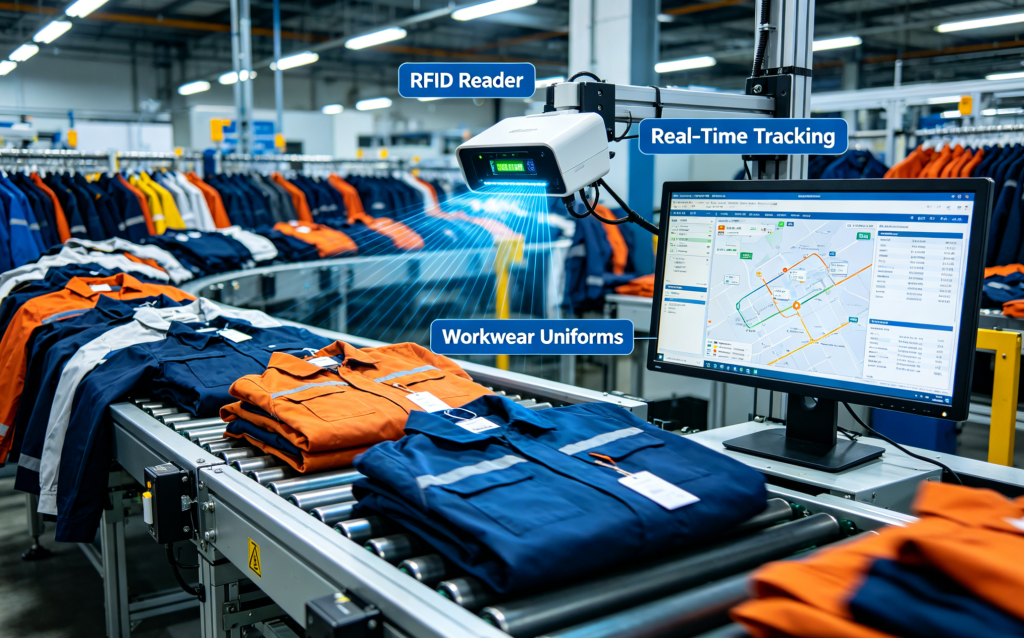
In today’s fast-paced industrial environment, companies are constantly searching for smarter ways to manage employee uniforms, protective garments, and industrial textiles. One of the most effective technologies transforming the industry is RFID. Many businesses ask: How Does RFID Work In Clothing? The answer lies in the ability of RFID technology to automate identification, tracking, and inventory management without manual scanning.
When applied to workwear, RFID technology helps companies improve uniform distribution, reduce losses, optimize laundry operations, and achieve full lifecycle tracking of garments.
1.How Does RFID Work In Clothing?
RFID (Radio Frequency Identification) uses radio waves to identify and track items equipped with RFID tags. In clothing applications, a small RFID tag is embedded or sewn into the garment. The tag contains a microchip and antenna that store and transmit data to an RFID reader.
Unlike traditional barcodes, RFID does not require direct line-of-sight scanning. Multiple garments can be scanned simultaneously, even when packed in boxes or laundry bags.
In workwear management systems, RFID technology enables automatic tracking throughout the entire garment lifecycle, from issuance and usage to washing and replacement.
2.Components of an RFID Workwear System
A typical RFID clothing management system includes several key components:
RFID Tags
RFID tags are attached to uniforms, safety vests, jackets, coveralls, or other workwear. These tags can be:
- Washable RFID laundry tags
- UHF RFID garment labels
- Heat-resistant textile RFID tags

Clothing Labels Custom
They are designed to withstand industrial washing, high temperatures, chemicals, and daily wear.
RFID Readers
RFID readers collect information from the tags using radio frequency signals. Readers can be installed:
- At warehouse entrances
- In laundry facilities
- At distribution counters
- In storage cabinets
- At factory gates
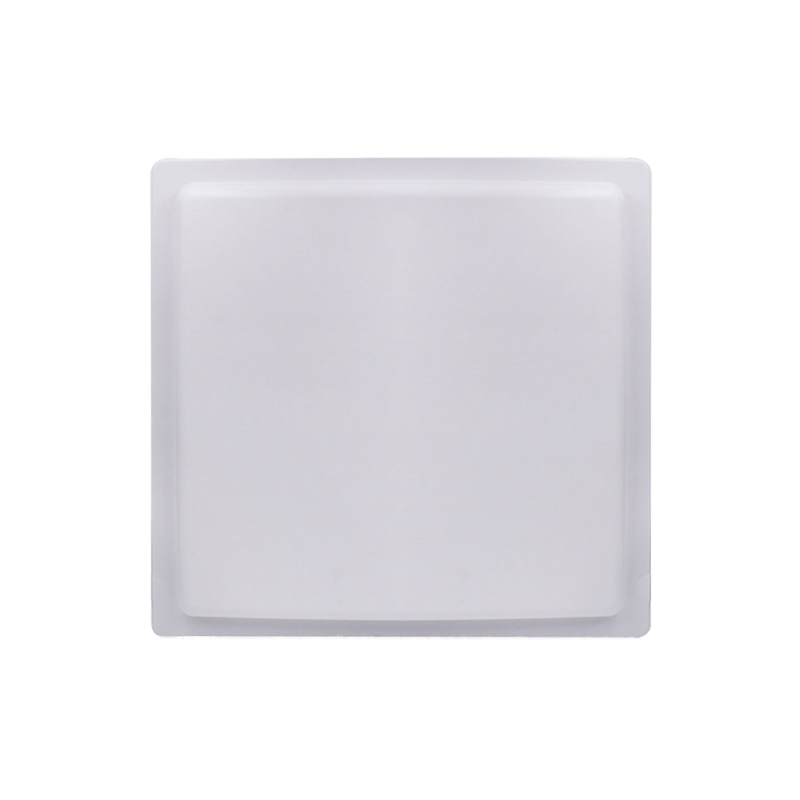
12dBi Circular Linear RFD UHF Reader Antenna
Management Software
The backend software stores garment data and automatically updates records such as:
- Employee assignment
- Laundry cycles
- Uniform inventory
- Replacement schedules
- Loss prevention records
3.How RFID Works in Workwear Management
Automatic Uniform Issuance
When employees receive uniforms, the RFID system automatically links the garment ID to the employee profile. This eliminates manual paperwork and reduces distribution errors.
For example, when a worker checks out protective clothing, the RFID reader instantly records:
- Employee ID
- Garment type
- Date and time
- Department location
Real-Time Inventory Tracking
RFID enables companies to track workwear inventory in real time. Unlike barcode systems, hundreds of garments can be scanned within seconds.
This is especially useful in industries with large uniform volumes, such as:
- Manufacturing
- Healthcare
- Hospitality
- Food processing
- Oil and gas
- Cleanroom environments
Real-time visibility helps prevent shortages and overstocking.
RFID in Industrial Laundry Operations
One of the biggest applications of RFID in workwear is laundry management.
Industrial laundry facilities process thousands of garments daily. RFID simplifies the entire workflow by automatically tracking garments during:
- Collection
- Washing
- Drying
- Sorting
- Delivery
RFID laundry tags can survive hundreds of wash cycles while maintaining accurate data transmission.
The system can also identify:
- Missing garments
- Incorrect sorting
- Excessive wash cycles
- Damaged uniforms
4.Benefits of RFID in Workwear
Improved Efficiency
RFID dramatically reduces manual scanning and paperwork. Bulk reading allows entire carts of uniforms to be identified instantly.
Better Traceability
Each garment has a unique digital identity, enabling full lifecycle tracking and accountability.
Companies can monitor:
- Who used the garment
- Where it was located
- How many times it was washed
- When replacement is needed
Reduced Loss and Theft
RFID security gates can automatically detect unauthorized garment removal. This helps reduce uniform loss and improves asset security.
Enhanced Compliance
Industries with strict safety or hygiene standards can use RFID to ensure workers receive the correct certified garments.
This is particularly important for:
- PPE management
- Cleanroom garments
- Medical uniforms
- Fire-resistant clothing
5.RFID vs Barcode for Workwear
Many companies compare RFID with traditional barcode systems.
| Feature | RFID | Barcode |
| Line-of-sight required | No | Yes |
| Batch scanning | Yes | No |
| Reading speed | Very fast | Slower |
| Durability | High | Moderate |
| Automation | High | Limited |
| Laundry resistance | Excellent | Limited |
Although RFID systems require higher initial investment, they provide greater automation and long-term efficiency for large-scale workwear management.
6.Common RFID Tags Used in Clothing
Several RFID tag types are commonly used in garments and uniforms:
UHF RFID Laundry Tags
Designed for industrial washing environments with long reading distance.
NFC Clothing Tags
Often used in retail clothing for customer interaction and authentication.
Heat-Resistant RFID Tags
Suitable for high-temperature industrial laundering.
Sewable RFID Textile Tags
Flexible fabric tags that can be stitched directly into garments.
7.Industries Using RFID Workwear Systems
RFID clothing systems are widely used in:
- Hospitals
- Hotels
- Manufacturing plants
- Airlines
- Construction companies
- Mining operations
- Pharmaceutical factories
- Food processing facilities
These industries rely on accurate garment tracking to improve operational efficiency and compliance.
8.Future Trends of RFID in Clothing
As Industry 4.0 and smart factories continue to evolve, RFID technology is becoming increasingly integrated with:
- IoT platforms
- AI analytics
- Smart lockers
- Automated vending systems
- Cloud-based inventory management
Future RFID workwear systems may even monitor garment usage conditions and automatically trigger replacement alerts.
9.Conclusion
So, How Does RFID Work In Clothing? In workwear applications, RFID technology enables automated garment identification, real-time inventory visibility, industrial laundry tracking, and full lifecycle management. Compared with traditional barcode systems, RFID provides faster scanning, higher efficiency, improved traceability, and stronger automation capabilities.
For companies managing large volumes of uniforms and protective clothing, RFID has become an essential tool for improving operational efficiency, reducing losses, and modernizing workwear management systems.